July 7, 2026
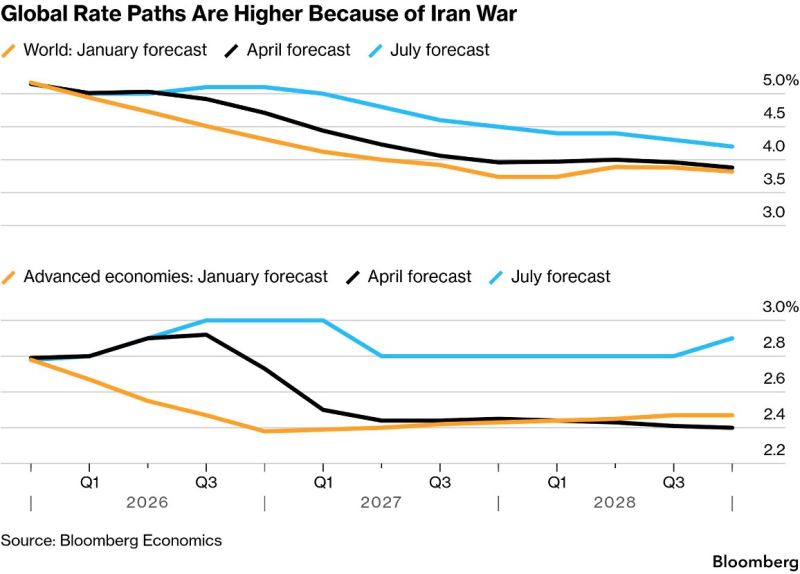
According to Bloomberg Economics, the global path of policy rates is now around 0.5 percentage point or more above that anticipated before the Iran–United States conflict, and this through to 2028.
The forecasts presented are as follows:
These estimates illustrate an expectation of lastingly higher rates than in the scenario envisaged before the conflict.
For Bloomberg Economics, the oil shock linked to the conflict would not be merely a temporary phenomenon.
This reading rests on the idea that central banks, marked by their lateness in responding to the inflation seen after the health crisis, now prefer to maintain a restrictive monetary policy rather than run the risk of a new error of judgement.
Even though oil prices have receded, they are said to fear that past increases will continue to spread into wages, services and inflation expectations.
This caution is set against the backdrop of the years 2021 to 2023, a period during which inflation was widely underestimated after the disruptions to supply chains.
According to this analysis, the risk today may be different: keeping rates high for longer than necessary if the persistence of inflation were, in turn, overestimated.
The factors likely to curb inflation durably have not entirely disappeared.
Those mentioned include demographics less favourable to demand in most developed economies, a high level of public and private debt that makes growth more sensitive to interest rates, and the productivity gains that artificial intelligence could generate in the medium term.
Conversely, several elements are presented as more inflationary than before 2020:
Taken together, these elements suggest that the economic regime may have evolved, not towards lastingly high inflation, but towards potentially more volatile inflation and central banks less inclined to return quickly to the very low rate levels seen during the 2010s.