July 9, 2026
SK Hynix is launching an issue of American Depositary Receipts (ADRs) representing 43,000 billion won, around 28 billion dollars.
The transaction, presented as one of the largest ever carried out by a foreign company in the United States, is based on the issue of 17.79 million new shares, corresponding to a capital increase of around 2.5%.
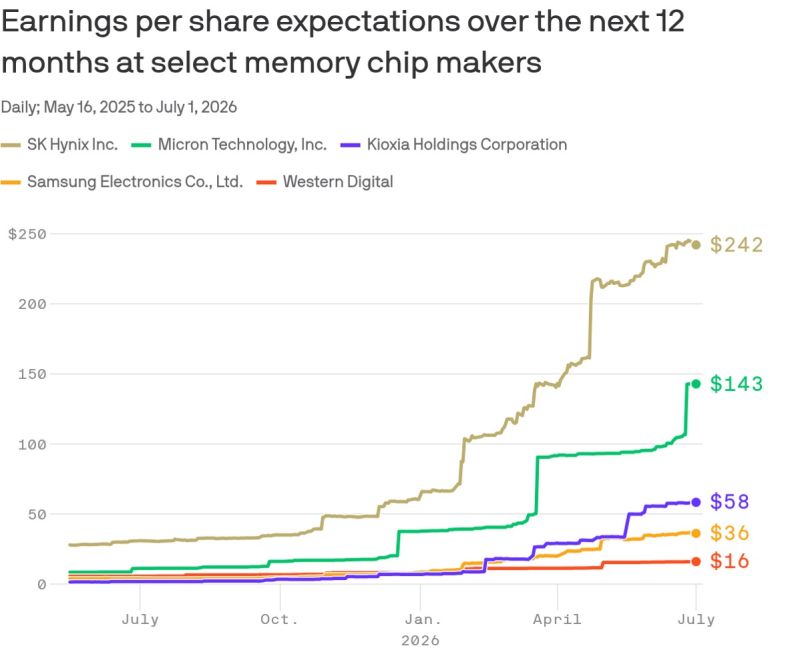
At the same time, earnings expectations have changed sharply over the last twelve months. Expected earnings per share for the next twelve months have risen from around 30 to 242 for SK Hynix. Micron Technology also shows an increase, from 9 to 143, while Samsung Semiconductor remains clearly behind, reflecting its lag in HBM memory for artificial intelligence.
This transaction goes beyond a simple fundraising.
Unlike ADRs already traded over the counter, this issue is based on newly created shares. It thus allows SK Hynix to raise capital while making its stock directly accessible to US investors.
According to the information provided, demand is already well above the number of securities offered. This oversubscription reflects investors' interest in companies positioned in memory chips for artificial intelligence.
The US listing pursues several objectives: broadening the investor base, bringing the valuation closer to that of Micron Technology and financing future production capacity.
In the short term, this US listing should improve the stock's liquidity, favour its inclusion in the main US indices and attract more passive investors.
It also opens up the possibility of arbitrage between the shares listed in Seoul and the US ADRs, which could help reduce the historical valuation discount.
Beyond the technical aspects, this transaction is a signal about the semiconductor cycle. Markets are willing to finance today production capacity that will not come on stream for several years.
This dynamic can be interpreted as a sign of confidence in the continuation of the investment cycle linked to artificial intelligence. It is also a reminder that the memory industry remains cyclical. According to the information presented, one of the key questions will be whether demand from data centres continues to absorb the substantial capacity currently under construction.