July 4, 2026
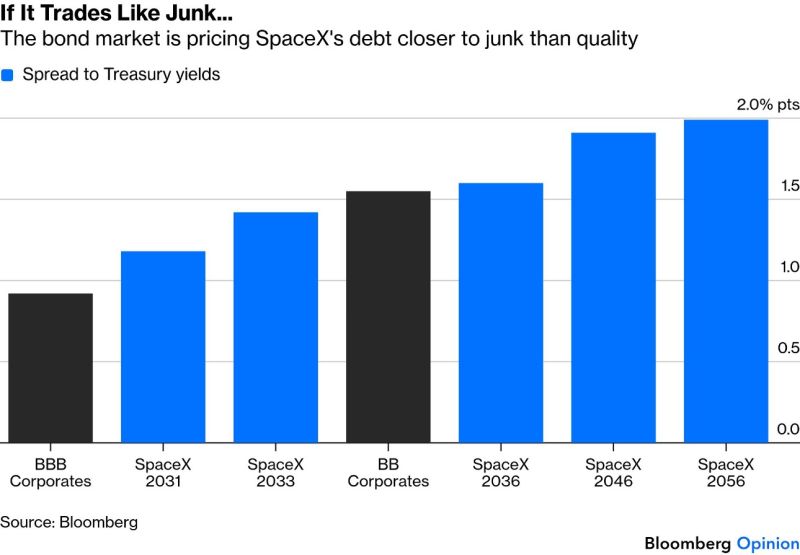
Eleven days after its IPO on 12 June, SpaceX announced a bond issue of $25 billion, settled on 26 June.
The rating agencies assign the company a BBB rating, corresponding to the Investment Grade category, that is, issuers considered to have sufficient credit quality for investors.
Yet SpaceX's bonds offer an average yield spread of around 1.62 percentage points above government bonds. This level is higher than the average observed for companies rated BBB (0.92 points) and close to that of companies classified in the BB (1.55 points) category, generally considered speculative.
Another notable element: the longer the maturity of the bonds, the wider this yield spread becomes. Investors therefore demand increasing compensation to lend to the company over longer horizons.
The price of a share and the yield of a bond do not follow the same logic.
The equity market values above all the company's development prospects. In the case of SpaceX, investors attach particular importance to projects such as Starlink, Starship, artificial intelligence, space launches and the company's ability to create new markets. They are investing in a growth trajectory they consider exceptional.
The bond market takes a different approach. Creditors do not participate directly in the company's future value creation beyond the expected yield of their bond. Their priority is therefore the issuer's ability to honour its financial commitments.
This difference in perspective explains how a company can enjoy a high stock-market valuation while having to offer a higher return to those who lend it capital.
The gap observed between the two markets does not necessarily mean that they contradict each other.
Shareholders accept a high level of risk in exchange for a potential for value creation that may be very substantial. Creditors, on the other hand, have a capped return and seek above all immediate compensation for the risk they take.
In this reading, the bond market does not call SpaceX's potential into question. Rather, it reflects a cautious assessment of the company's ability to finance very large investments sustainably, the returns on which remain largely uncertain.
Beyond the SpaceX case alone, this situation illustrates an environment in which bond markets appear more selective than during the years marked by abundant liquidity. Even the most emblematic companies must convince investors of their ability to turn their ambitions into cash flows.
For investors, this is a reminder that a high valuation does not, by itself, guarantee low-cost financing.
The bond market's view is thus often a useful indicator of the financial credibility of a long-term project and of its ability to turn a vision into lasting value creation.