October 7, 2026
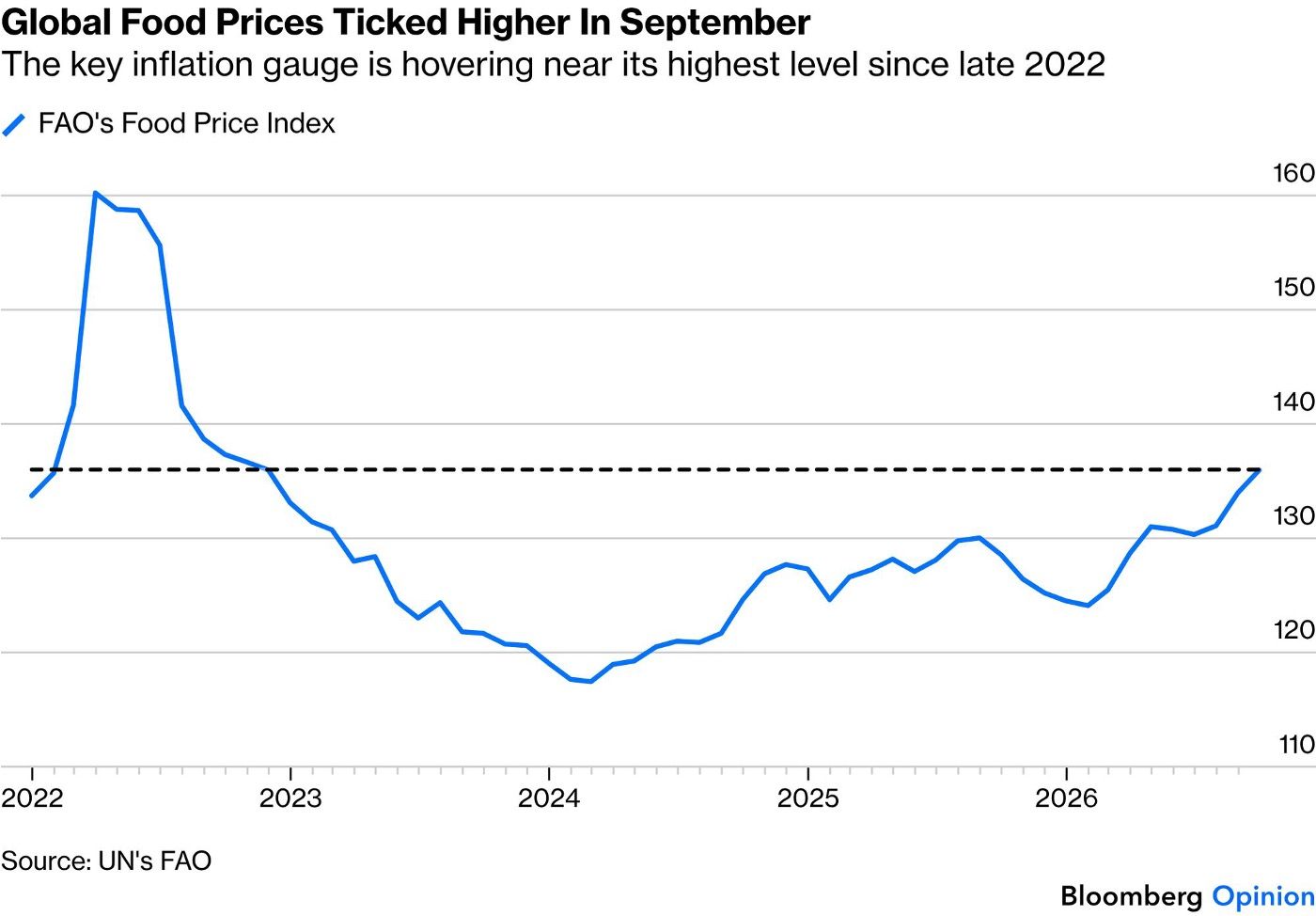
The FAO Food Price Index reached 136 points in September 2026, up 1.5% month-on-month and 5.8% year-on-year. While this level remains 15.1% below the March 2022 peak, the trend reveals a worrying dynamic: several simultaneous shocks — climatic, energy, logistical and geopolitical — are beginning to erode the buffers that have so far protected markets. None of these factors alone is enough to reproduce the 2022 crisis, but their gradual convergence turns short-term risks into structural threats.
In September, the Bloomberg agricultural commodities index recorded its strongest quarterly rise since 2022. This acceleration is concentrated in grains: wheat rose by 6.3% and corn by 5.6% in the month of September alone. These moves suggest a reaction by futures markets to expectations of lower supply or growing concerns about availability.
Although the FAO index remains 15.1% below its 2022 record high, this upward trajectory differs from a simple cyclical correction: it aggregates several sources of tension simultaneously, leaving little safety margin.
Climate phenomena — El Niño, regional droughts, a failing monsoon — directly reduce yields and harvest volumes. These shocks affect production areas unevenly: El Niño primarily threatens Asian and tropical crops, while geopolitical tensions in Ukraine directly hit the wheat and corn flows that feed global markets.
The reaction is immediate: expected supply falls, and futures contracts react instantly, reflecting operators' concern about future volumes.
Fertiliser, natural gas and diesel are becoming more expensive. This cost increase squeezes the producer's margin as long as the final agricultural price does not follow proportionally. Unlike production shocks, cost shocks act through a delayed mechanism: if fertiliser becomes too expensive, farmers reduce its use or cut cultivated areas.
This adaptation has a time cost. A price increase in 2026 can thus turn into a yield reduction in 2027, cascading the shock from one year to the next.
Even with sufficient production, attacks in the Black Sea, growing maritime risks and rising insurance and transport costs increase the cost of shipping grain to the final consumer. This factor acts independently of physical availability: an abundant harvest can remain expensive to deliver.
Diesel, moreover, comes into play at several levels of the chain: production, harvesting, transport and processing. Producers do not always pass on these extra costs immediately; they absorb them, reduce inputs or seek public support.
The most worrying scenario does not stem from an immediate shortage, but from a gradual erosion of margins and incentives to produce. A farmer facing high fertiliser and fuel costs may, for lack of sufficient profitability, reduce flagship crop areas or target yields. This type of adjustment involves a lag: visible on futures markets in expectations, but effective in harvests only several months later.
At the same time, geopolitical tensions directly affect export flows from certain key regions, interrupting the circulation of global stocks even when overall availability is comfortable.
The main reassuring element remains unchanged: global grain stocks remain historically high and relatively comfortable. The 2026 harvest is still within a comfortable range compared with previous years. This buffer has thus absorbed the shocks of recent months without leading to a spiral of shortages.
However, this resilience masks a growing fragility. No single shock — weather, energy, logistics or geopolitics — is enough to reproduce the 2022 crisis. But their gradual accumulation progressively erodes these safety cushions. The more constraints overlap, the less margin remains to absorb an additional shock.
The current scenario differs from 2022. At the time, a major and concentrated geopolitical shock had frozen exports from a key region, creating an acute shortage and a violent price spike. Today, the risk is of a different nature: it stems from the accumulation of small constraints which, taken individually, remain manageable, but which together gradually turn a cost increase into a supply decline.
This process is less visible and slower, but potentially harder to correct, because it involves investment and production decisions staggered over time, rather than a sudden supply disruption.
This is not investment advice.