August 27, 2026
In twenty-four years, trade between China and Latin America has multiplied thirty-five-fold. China has become South America's leading trading partner, while its presence extends well beyond commodities: electric vehicles, batteries, digital networks and critical infrastructure. This transformation calls the Monroe Doctrine into question and forces Washington to rethink its regional strategy.
The scale of the change can be measured in figures. Since 2000, bilateral China-Latin America trade has grown exponentially, from $14 billion to more than $500 billion in 2024. This growth is not geographically uniform.
In South America, China has become the leading trading partner, ahead of the United States and most European countries. Brazil, Peru and Chile are among the economies most integrated into China's economic orbit, notably through the mining and agricultural sectors. Conversely, in Mexico, Central America and the Caribbean, Washington retains a dominant position, fed by geographic proximity and historical trade agreements.
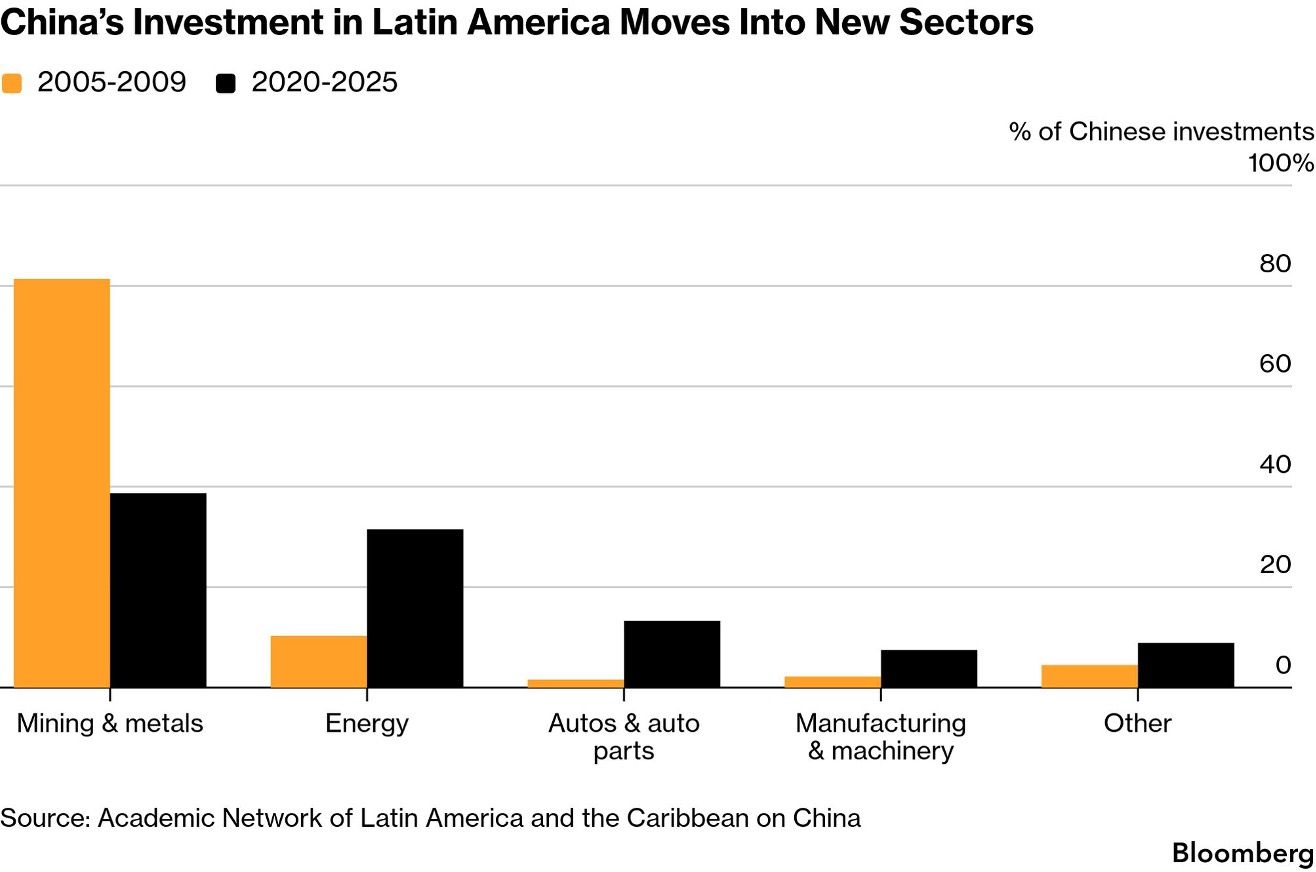
The major change lies not so much in the volume as in the nature of the trade. During a first phase, Chinese engagement focused on natural resources, ports and transport infrastructure. This strategy met the energy needs of a rapidly expanding economy.
Since then, Beijing has diversified its portfolio. Chinese investment now covers electric vehicles, lithium batteries, power grids, data centres and digital technologies. Chinese carmakers already account for around 20% of the regional car market by value, a rise that illustrates the shift of the Chinese model towards high value-added, high-technology sectors.
This evolution makes the Chinese footprint harder to challenge once it is integrated into local economies. A port can be politically contested; an automotive supply chain or a power grid takes root in economic and social structures.
A structural paradox characterises Latin American relations today. The United States retains a clear political and security superiority. Washington has diplomatic, military and institutional tools without regional equivalent. Its influence remains particularly strong in Mexico and Panama, where geographic proximity, access to the US market and control of strategic infrastructure reinforce its position.
However, this superiority is no longer enough to dominate economic choices. Brazil, Peru and Chile, while maintaining stable relations with Washington, have built deep economic dependencies on Beijing. Even Ecuador, although aligned with US security positions, continues to seek Chinese investment and technology.
The model that is emerging is therefore clearly bifurcated: Latin American countries manage their security and political alliances with the United States, while their economic growth and technologies increasingly come from China. This separation of logics is not without friction, but it has consolidated enough to become structural.
Faced with this transformation, an exclusively defensive reaction would be ineffective. Washington should instead focus its efforts on the truly strategic sectors: ports, telecommunications, power grids, data centres and access to critical minerals. The main lever remains access to the US market, an asset Beijing cannot offer.
The challenge also lies in the method. Beijing is adapting its approach: fewer large, politically visible and widely publicised projects, more smaller-scale industrial and technological investments that are hard to challenge once integrated. This discretion makes the influence less visible, but also less vulnerable to political blows.
The final paradox remains unavoidable: the United States can potentially strengthen its geopolitical dominance in Latin America through traditional tools (alliances, security, diplomacy) while China simultaneously deepens its economic hold. Washington can no longer decide alone with whom the region will do business. That is the price of two decades of growth in China-Latin America trade and the reflection of a multipolar reality in full consolidation.
This is not investment advice.