September 30, 2026
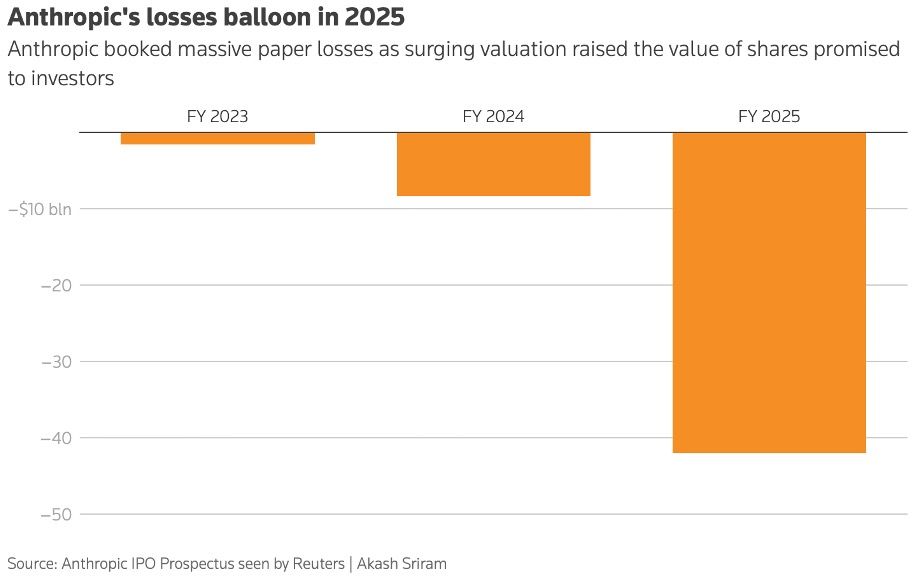
Anthropic's confidential prospectus, reviewed by Reuters two weeks after Dario Amodei's warning on AI risks, reveals a company with spectacular funding and equally visible contradictions. With a valuation that has risen from $380 billion in February to more than $2,000 billion by the IPO, Anthropic embodies the structural tensions of the artificial intelligence sector: dizzying growth confronted with massive long-term commitments and significant customer concentration.
Anthropic's figures illustrate the scale of the race for computing capacity in the AI sector. 2025 revenue reached close to $4.6 billion, a 12-fold increase in one year. Available cash at the end of 2025 stood at $20.28 billion, while the company spent $7.33 billion on compute and infrastructure.
However, this rapid expansion comes with substantial losses. The operating loss stands at $8.06 billion. The net loss of $42 billion nevertheless includes $34 billion of accounting charges with no immediate cash outflow, a crucial distinction for understanding the company's real financial structure.
The prospectus reveals a particularly significant infrastructure commitment: Anthropic plans at least $518 billion of commitments over ten years, of which around 80% would be difficult to cancel. This element transforms the company's risk profile: costs become largely fixed, while revenues remain variable.
The prospectus reveals a marked dependence on a small number of customers. Two of them account for 24% of total revenue. In addition, 47% of sales flow through Amazon and Google, creating major indirect exposure to these two technology giants.
This concentration creates a risk asymmetry: a large share of customers can quickly reduce their consumption depending on their needs or internal strategies, while Anthropic commits to paying for its computing capacity for seven to ten years. The model therefore combines still partly variable revenues with largely irrevocable costs.
Ten days after Dario Amodei's public warning calling for a slowdown in the rollout of the most powerful models, Anthropic launched Opus 5.5. The prospectus confirms this apparent contradiction: a continuous succession of new models is acknowledged as indispensable to maintaining a competitive position.
This necessity reflects a structural reality of the sector. Anthropic cannot slow down alone without benefiting its competitors. The commercial imperative prevails over internal calls for caution, a tension inherent in competition in generative AI.
Dario Amodei's public warning on the existential risks of AI is not necessarily at odds with Anthropic's commercial strategy. The safety narrative in fact serves several functions simultaneously: the probable personal conviction of its leaders, legal protection vis-à-vis regulators, differentiation with client companies and an implicit assertion of technological power.
This last point deserves attention. An artificial intelligence presented as difficult to control or dangerous can also be perceived as sufficiently advanced to justify an exceptional valuation. The two narratives reinforce each other: demonstrating credible risks also validates the technological relevance and the massive investments required.
This is not to deny the sincerity of the desire to make a powerful technology safe. However, these convictions and these commercial imperatives coexist in a single narrative with no apparent contradiction for markets and regulators.
Nothing formally proves that Anthropic was behind the disclosure of the prospectus to Reuters. However, the timing proves favourable to the company.
Publishing the document before the official IPO serves several purposes. It publicly anchors a $2,000 billion valuation, gradually accustoms the market to the $518 billion infrastructure commitments, and allows the weaknesses of the business model to be absorbed before the formal presentation to investors.
Above all, it positions Anthropic as the company developing one of the most powerful technologies, understanding its dangers best, and therefore best placed to make it safe. This narrative is powerful with regulators, with clients sensitive to governance issues and with institutional investors assessing long-term risks.
AI safety can be an authentic conviction while serving Anthropic's commercial, regulatory and financial strategy remarkably well. The two are not mutually exclusive; they amplify each other.
This is not investment advice.