September 2, 2026
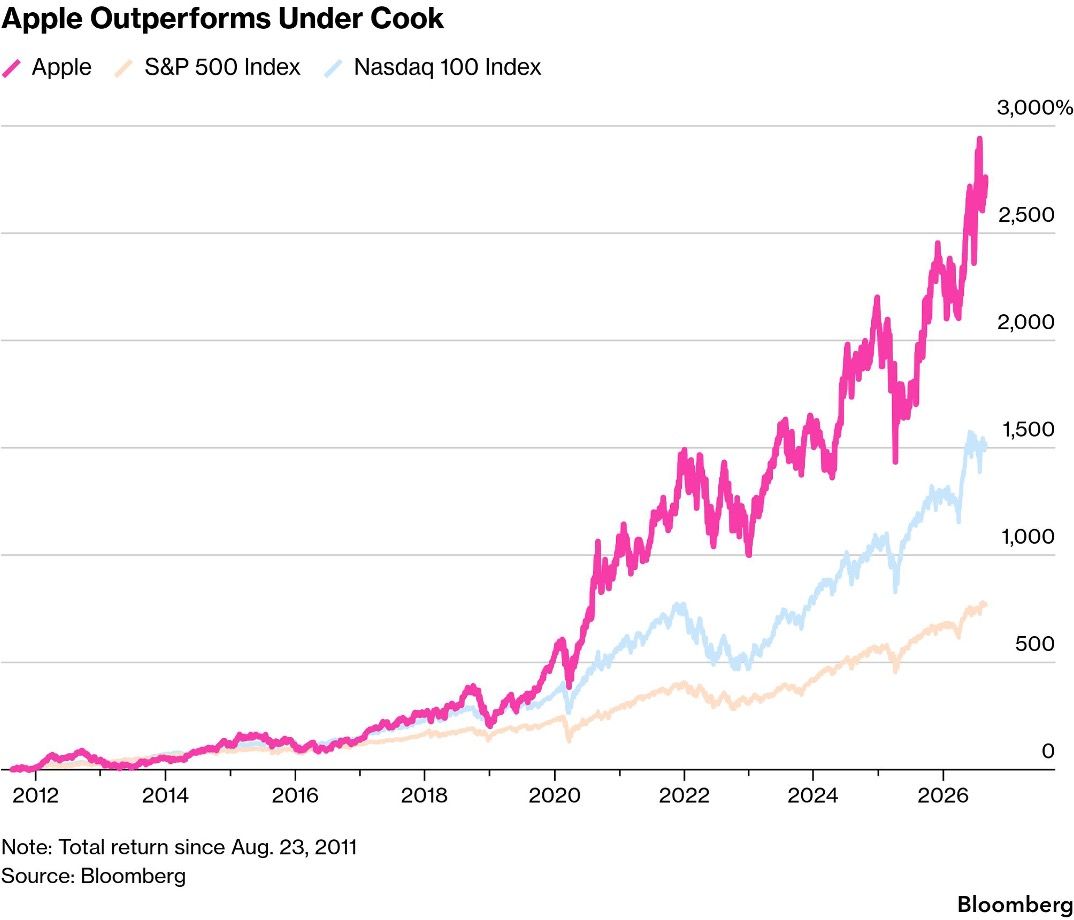
After 15 years at the helm of Apple, Tim Cook is handing the chief executive role to John Ternus, 51, the former head of hardware. The transition comes as Apple posts remarkable growth: revenue rose from $157 billion in 2012 to $416 billion in 2025, while market capitalisation has reached roughly $4,600 billion. Ternus's challenge will be to sustain this trajectory while renewing the technology giant's sources of growth.
Tim Cook did not create new iconic products in the manner of Steve Jobs. He did much more: he turned innovation into a global industrial, commercial and financial machine.
On the product side, Apple extended its ecosystem well beyond the iPhone. The Apple Watch, AirPods, Apple Silicon, Apple Pay and Apple Music illustrate this diversification. Some projects, such as the self-driving car and the Vision Pro, did not achieve the expected impact, but they reflect a willingness to explore strategically.
The real success lies in services. Revenue from this business grew from $16 billion in 2013 to more than $109 billion in 2025, now accounting for more than a quarter of total sales. This diversification has made Apple less dependent on hardware sales alone and more resilient to technology cycles.
Financially, Cook orchestrated more than $840 billion in share buybacks since 2012, reducing the number of shares outstanding by nearly 45% from their peak. This strategy supported shareholder value while concentrating ownership.
Beyond the figures, Cook demonstrated that Apple could outlive Steve Jobs and operate as an institution rather than as the expression of a single visionary. That is a fundamental achievement for the company's longevity.
John Ternus embodies a different positioning. An engineer by training with 25 years of seniority at Apple, he successively led the Mac, iPad, AirPods and iPhone lines before taking responsibility for all hardware. His background places him far closer to the technology and product domain than Cook, whose expertise lies more in supply chain and operations.
This difference in profile suggests a renewed strategic direction: moving from operational optimisation to the pursuit of technological breakthroughs.
Apple has considerable assets for AI: ubiquitous devices, high-performance proprietary chips, integrated software and an installed base of more than 2.5 billion active devices. Nevertheless, the group has fallen behind on generative artificial intelligence compared with some competitors. The new Siri will be a key indicator of Apple's ability to catch up and to integrate AI meaningfully into its ecosystem.
The iPhone remains Apple's profit pillar. To accelerate, however, Ternus must unlock new drivers: a foldable iPhone, smart glasses, AI-enhanced AirPods, connected-home solutions. The challenge is to develop these new markets without weakening the golden goose that is the iPhone.
A significant share of the senior executives recruited or developed under the Cook era are approaching the end of their careers. Ternus will need to gradually build his own leadership team, both to ensure continuity and to instil a culture more oriented towards product innovation.
Ternus benefits from solid legacies: an exceptional brand, a locked-in ecosystem, considerable profitability and the presence of Tim Cook as executive chairman to accompany the transition. These foundations offer welcome stability.
The major challenge is mathematical. Apple is valued at roughly $4,600 billion and trades at around 33 times expected earnings. Maintaining growth comparable to Cook's will become exponentially harder. The law of large numbers applies: doubling the capitalisation of a $350 billion company is easier than going from $4,600 billion to $9,200 billion.
Ternus's success will therefore be measured not only by the continuation of past growth, but by the ability to open a new cycle: integrating AI credibly, producing innovative categories and strengthening ecosystem loyalty.
Jobs created the machine. Cook turned it into an empire. Ternus must now prove that Apple can still write a new chapter of growth.
This is not investment advice.