November 6, 2026
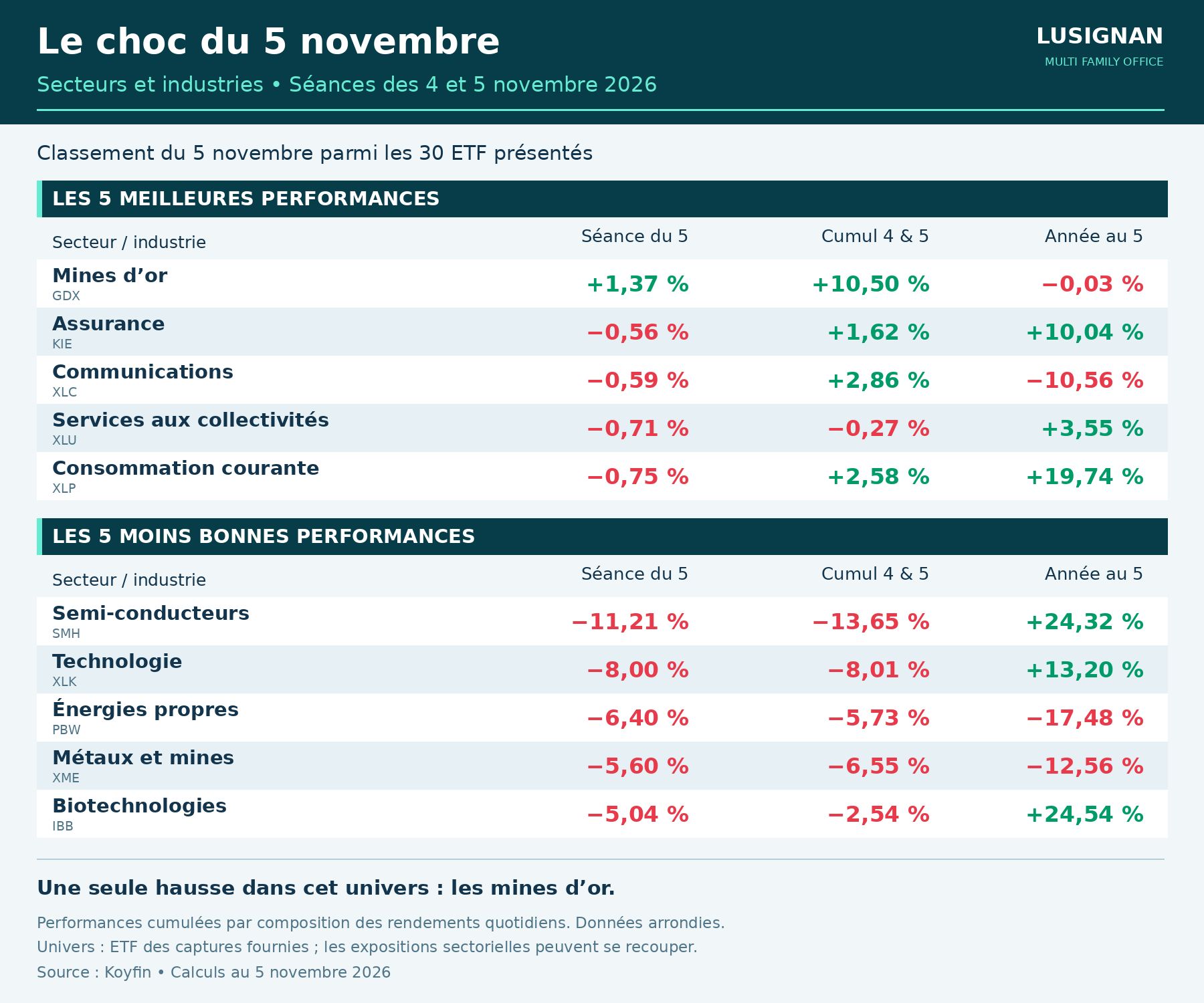
On 5 November 2024, the US market suffered a sharp correction: the S&P 500 lost 4.4%, while the Nasdaq 100 collapsed by 6.4%. Semiconductors, the beating heart of the technology sector, plunged 11.2%. This slide reveals a concentration of risk far deeper than the decline figures alone suggest. It exposes the vulnerability of a global economy built on a single investment cycle: that of data centres for artificial intelligence.
On 5 November, all eleven S&P 500 sectors declined, but ten of them held up better than the broad index. Technology, for its part, lost 8%, while communications, utilities and consumer staples posted losses of less than 1%. The next day, the contagion spread to Taiwan, where the index closed down 4.5%, dragging Asian component suppliers with it.
This apparently sector-driven dynamic carries a deeper meaning: the relative performance of other sectors was not enough to stabilise the broad index. Diversification between the United States and Asia offered only limited protection. The reason: the earnings of Asian suppliers depend, to a large extent, on the same data-centre spending as those of US manufacturers.
The prospect of additional constraints on data centres threatens the pace of chip orders. If buyers—mainly cloud and AI giants—decide to spread out their build-outs, this would preserve their cash. But for semiconductor suppliers, the opposite applies: a slower pace would have a decisive impact on capacity tightness, prices and margins. When earnings prospects recede further into the future, they also weigh on present valuations.
Investors were already worried about high spending, indebtedness and longer payback periods. The recent releases from Qualcomm and Arm added an operational dimension to these structural concerns. The 5 November election accelerated a reassessment that had begun before the vote, acting as a catalyst for a correction that was already latent.
Margin calls triggered forced selling, notably in Asia, where leveraged positions caught in the correction generated further liquidations. The scale of the decline therefore does not measure only the deterioration in earnings prospects: it also reflects the mechanics of financial markets, where falling prices force the realisation of additional losses to meet loan collateral requirements.
Over the two US sessions, some sectors showed real resilience. Communications held on to a 2.9% gain and consumer staples 2.6%. These figures are not trivial: they prove that divergence exists when the economic engines truly differ.
In Asia, India held up better than its neighbours. Several factors explain this: lower exposure to chipmakers, the retreat in oil prices (favourable to net importers) and the return of foreign capital. The hope of lower US tariff pressure also supports expectations for the Indian market, even though no relief has yet been secured.
The November correction illustrates a fundamental principle: several sectors and several countries can conceal the same underlying dependence. A geographic or sector allocation that looks reassuring on the surface can prove illusory if all the components of the portfolio benefit from the same economic cycle.
True diversification requires examining not only sectors and regions, but also earnings drivers and financing methods. Portfolios diversified by driver—some exposed to the AI cycle, others to real yields or defensive cash flows—would have cushioned this correction better.
This is not investment advice.






