October 15, 2026
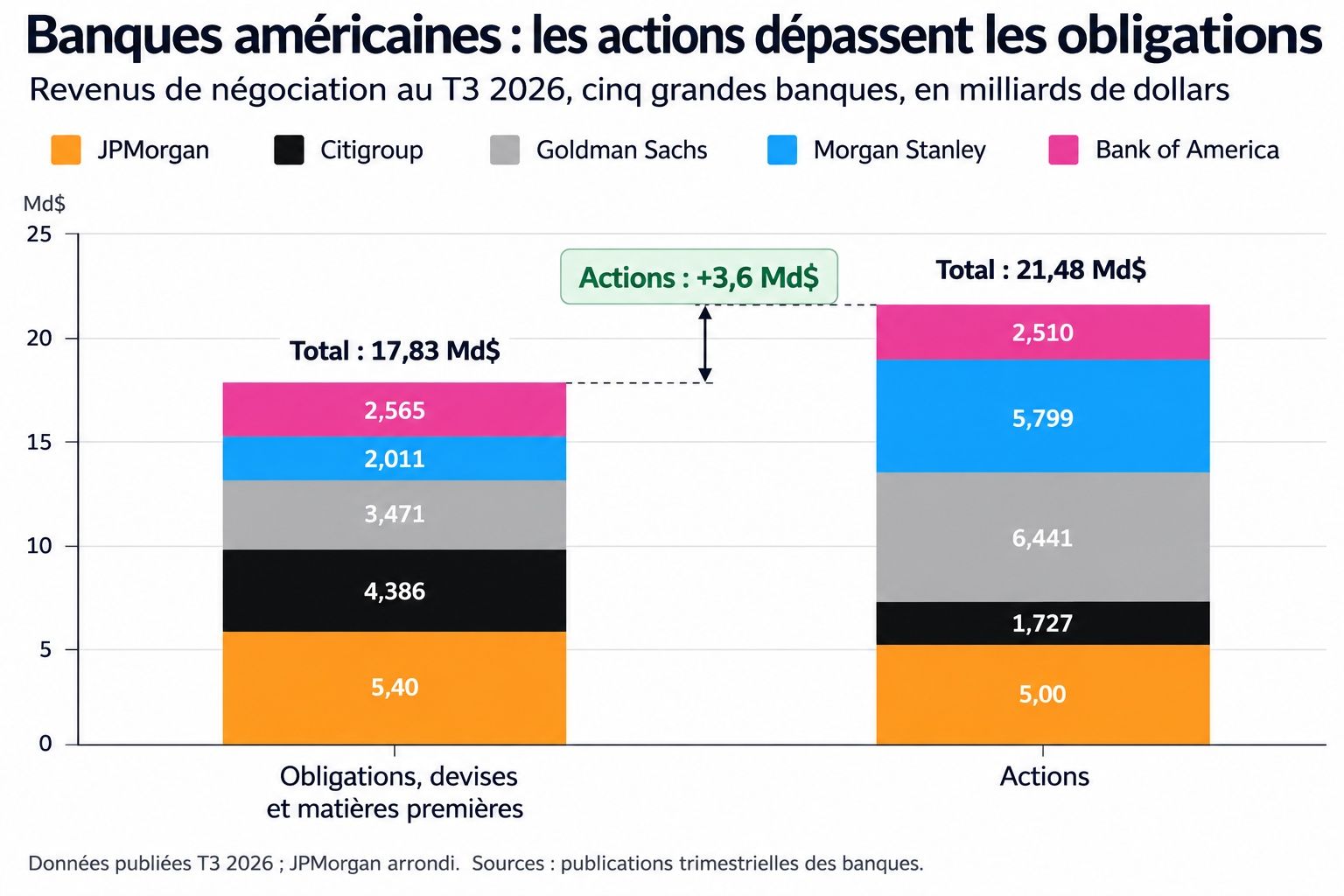
The third-quarter 2026 results of the six largest US banks paint a mixed picture of the US economy. While consumption and credit remain dynamic, warning signs are appearing on margins, provisions and corporate financing. Equity markets are carrying the results, while bonds are under growing pressure.
Six institutions (JPMorgan, Bank of America, Citigroup, Wells Fargo, Goldman Sachs and Morgan Stanley) have published their Q3 accounts. The data reveal two diverging trends.
Card spending shows growth of between 8% and 12% year on year depending on the bank. Payment delinquencies remain stable or are falling, a sign that households are honouring their obligations. On the credit front, JPMorgan records an increase of 10%, Bank of America 6%, Wells Fargo 11% and Citigroup 12%.
This growth in credit reflects persistent corporate needs, notably in infrastructure and artificial intelligence. It confirms that the US economy is not entering a phase of contraction.
Equity trading activity has surged. Goldman Sachs posts an increase of 72%, JPMorgan 49% and Morgan Stanley 41%. This strength contrasts with the decline in fixed-income revenue at several institutions.
Morgan Stanley gathered $232 billion in wealth management in Q3, a record. More than half comes from IPOs, illustrating how the creation of financial wealth feeds future fees.
Several banks are strengthening their provisions, particularly on corporate portfolios. This move is telling: anticipated risks are growing faster than the losses actually recorded. Banks are preparing for a more fragile environment without the crisis being current.
The increase in deposit remuneration is reducing intermediation margins. Bank of America still benefits from the gradual rollover of its older assets at higher yields, giving it a temporary advantage. This effect will fade as the portfolio normalises.
The conclusion is clear: growth in credit volumes no longer guarantees growth in profits. Margins are being squeezed.
The exceptional activity in equities coexists with a high-rate environment and a slowdown in mergers and acquisitions and issuance since the second quarter. Q2 had benefited from exceptional deals, notably the SpaceX IPO. Volatility benefits intermediaries, but the cost of capital is holding back financing deals.
Households continue to spend and repay. Q3 confirms the resilience observed in the previous quarter. However, the data do not signal an acceleration in real consumption. Growth exists, but it is not amplifying.
Companies remain in demand for credit to invest in infrastructure and innovation. At the same time, the first signs of fragility are emerging in certain credit and private asset segments. The strengthened provisions attest to this.
Since Q2, three phenomena have become more visible. First, the cost of deposits is rising, squeezing margins. Second, unrealised losses on bonds weigh on balance sheets. Finally, the slowdown in financing deals reduces the associated revenue.
The financial economy is becoming more expensive to finance. High rates and more restrictive conditions reduce the flexibility of economic players.
The bank results do not signal an imminent credit crisis. They depict a US economy that is still dynamic, but whose growth is running into growing obstacles.
The divergence is visible: equity markets benefit from high volatility and the creation of financial wealth, while credit intermediation has to contend with compressed margins and growing spending on deposits. Sectors exposed to high rates and expensive financing are experiencing growing fragilities.
The structural question remains: how long can this dynamic persist? Will households continue to consume and repay? Will companies give less weight to the cost of financing in their investment decisions? Will equity markets remain the main driver of bank revenue?
The Q3 data offer partial answers. They do not settle the matter.
This is not investment advice.