September 11, 2026
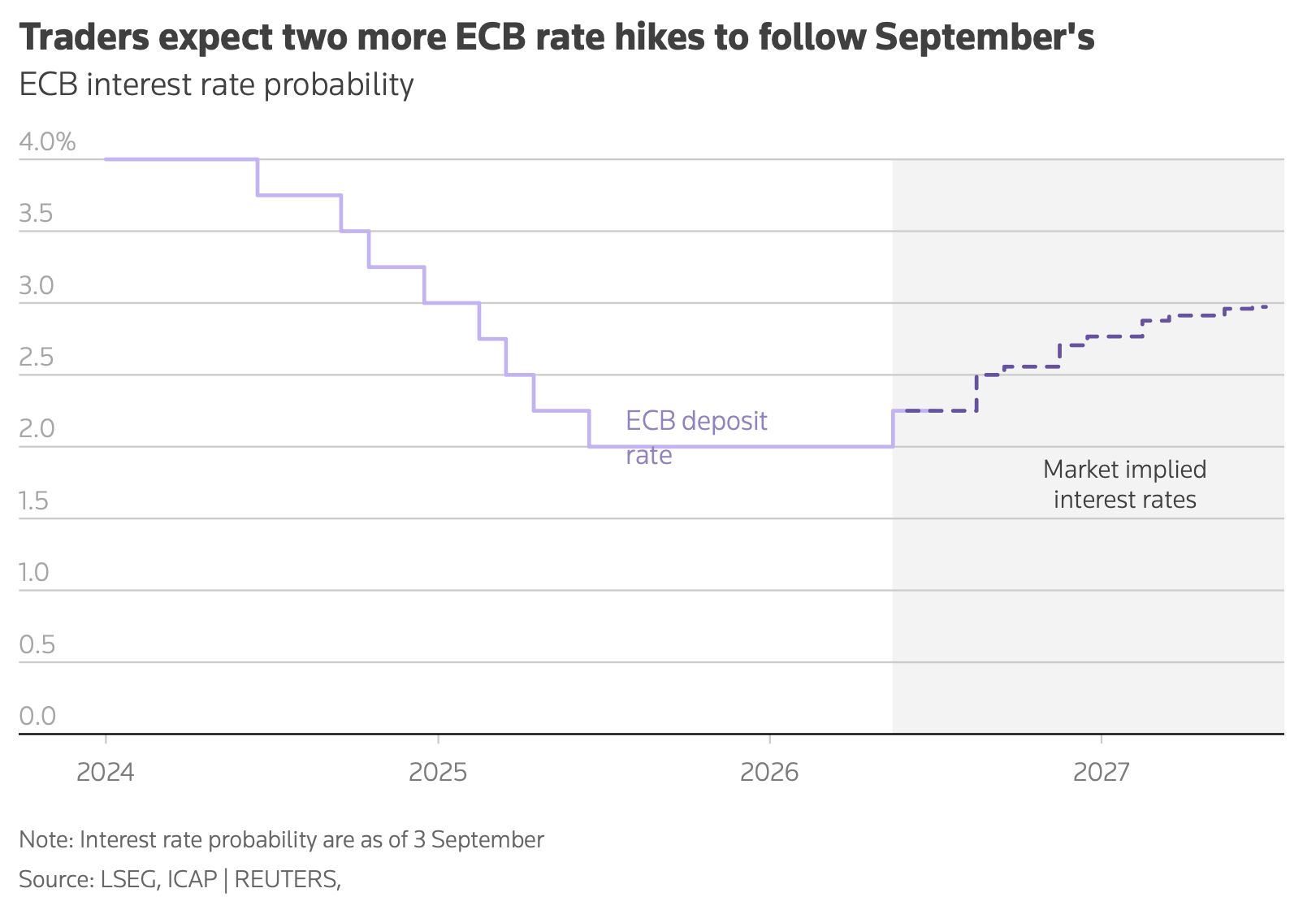
The ECB raised its policy rates in September 2026, joining a global move towards monetary tightening in response to rising inflation. Yet this decision raises a fundamental question: can raising rates really fight an energy shock? The answer reveals the limits and the true objectives of central bank action in the face of current inflationary pressures.
In September 2026, the European Central Bank raised its deposit rate by 25 basis points to 2.50%, following a first hike in June. The decision was unanimous within the Governing Council.
Euro area inflation stands at 3.3% in August, but this average hides a differentiated reality: core inflation, excluding food and energy, remains contained at 2.4%. The ECB's forecasts anticipate economic growth of 0.9% for 2026 and average inflation of 3.0%.
In the United States, July data show headline inflation of 3.4%, but only 2.5% excluding food and energy, revealing a similar profile. The Federal Reserve was meeting on 16 September for its own decisions.
The real shock comes from commodities: the price of Brent has crossed 100 dollars a barrel following the resumption of geopolitical tensions in the Middle East. Copper is trading around 14,000 dollars a tonne, supported by investment in artificial intelligence and power grids and by constrained supply.
One economic truth stands out from the outset: raising rates produces neither oil, nor gas, nor copper. Central bank action therefore cannot directly resolve the energy shock. This technical limit defines the true mission of monetary tightening in a commodity shock environment.
The challenge is to interrupt a well-known mechanism: more expensive energy → higher production costs → consumer prices → wage demands → lasting inflation. By raising rates, the central bank also sends a strong signal: it will not tolerate the energy shock unanchoring inflation expectations. This credibility, in itself, can help keep wages and pricing behaviour in controlled territory.
The additional 25 basis points therefore serve an insurance function: demonstrating determination without immediately deploying the heavy weapon of a massive increase.
However, long-term rates are already very high, and they are already exerting significant tightening on credit, residential real estate and corporate financing. In this context, the marginal economic effect of an additional 25 basis points may prove limited. It is more an insurance premium than a substantial additional brake on the economy.
In the euro area, price rises remain essentially concentrated in energy. Services, wages and core inflation do not yet show signs of overheating. Continuing to raise rates significantly would expose the ECB to a classic risk: adding expensive credit to already expensive energy, when the latter shock is already reducing purchasing power and economic growth.
The US economy presents a more resilient profile. Industry and services are growing, and the growth base remains broader than in Europe. Nevertheless, a similar risk exists: a significant share of inflationary pressures comes from investment in AI, electricity and infrastructure. These investments show limited sensitivity to an additional 25 basis point rise. The consumer, on the other hand, who accounts for nearly 70% of US GDP, remains very sensitive to the cost of credit.
At this stage, holding rates at already high levels may prove as effective as raising them again. Monetary action has reached a plateau where the credibility of the message counts as much as the magnitude of the move.
The next central bank decisions must be justified by a genuine spread of energy inflation into wages and services. As long as inflation remains concentrated in commodities and core inflation stays contained, each additional hike must be assessed not on the basis of preventive insurance, but on concrete evidence of spillover.
This is not investment advice.