September 13, 2026
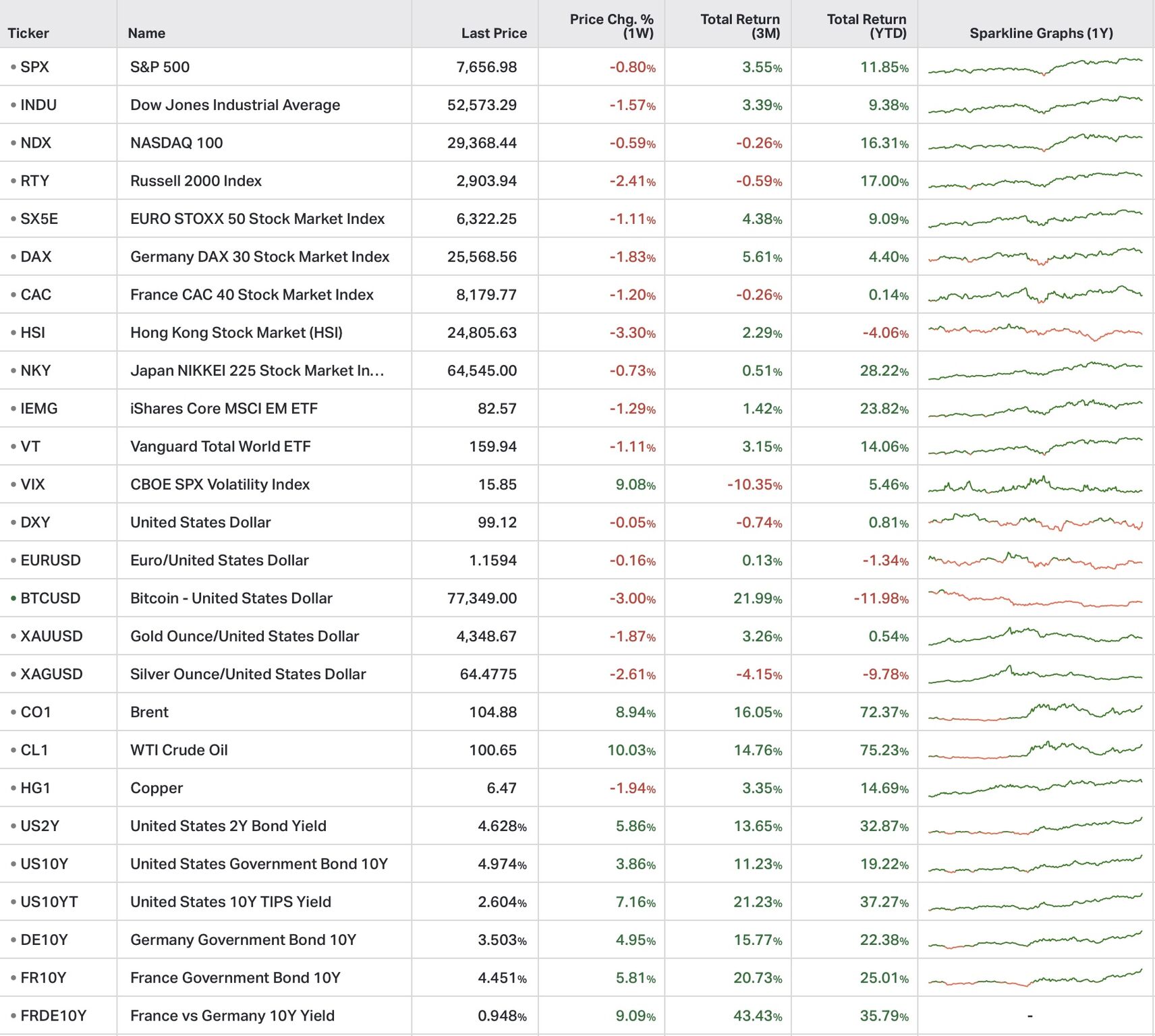
The week of 7 to 11 September 2026 was marked by a broad correction in equity markets, a significant rise in bond yields and a surge in energy prices. The common thread: an energy shock that is raising the cost of financing the economy even before threatening growth, while central banks maintain their restrictive path.
The main US and European equity indices fell over the week. The S&P 500 lost 0.8%, the Nasdaq 100 0.6%, while the Russell 2000 small-cap index gave up 2.4%. In Europe, the Euro Stoxx 50 retreated 1.1%.
This divergence reveals a classic phenomenon: faced with rising rates, small caps, more indebted and less profitable, suffer more than the technology giants. The latter benefit from considerable investment flows linked to computing power needs for artificial intelligence.
Bond yields tightened noticeably. The US two-year rate reached 4.6% (up 26 basis points), while the ten-year moved to 5.0% (+19 bp). In Europe, the German ten-year yield stood at 3.5% (+17 bp) and the French at 4.5% (+24 bp).
The Franco-German spread widened, probably reflecting accumulated concerns around fiscal risks. At the same time, these higher real yields weighed on assets considered riskier, notably gold and copper.
The US dollar remained relatively stable despite expectations of a Federal Reserve rate hike. The euro fell 0.2%, suggesting that expectations of US monetary tightening are not enough to revive the greenback in the current macroeconomic context.
Energy dominated the moves. Brent crude climbed 8.9% to 104.9 dollars a barrel, driven by attacks that raised the cost of oil shipping. This energy shock is gradually spreading through global supply chains.
Gold fell 1.8%, penalised by the rise in real yields (nominal rates less expected inflation), which reduce the appeal of non-yielding assets. Copper lost 1.9%, with uncertainty around trade negotiations and tariffs curbing demand for a metal sensitive to economic activity. Bitcoin fell 3.0% in a week that was broadly unfavourable to risk assets.
In the United States, producer price inflation reached 5.4% year on year in August, largely supported by energy. Headline consumer price inflation stands at 3.4%. Core inflation (excluding food and energy) rose 0.3% over the month, more than expected, suggesting some persistence beyond the energy shock alone.
This trajectory increases the probability of a Federal Reserve rate hike, although the indices do not yet show a lasting and generalised spread of the energy shock to the economy as a whole.
The European Central Bank raised its deposit rate by 0.25 point to 2.5% and forecasts inflation of 3.0% in 2026. At the same time, second-quarter growth was revised upwards to +0.6%, mainly thanks to Ireland's performance. However, German industrial production fell 1.1% in July, a sign of weakness in Europe's economic engine.
Natural gas continues to threaten an uneven recovery, with countries exposed to energy risks facing stronger headwinds than others.
Chinese exports jumped 25% in August, driven by demand for artificial intelligence products. The trade surplus stood at 119 billion dollars. This momentum contrasts with European weakness and illustrates a concentration of productivity gains in the technology sector.
Canada announced the imposition of duties of 15% to 50% on targeted US products, continuing the escalation of trade tensions.
Oracle posted revenue growth of 30% to 19.3 billion dollars, driven by demand for AI computing power. However, the company spent 28.5 billion on capital expenditure and recorded negative free cash flow of 5.4 billion, illustrating the exorbitant cost of financing this technological transition.
Google announced 13 billion euros of AI investment in Finland, while Apple unveiled its new Duo foldable phone, marking the evolution of the mobile device market.
The week highlights a key issue: the energy shock is raising the cost of financing the economy even before damaging real growth. Central banks, particularly the Fed and the ECB, face a dilemma: maintain a restrictive policy to fight core inflation, or ease their stance to cushion the effects of higher energy costs. The duration and scale of this shock will determine the pace and extent of the monetary tightening to come.
This is not investment advice.






