August 30, 2026
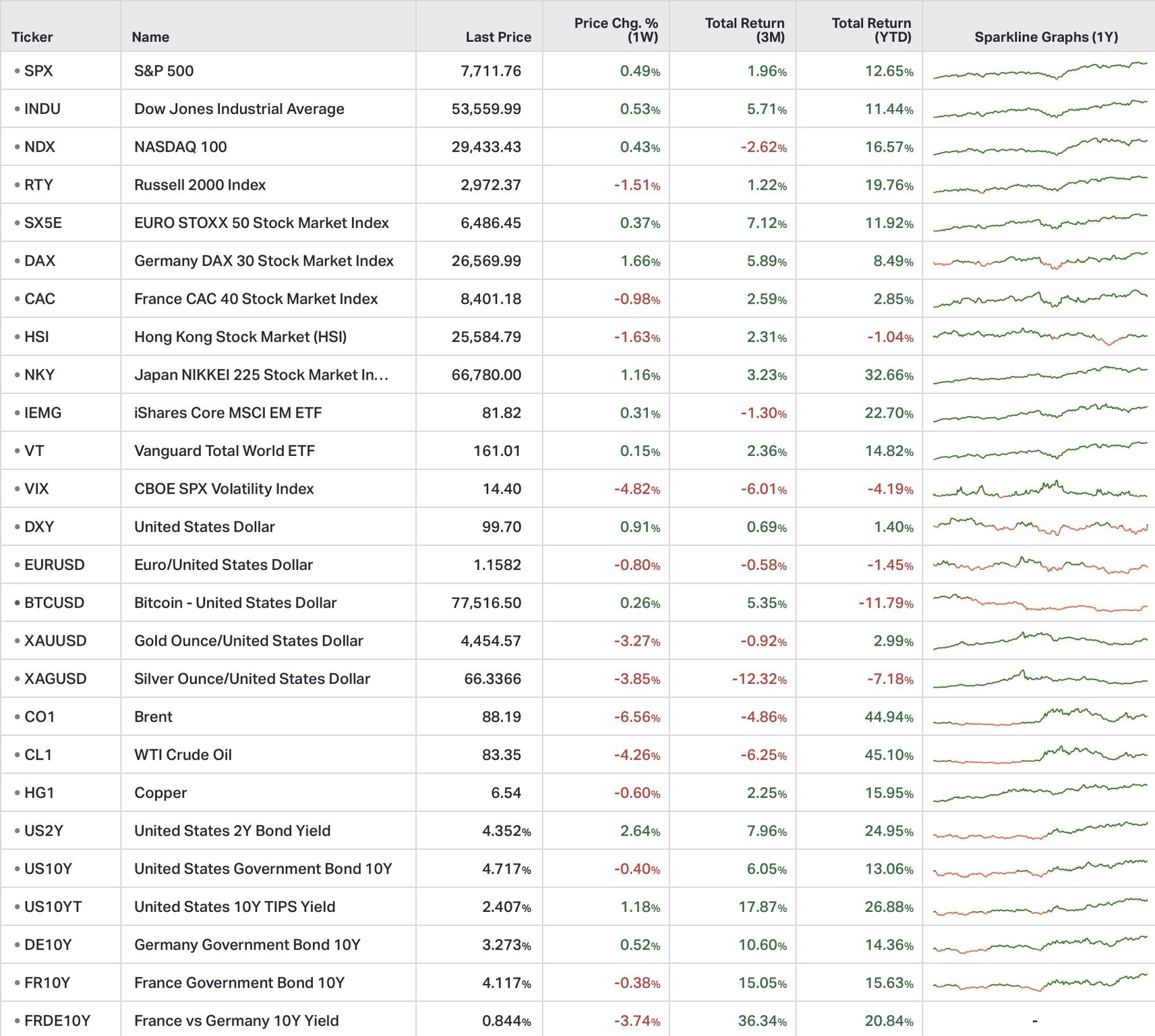
The week confirmed the resilience of the artificial intelligence investment cycle, driven in particular by NVIDIA and the spread of AI solutions into software and cybersecurity. At the same time, the world's central banks are hardening their stance: the market now prices a probability above 50% of a US rate hike in September, while hikes are also looming in Japan. This divergence between the strength of technology earnings and monetary tightening is reshaping the investment environment.
The main US indices posted modest gains. The S&P 500 gained 0.5% and the Nasdaq 100 0.4%, reflecting sustained demand for technology stocks despite high valuations. This apparent stability nonetheless conceals a growing divergence: the Russell 2000, the small-cap index, lost 1.5%, signalling a marked investor preference for the established leaders of the technology sector over cyclical or domestic segments.
NVIDIA consolidated its position with quarterly revenue of $96.2 billion and guidance of $108 billion for the following quarter, confirming the durability of demand for AI computing power. Beyond the pure technology play, the spread of the AI ecosystem can be seen at Salesforce and CrowdStrike, both of which beat expectations. This gradual diffusion of AI capabilities into business software and cybersecurity remains an important support for medium-term earnings.
In Europe, the picture was more mixed. Germany's DAX rose 1.7%, lifted by signs of improvement in the German economy and increased investment in infrastructure and defence. France's CAC 40, by contrast, fell 1%, reflecting concerns about fiscal risks. In Hong Kong, the index shed 1.6% amid a Chinese industrial slowdown, while Alibaba Group announced a $10.2 billion technology investment programme.
The week consolidated expectations of US monetary tightening. The 2-year yield rose 11 basis points to 4.35%, while the 10-year yield remained almost unchanged at 4.72%. This dynamic flattened the yield curve, a signal often observed when investors anticipate a pause in hikes after an initial tightening phase.
The firm speech by Kevin Warsh, an influential voice on monetary policy, strengthened the dollar by 0.9% and brought the euro down to $1.158. This appreciation of the greenback reflects growing expectations of a more restrictive federal policy, reinforced by the macroeconomic diagnosis: core inflation (PCE) rose 0.2% in July and stands at 3.3% year on year, well above the Federal Reserve's 2% target.
In the United States, the economic dynamic presents a revealing paradox. On one side, final demand indicators are weakening: real spending is stagnating, consumer confidence has fallen to 89.4 (against higher levels seen recently) and new home sales dropped 10.5%. On the other, corporate margins will reach a record this year, while earnings show remarkable resilience.
This mix of persistent inflation, slowing demand and high profitability puts the probability of a US rate hike in September above 50%. The Federal Reserve faces a trade-off: keep tightening to fight inflation, or pause in the face of the first signs of economic fatigue.
In Europe, Germany is showing the first signs of stabilisation, with GDP up 0.3% in the second quarter, supported by exports and public spending on infrastructure and defence. In Japan, inflation excluding energy and fresh food reached 2%, taking the probability of a Bank of Japan rate hike in September to 82%. In China, industrial profit growth slowed for the third consecutive month, illustrating the slowdown in the activity cycle.
Commodities fell under the combined weight of a stronger dollar and expectations of more moderate demand. Brent declined 6.6%, helped by hopes of a normalisation of trade flows through the Strait of Hormuz. Gold and silver lost 3.3% and 3.9% respectively, penalised by the US rate hike expected in September: a stronger dollar and higher real rates weaken the appeal of precious metals, which offer investors no yield.
The week's dynamics outline a bifurcated investment environment. The AI cycle continues to generate significant flows and to support the earnings of technology leaders, but this strength now sits within a framework of more restrictive and durably more constraining monetary policies. Investors must therefore weigh the resilience of technology returns against the risk of valuation compression if long-term rates rise further.
The divergence between small and large capitalisations, as well as between developed markets, underlines the importance of diversified allocation. Europe is showing the first signs of recovery, while China faces a prolonged cyclical slowdown. Japan is beginning its own cycle of monetary normalisation.
This is not investment advice.






