September 17, 2026
Canada is exploring a structural rapprochement with the European Union, driven by Ursula von der Leyen's proposal to create an "associate member" status and by Finance Minister Mark Carney's economic diversification ambitions. Far from a break with the United States, this trajectory answers an imperative of resilience: reducing dependence on Washington amid growing trade tensions.
Ursula von der Leyen proposes making Canada the European Union's first "associate member". This status does not yet exist in EU law: it is neither full membership nor automatic access to the single market, but falls within a logic of structured partnership. The formula reflects a geopolitical reality: Canada does not aspire to European integration, but wishes to consolidate bilateral relations.
Mark Carney, Finance Minister, has framed this vision around a "unique economic and security alliance". In response to the new US tariffs, Ottawa retaliated "dollar for dollar" on 27.6 billion Canadian dollars of imports, signalling its bargaining power while seeking opportunities elsewhere.
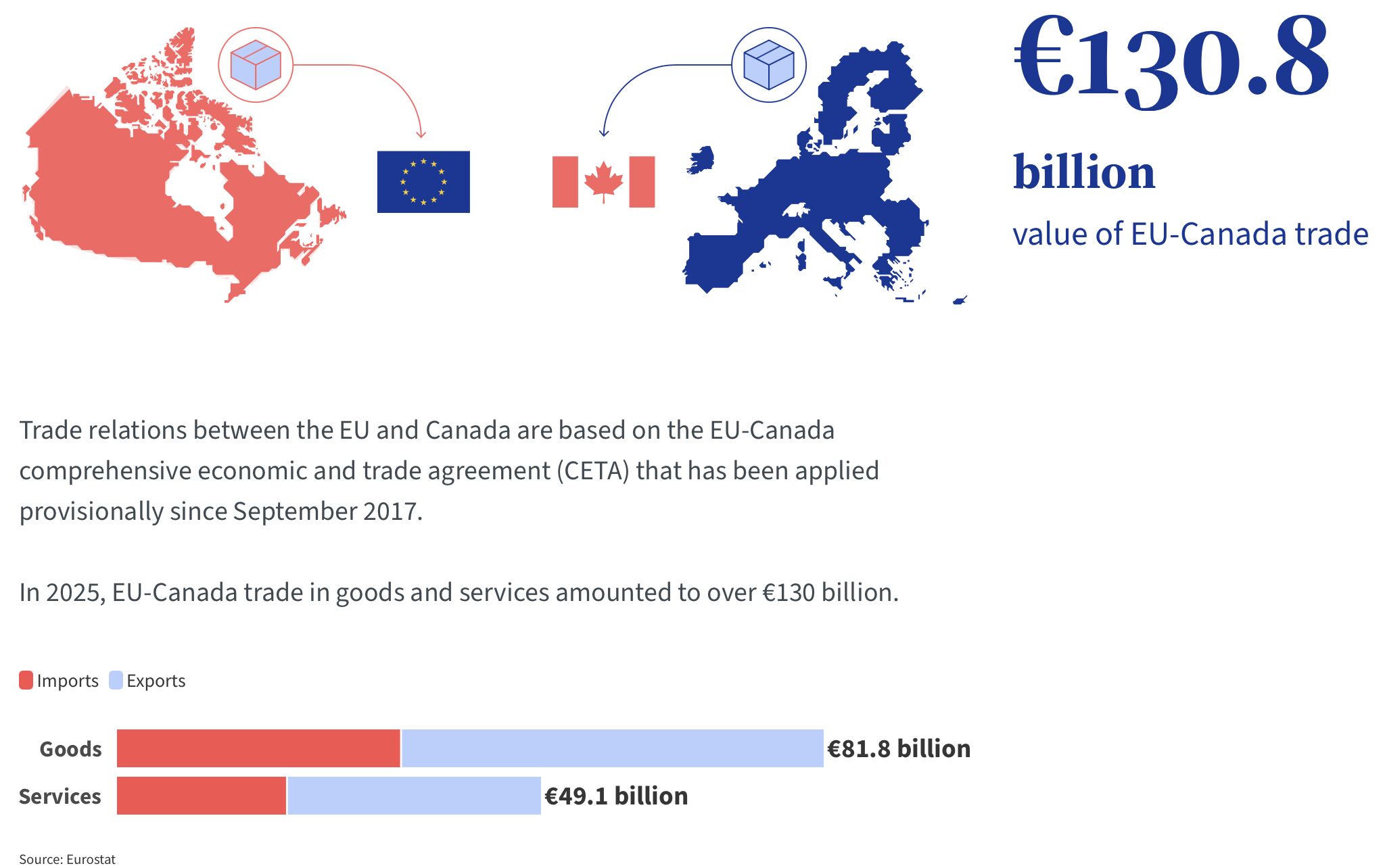
The figures put the scale of the pivot in context. In 2025, EU–Canada trade reached 130 billion euros. By comparison, bilateral Canada–United States trade amounts to 872 billion US dollars. At comparable currency and purchasing power, the second flow remains nearly six times larger than the first. This hierarchy will not change quickly: the United States still absorbs 72% of Canadian goods exports.
These data illustrate a reality: Canada is not seeking to replace its North American anchor, but to counterbalance it.
The Canada–EU rapprochement was not born with the latest American offensive. The Comprehensive Economic and Trade Agreement (CETA), in force since 2017, removed 99% of tariff lines between the two blocs. This opening has borne fruit: trade has grown by more than 80% in less than a decade, creating interdependencies in key sectors.
The trade tensions of 2025–2026 have transformed the strategic stakes: reducing Washington's ability to unilaterally constrain the Canadian economy. Ottawa has set an ambitious target: doubling its non-US exports by 2035. This imperative guides the current negotiations.
Actions go beyond political vocabulary. Canada signed a defence partnership with Europe in 2025 and gained access to the European SAFE military procurement programme in 2026. Four rounds of negotiations on digital trade have been launched. These sectoral advances are building an institutional architecture even before the "associate" status is formalised.
This sequence shows that the project goes beyond a mere means of pressure on Washington. It represents a lasting strategic reorientation, even if its staging strengthens Canada's bargaining position in the short term.
The complementarities between Canada and the EU are robust. Canada has critical minerals, uranium and energy resources sought after in Europe. Artificial intelligence, fundamental research, aerospace, financial and digital services offer solid bases for industrial and technological partnerships.
Several structural factors will nevertheless limit a complete substitution for North American trade. Physical distance, logistics infrastructure historically oriented towards the United States, and regulatory divergences will weigh on trade flows. The non-ratification of CETA by ten EU member states also slows bilateral momentum.
North American industrial integration, built over decades and crystallised by NAFTA, remains incomparable in depth and density.
The EU–Canada summit of 29 and 30 October 2026 will have to give substance to the inaugural announcement. Expected priorities include a digital trade agreement, pilot industrial projects, facilitation of professional mobility and possibly a formal negotiating mandate on "associate" status.
Deeper integration would take several years, requiring regulatory harmonisation and infrastructure investment. This measured timeframe underlines that the Canada–EU rapprochement belongs to a long strategic horizon, not to an immediate rupture.
Europe is on the way to becoming Canada's second strategic pillar, strengthening its resilience to American pressure. This diversification reduces the economic vulnerability of the Canadian federal state without calling into question its industrial and commercial anchor in the United States. The model is therefore not a substitution, but a rebalancing.
This is not investment advice.