October 21, 2026
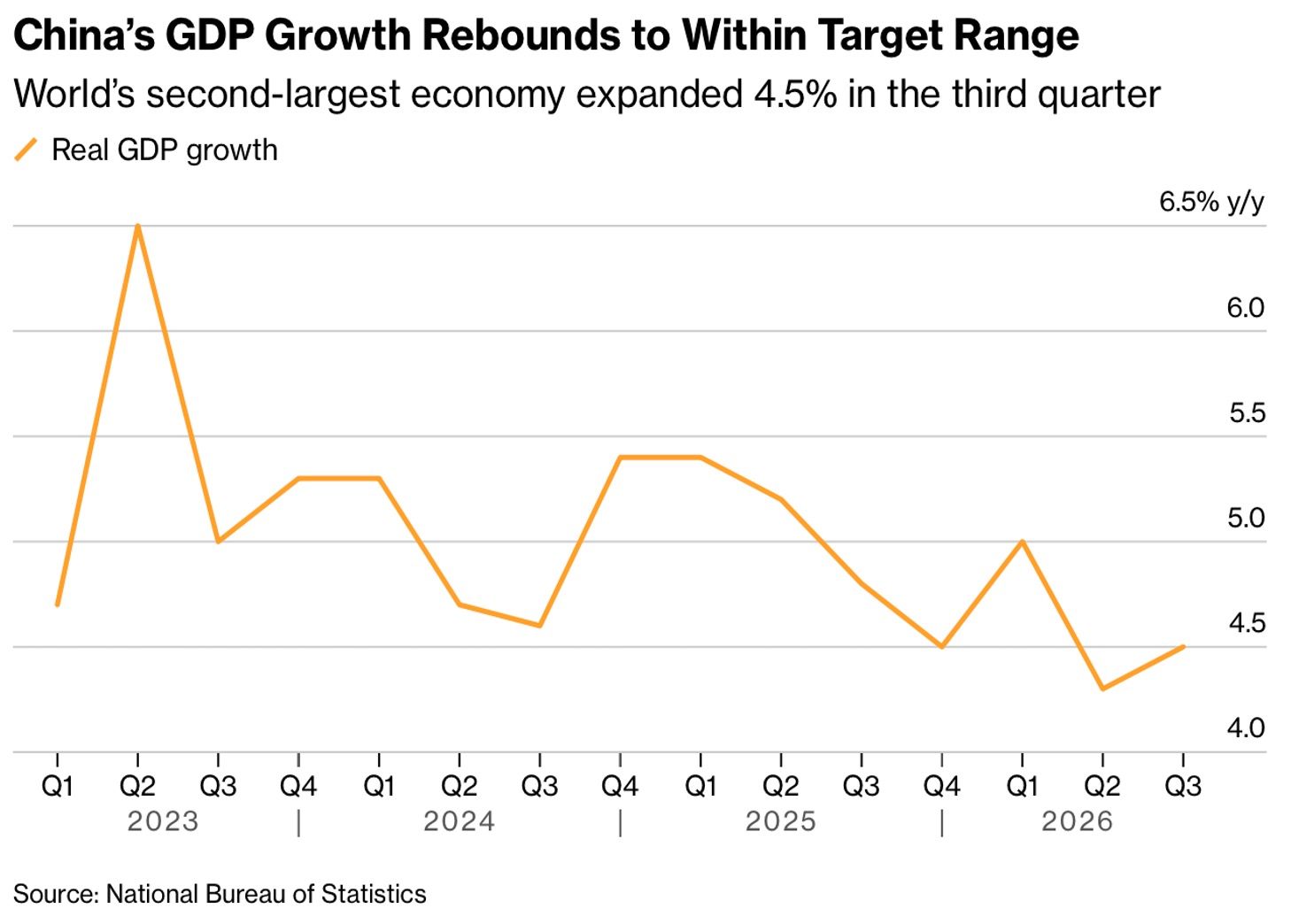
China is posting growth that has become steady again, but its fundamentals remain fragile. While manufacturing and exports drive the momentum, household confidence is eroding and private investment is contracting. This contrast reveals a structural challenge: turning industrial power into sustainable domestic demand.
In the third quarter, gross domestic product reached +4.5% year on year, against +4.3% in the previous quarter. Over nine months, growth stands at +4.6%, which keeps Beijing within its target range of 4.5 to 5% for the full year.
This moderate acceleration conceals very different movements across sectors. In September, industrial production jumped to +5.5%, while retail sales rose only 1.1% in value. These figures tell a simple story: industry produces, but consumers buy little.
The most dynamic segment remains high-technology manufacturing: +14.3% over nine months. Chinese companies are capturing a growing share of global investment linked to artificial intelligence and benefiting from sustained external demand for semiconductors, advanced components and IT equipment.
This expansion reflects a genuine move up the value chain by Chinese manufacturing. However, this trajectory has a downside: these high-technology activities are often automated. They generate revenue, but create relatively few jobs compared with the massive losses in construction and residential real estate, which long employed millions of workers.
These industrial gains do not flow sufficiently through to households in the form of wage income or fiscal transfers. At the same time, the destruction of real estate wealth sustains caution: consumers are cutting spending to rebuild their savings.
The real warning signal concerns private investment, which contracted 6.7% over nine months, even excluding the real estate sector. Real estate itself is collapsing, down 20.6%.
This generalised weakness cannot be reduced to a single factor. Interest rate cuts and credit easing should have stimulated corporate investment. Yet companies remain cautious. The reason is simple: cheaper credit does not encourage investment when visibility on outlets diminishes. Business leaders observe sluggish domestic demand and heightened uncertainty over trade. In this context, why increase production capacity?
One positive point deserves mention: services grow 5% over nine months, providing a buffer against the weakness of the real estate sector. Restaurants, transport, leisure and other service activities are holding up better, fuelled by domestic tourism and a degree of urban mobility.
Nevertheless, this resilience only partially offsets the fall in investment and the stagnation of real estate income. Consumers remain cautious, and overall consumption growth remains uneven.
On the price front, a striking contrast emerges: industrial prices rise 5%, while consumer inflation stands at only 0.9% in September. This divergence reveals that energy and components (critical inputs) are raising production costs, without final demand showing sufficient strength to justify these increases. In other words, companies are bearing higher costs in a soft demand environment.
China recorded a trade surplus of $938 billion over nine months. This external engine partially offsets domestic weakness and supports growth. However, this dependence creates a structural vulnerability.
China depends on foreign purchases of its manufactured and technological products. A slowdown in global investment in artificial intelligence, or the imposition of new trade barriers, would quickly weaken this growth lever. This balance is precarious: until domestic consumption recovers, exports will remain the main pillar.
For Europe and other exporting economies, this Chinese dependence on external outlets translates into increased manufacturing competition and less dynamic import markets. Europe in particular suffers from increased competition in key industrial sectors, while its hopes of growing Chinese demand for services are fading.
Beijing has room to strengthen support for the economy. Current data suggest that the annual growth target is once again within reach without new massive measures. This may justify holding off on additional support. However, this choice carries a risk: prolonging the weakness of domestic demand, which would keep China excessively dependent on external trade.
The structural challenge remains intact: turning manufacturing and technological power into well-paid job creation and rising household consumption. Without this transformation, Chinese growth will remain constrained, and external imbalances will deepen.
This is not investment advice.