October 16, 2026
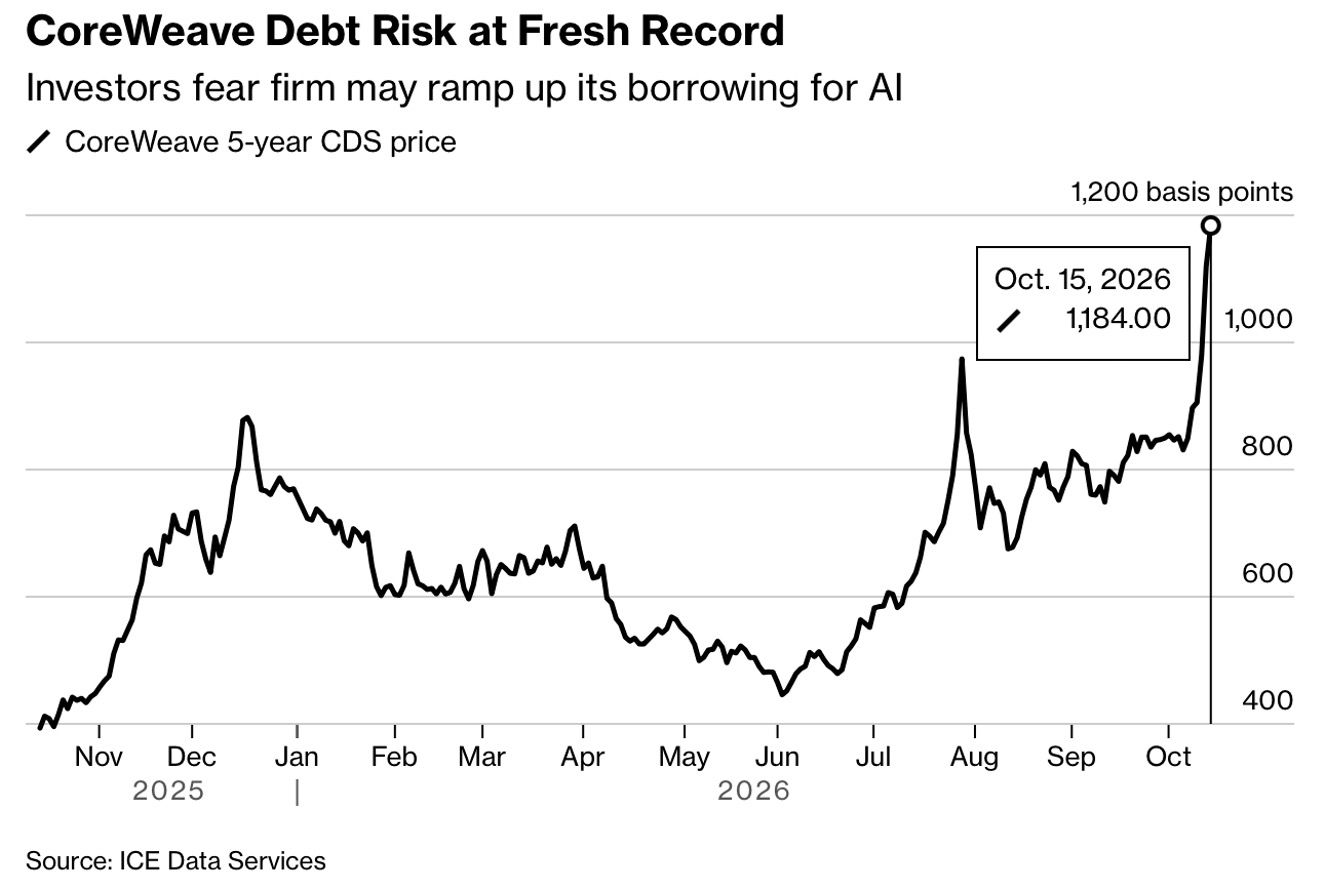
CoreWeave, a major provider of GPU infrastructure for artificial intelligence, faces growing tension between its massive financing needs and the availability of capital. On 14 October 2026, its share price fell 15.5%, reflecting market concerns. Beyond this particular stock, a broader question emerges: can the exponential growth of AI be financed indefinitely on current terms?
Signs of strain are multiplying. On 15 October, CoreWeave's five-year CDS (Credit Default Swap) spread reached nearly 1,195 basis points, a level that reflects a default risk perceived as significant. At the same time, several of the company's bonds are trading around 80% of par, offset by yields exceeding 15%.
These figures do not reflect an imminent crisis, but rather a reassessment of the risk profile. Investors are demanding a considerable premium to accept the uncertainty tied to CoreWeave's business model.
At the heart of the problem lies a fundamental timing mismatch. CoreWeave pays for its equipment (servers, GPUs, real estate infrastructure) before collecting the revenue generated by its use. Each new customer contract therefore increases financing needs before contributing to cash flow.
The end-June figures illustrate this: $35.1 billion of financial debt, supplemented by $16.3 billion of lease commitments. This funding base is proportionate to expected growth, but it imposes a permanent dependence on new capital.
Consider a strong-growth scenario. Even if revenue were multiplied by more than 3 between 2026 and 2028, adjusted operating income would remain below the net interest payable. In other words, the company's operations would not generate enough profit to service its debt. Investment would continue to absorb more cash than the business generates.
This dynamic creates a structural dependence: it is impossible to "grow" to financial equilibrium. At the same time, the chips and computing capacity installed must be made profitable before technological obsolescence erodes their value. It is a dual and demanding imperative.
Until recently, financing growth was an almost mechanical matter for AI players. The environment has changed on two fronts.
First, inflation is persisting beyond initial expectations. This revives the risk that interest rates remain durably high, increasing the marginal cost of each dollar borrowed.
Second, distrust is setting in within the technology sector itself. The difficulties other players have encountered in raising capital reinforce a natural caution among investors. The bond and financing market is tightening.
The 15% yield offered by CoreWeave's bonds does not apply retroactively to existing debt. However, it sets the price at which new financing will have to be raised. Strong demand for capacity can coexist with a cost of capital that has become incompatible with profitability.
The CoreWeave case raises a broader question: could the financing of AI infrastructure become a point of systemic fragility?
More difficult and more expensive access to credit can slow orders for chips, servers and data centres. The entire value chain, from semiconductor suppliers to real estate operators, would feel the effects. Outlooks would be revised in cascade.
NVIDIA, the main GPU supplier, has a direct interest in protecting its customers. Its commitment to purchase unused capacity offers a form of partial protection, but without guaranteeing all the debt. This support creates a closer interdependence between supplier, customer and financiers, redistributing part of the risk rather than eliminating it.
The risk would become truly systemic if losses weakened lenders to the point of restricting credit well beyond the AI sector. As a benchmark: a broad decline in technology stocks, even a pronounced one, does not in itself establish such a scenario.
CoreWeave embodies a growing tension in the AI sector: exponential growth requires exponential financing, in an environment where rates are high and sentiment less accommodating. Filling data centres is not enough; it must be shown that the equipment generates sufficient returns before obsolescence, while servicing a growing debt.
This dynamic does not mean an imminent collapse, but it signals that the underlying business model needs to be scrutinised. Investors are now willing to pay a significant premium for this risk. This market adjustment is in itself worth watching.
This is not investment advice.