October 14, 2026
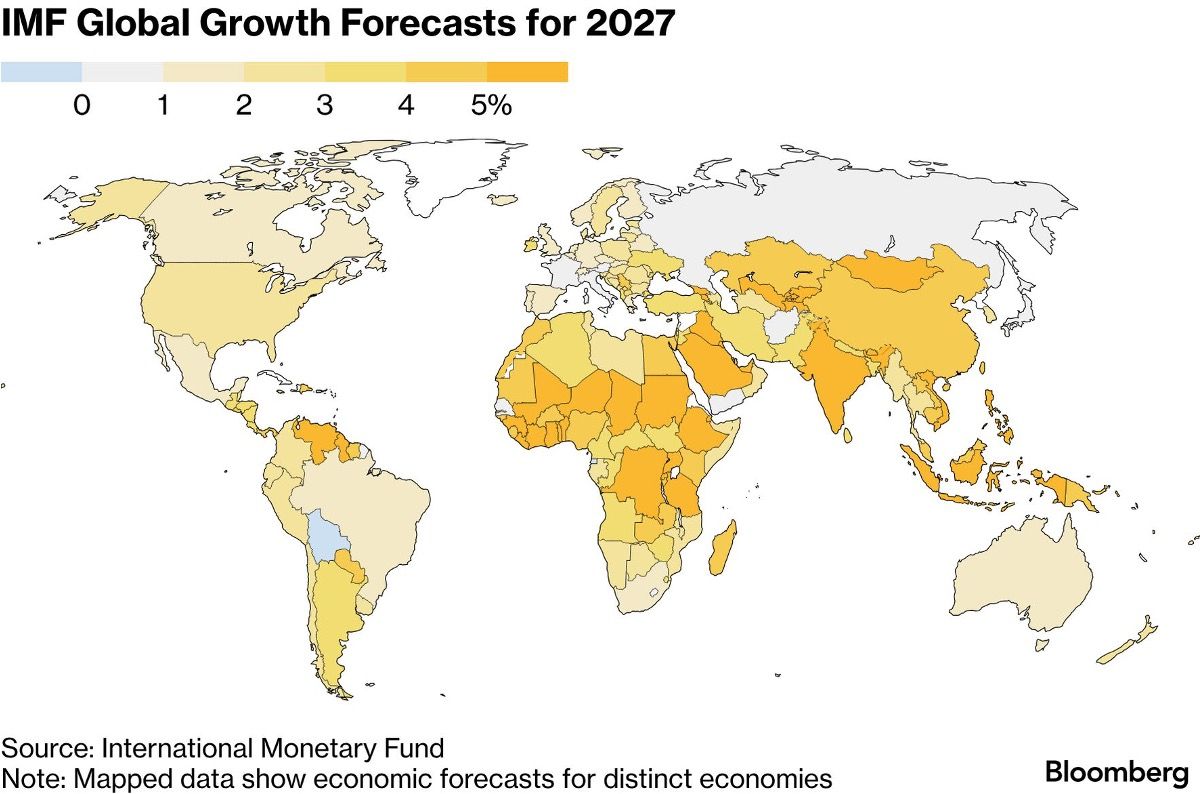
The International Monetary Fund maintains its growth forecasts for 2026 and 2027, but its latest report highlights a critical point: the capacity to absorb new economic shocks is eroding. Between the apparent stability of the figures and the implicit warning about accumulating risks, investors need to decipher where the vulnerabilities really lie.
The Fund slightly raises its global growth projections by 0.1 point for 2026, taking the rate to 3.1%. For 2027, it maintains 3.4%. Inflation, meanwhile, is rising: 4.7% in 2026, then 4.1% in 2027, an increase of 0.2 point for the following year.
These headline figures mask very contrasting trajectories. The United States stabilises its growth at 2.3% in both years. France, by contrast, shows much weaker momentum: 0.4% in 2026 and 0.7% in 2027, revised down by 0.2 point each year. This disparity between the major advanced economies already heralds potential tensions on exchange rates and capital flows.
The energy shock has eased thanks to several factors: increased oil production outside the Gulf, the use of alternative trade routes and the gradual reduction in dependence on hydrocarbons. These adjustments have cushioned the initial impact.
However, a fragile mechanism supports this apparent balance: global energy stocks are being drawn down to compensate for insufficient supply. This buffer strategy does not restore the supply-demand balance in a lasting way. Once the reserves are exhausted, the dynamic reverses quickly.
Artificial intelligence is currently supporting capital expenditure and technology exports. But the IMF raises an important methodological point: its central growth forecasts incorporate no additional productivity linked to the adoption of AI.
In other words, the scenario assumes that the potential gains do not yet offset the costs incurred. The investments are tangible; the returns remain theoretical. This timing asymmetry contains a major risk: if companies and governments spend today in anticipation of returns that are slow to materialise, the investment-disappointment cycle can accelerate quickly.
A further element shapes the 2027 projections: the IMF assumes a gradual reopening of the Strait of Hormuz from March and a return to pre-crisis conditions around October. These two assumptions support the rebound scenario. They nonetheless remain contingent.
A structural danger emerges from this conjunction. AI massively increases electricity needs precisely at a time when energy remains under strain. The technology engine therefore assumes a security of electricity supply that does not exist everywhere and that may deteriorate.
If spending on AI infrastructure and energy exceeds available capacity, it pushes up the prices of equipment and electricity before productivity improves users' margins. This intermediate inflation erodes expected returns and can discourage investment.
The IMF considers a technology recession scenario. If AI productivity gains disappoint massively, investment contracts, markets fall, and financing conditions tighten immediately.
In this context, global growth in 2028 would be 1.1% below the central scenario, and that of the United States 1.8% below. An amplification of this order is not marginal. It would add to government balance sheets already weakened by debt: governments would have reduced budgetary resources to compensate or cushion.
Building capacity is no longer enough. Governments and companies must convert their investments into tangible revenue and cash flow. This conversion is never guaranteed. It depends on actual adoption, competition and regulatory trade-offs.
Several contradictory forces may act simultaneously: weak growth, high energy costs and large public deficits. This combination has rarely fed stable long rates. It signals a latent risk premium, whose size depends on the perceived credibility of governments.
Beyond press releases, two variables deserve constant attention: first, the evolution of global and regional energy reserves; second, actual measures of productivity outside technology, which reveal whether the real economy is genuinely benefiting from AI spending.
The central paradox of the IMF report is this: growth is confirmed, but the flexibility to absorb surprises is eroding. Each mechanism mobilised (energy stocks, AI investment, public debt) reduces future room for manoeuvre. A new incident, even a moderate one, can trigger a disproportionate reaction.
This is not investment advice.