September 14, 2026
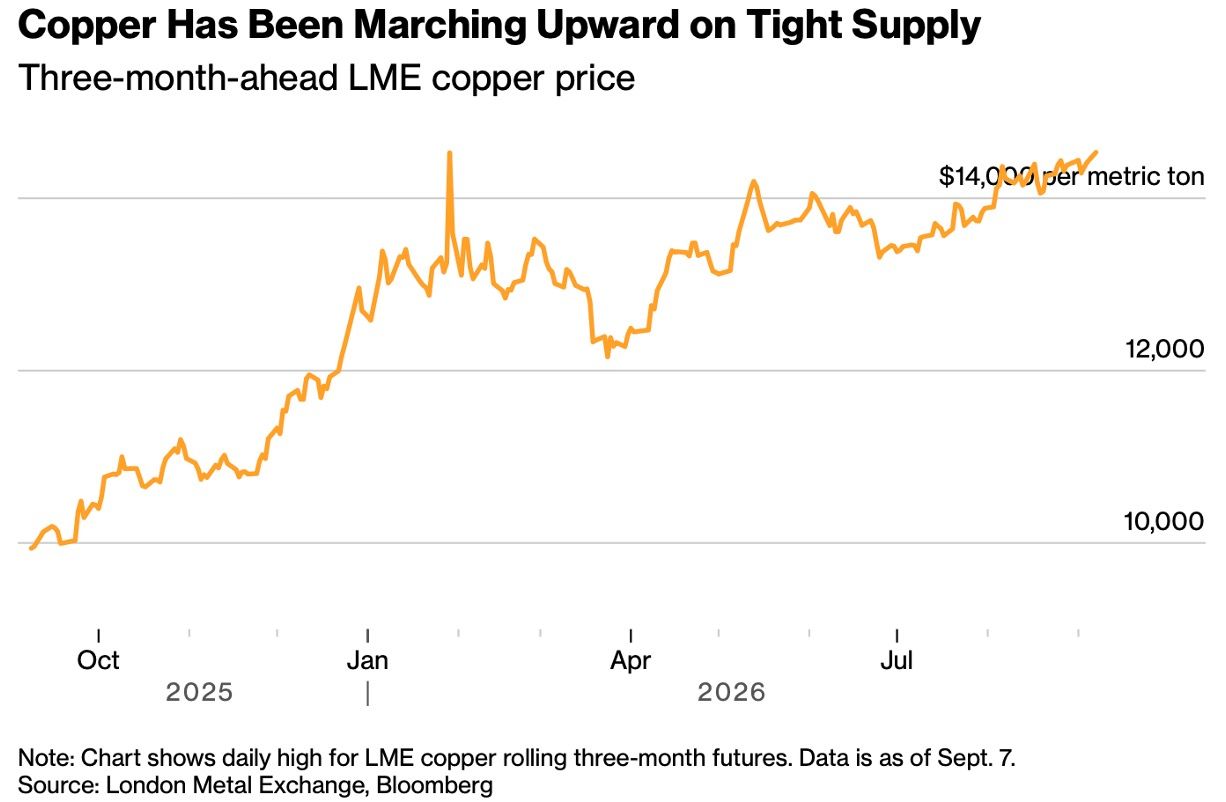
Copper has had a mixed trajectory, exceeding $14,800 a tonne on the London Metal Exchange before a correction linked to US trade uncertainties. Behind this short-term volatility lies a persistent structural equation: constrained mining supply against continuously growing electrical demand.
Copper's recent volatility can only be understood in the context of US trade policy. For more than a year, the prospect of tariffs on refined copper has encouraged traders to redirect metal massively towards the United States, in anticipation of an import levy.
This logistical flow has created a paradoxical situation: copper is not necessarily scarce globally, but a significant share of the available stock has become concentrated in the United States awaiting tariffs. Market data reflect this build-up: official COMEX inventories reached nearly 680,000 metric tonnes, roughly eight times their level of early 2025. Including metal held off-exchange, total US stock is estimated at more than 1 million tonnes.
Washington's recent hesitations over applying these tariffs logically triggered a correction. Less tariff risk means less incentive to stockpile copper in the United States. After ten weeks of gains, a significant part of the speculative and logistical premium proved vulnerable.
The easing of the spot market confirms this interpretation. In August, the cash/3-month spread had exceeded $500/t, a signal of extreme tension on immediate deliveries. This spread has come back to around $10, indicating a normalisation of very short-term tension. This rapid fall in backwardation reflects the relative abundance of metal available in the United States once tariff concerns eased.
The tariff correction should not, however, overshadow the underlying reality of the copper market. Mining supply remains structurally constrained for the years ahead.
On the production side, several factors limit a rapid expansion of supply. Ore grades are gradually declining, forcing producers to process growing volumes to extract the same quantity of copper. Permitting times are lengthening. New projects face major energy and water challenges. Operational accidents and rising production costs slow capacity development. Beyond these obstacles, a full mining development cycle can exceed fifteen years, creating a structural lag between current market needs and future supply.
On the demand side, the electrical trajectory is accelerating. Power grids are being modernised and extended. Manufacturing of transformers, cables and electrical equipment is growing. The electric vehicle fleet is expanding. Renewable energy installations are multiplying. Data centres are developing massively, driving growing infrastructure needs. Although AI still directly consumes only a modest share of global copper, its impact comes mainly through the acceleration of basic electrical infrastructure needs.
At price levels of $14,000 to $15,000 a tonne, copper significantly increases the cost of cables, electrical equipment, grids and industrial infrastructure. A lasting rise in industrial metals can slow the disinflation process, even without a fresh acceleration in wages or services. This is an often underestimated channel for transmitting raw material cost shocks to final prices.
The structural equation taking shape remains tight: constrained, slow-growing mining supply against electrical demand advancing on several fronts simultaneously. Episodes of short-term volatility, such as the one observed recently, do not call this underlying dynamic into question.
This is not investment advice.