October 27, 2026
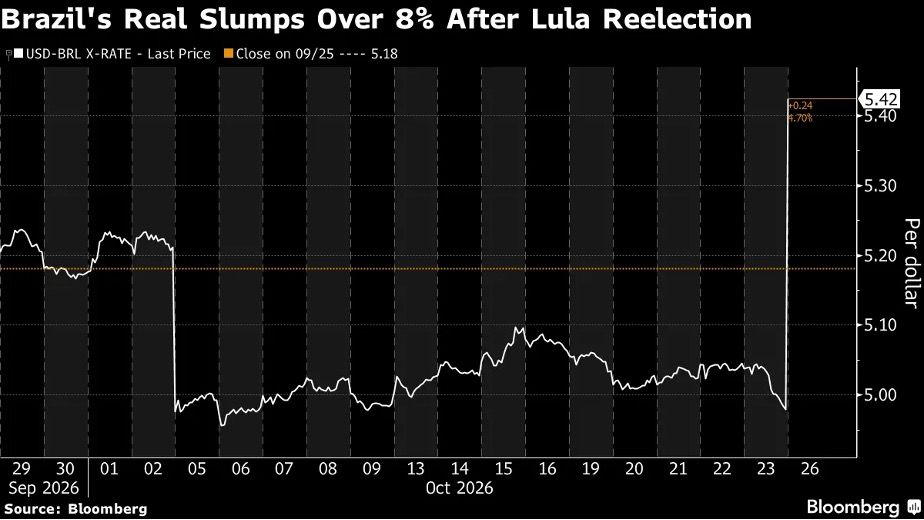
On 26 October 2026, Brazil surprised financial markets. Lula's electoral victory with 51.8% of the vote, against 48.2% for Flávio Bolsonaro, triggered a sharp correction: the Ibovespa plunged 17%, the real lost 11% against the dollar and 10-year sovereign yields jumped to 15.5%. This episode illustrates a fundamental paradox: markets are not infallible, and anticipation errors can generate shocks out of proportion to economic reality.
Before the vote, investors had built their portfolios on one premise: a Bolsonaro victory. This expectation rested on the hope of lower public deficits and a gradual reduction in policy rates. Brazilian equities had posted significant gains on this basis.
The electoral outcome reversed the scenario. Lula returns to power, bringing with him a different policy orientation. The immediate market shock therefore reflects two intertwined phenomena: on the one hand, the brutal scale of the unwinding of positions built the wrong way round; on the other, legitimate concerns about Brazil's macroeconomic trajectory under this government.
Some assets, notably small caps, recorded declines of 30%, forcing temporary trading halts. Such volatility is not unusual when a market consensus suddenly breaks apart.
Beyond the electoral anticipation effect, Brazil's macroeconomic indicators reflect real structural challenges.
Public debt is approaching 83% of GDP. The total deficit is close to 9.5%. These levels leave little room for expansionary policies without consequences for financing costs and inflation.
The policy rate stands at 13.75%. This high level reflects the central bank's efforts to contain inflationary pressures. Yet the policy announced by Lula favours stronger social transfers, support for consumption and credit expansion.
Without credible and sustainable financing for these measures, the risk is tangible: they could fuel inflationary pressures, slow the decline in policy rates and increase the cost of sovereign debt. This vicious circle would progressively penalise the real economy.
Persistently high rates would hold back productive investment and real estate. For households, already heavily indebted in a high-rate environment, credit conditions would remain restrictive. A weak real is double-edged: it benefits some exporters, but makes imports more expensive, affecting purchasing power and production costs.
Lula maintains his goal of ending net deforestation in Brazil by 2030. This continuity is favourable to ecosystem protection and to climate finance mechanisms. However, the government is also pursuing oil projects, revealing the tensions between environmental ambitions and the need for budget revenues.
Brazil is not an isolated market. The world's leading soybean exporter and a major player in iron ore, oil and strategic metals, it holds a central position in global supply chains. Its closer ties with China and its desire for relative autonomy from the United States amplify its role in redefining global trade balances.
Persistent inflation in Brazil and a weak real would directly affect the prices of key commodities, influencing costs for developed and emerging economies that import these resources.
Markets are now reacting to a twofold uncertainty: the electoral anticipation error and the lack of clarity on credible financing for the new government's fiscal ambitions. The next economic decisions—tax reform, structural measures, debt refinancing—will be decisive in restoring confidence.
This Brazilian sequence recalls a fundamental truth of financial markets: they are not omniscient. Sharp corrections reflect collective anticipation errors as much as legitimate economic concerns. Distinguishing one from the other remains one of the most difficult tasks for investors.
This is not investment advice.