September 5, 2026
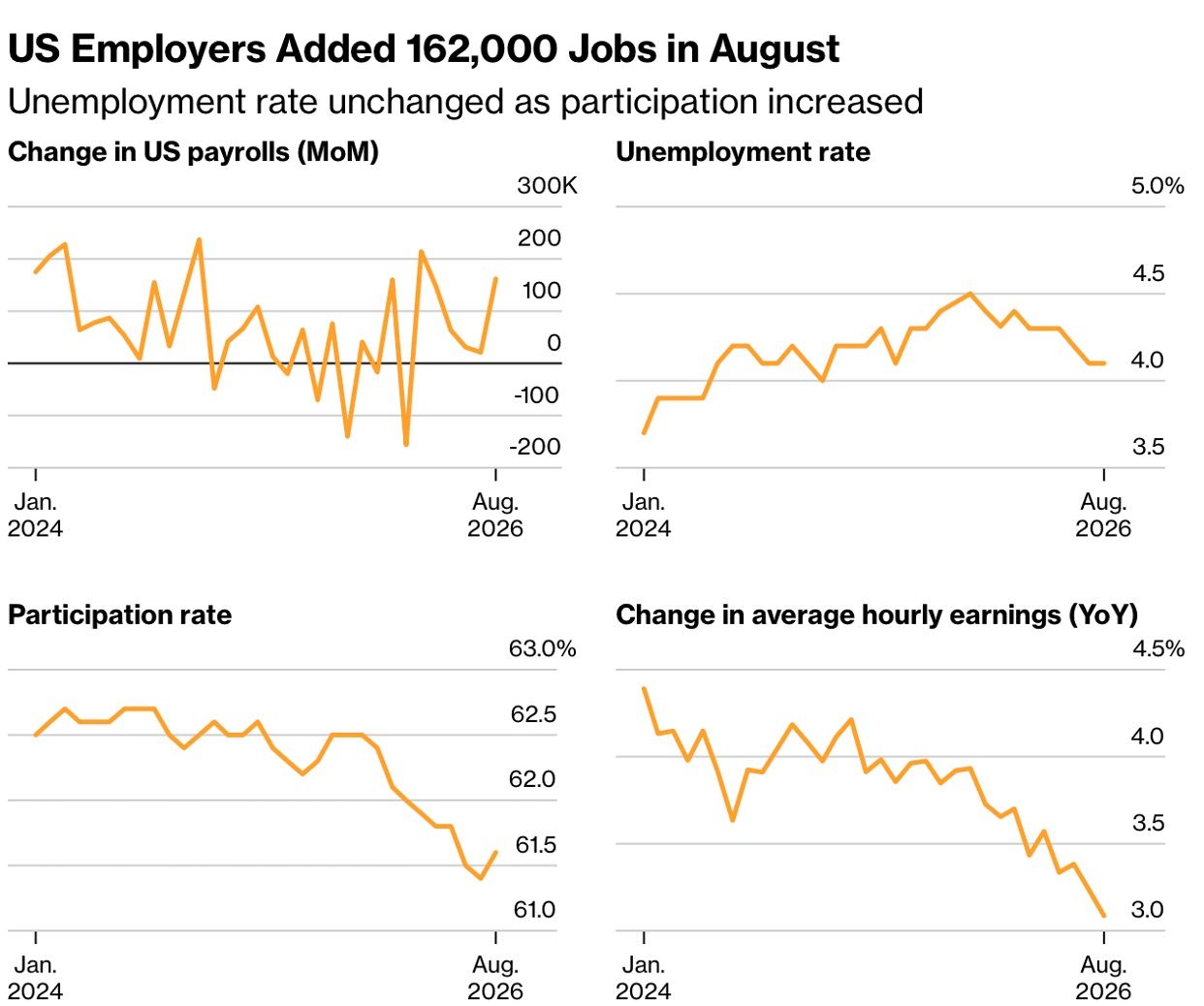
US job creation in August far exceeded expectations, strengthening the case for a Federal Reserve rate hike. Yet this strong figure conceals contrasting dynamics: a labour market that is recovering, but without apparent wage overheating. The September decision remains open and will depend above all on inflation.
Employment rose by 162,000 positions in August, well beyond expectations. This strength comes with upward revisions: June and July together gained 55,000 jobs. The unemployment rate holds at 4.1%, while labour-market participation rose to 61.6%, a signal of improvement on the labour-supply side.
Hourly wages rose 0.3% over the month and 3.1% year on year, reflecting slight inflationary momentum but no explosion.
The rebound is not concentrated solely in cycle-sensitive sectors. Manufacturing created 43,000 jobs in three months, its best run since late 2022. Over six months, goods-producing employment is up 0.6%, against 0.4% in services, pointing to a favourable rotation.
Construction is adding an average of 11,000 positions per month this year. More significant still: investment in data centres, semiconductors, defence and the pharmaceutical industry is now directly supporting employment. This diffusion is reassuring about the economy's resilience but also illustrates two-speed growth: a powerful wave of investment linked to artificial intelligence is offsetting weakness in certain service activities.
The rebound includes a non-negligible seasonal component. Local public education added 42,000 jobs after a sharp fall in July. Adjustments in leisure and hospitality (linked to one-off events) complicate the reading of the raw data.
The monthly figure also needs to be put into perspective: job creation only slightly exceeds 70,000 on a three-month average. Participation among 25-54 year-olds is not recovering, and wages are now rising more slowly than inflation. The labour market therefore shows no obvious sign of wage overheating, a key point for monetary analysis.
Stronger employment reduces the risk that a rate hike would quickly cause a sharp deterioration in economic activity. This is the first effect: the Federal Reserve has more freedom to adjust its stance.
Immediately after the release, the probability of a hike in September rose from 51% to 63%. This move, however, only brings expectations back to their level of barely two days earlier, revealing the underlying instability of the consensus. The decision remains open and will depend above all on the next inflation figures.
Employment removes one obstacle to a rate hike. But only inflation can still give the Fed sufficient reason to act in September. Without confirmation that inflationary momentum is intensifying, a hike could appear premature or poorly calibrated.
An additional difficulty adds to the monetary calculation: political pressure. A rate hike becomes more costly politically, while holding rates could already appear an acceptable compromise. This context does not change the economic logic, but it frames the institutional room for manoeuvre.
The August employment data are reassuring about economic resilience and justify greater flexibility for the Fed. They do not, however, settle the question of a hike in September. Inflation and the next macroeconomic data will remain the real pivots of the monetary decision in the short term.
This is not investment advice.






