August 26, 2026
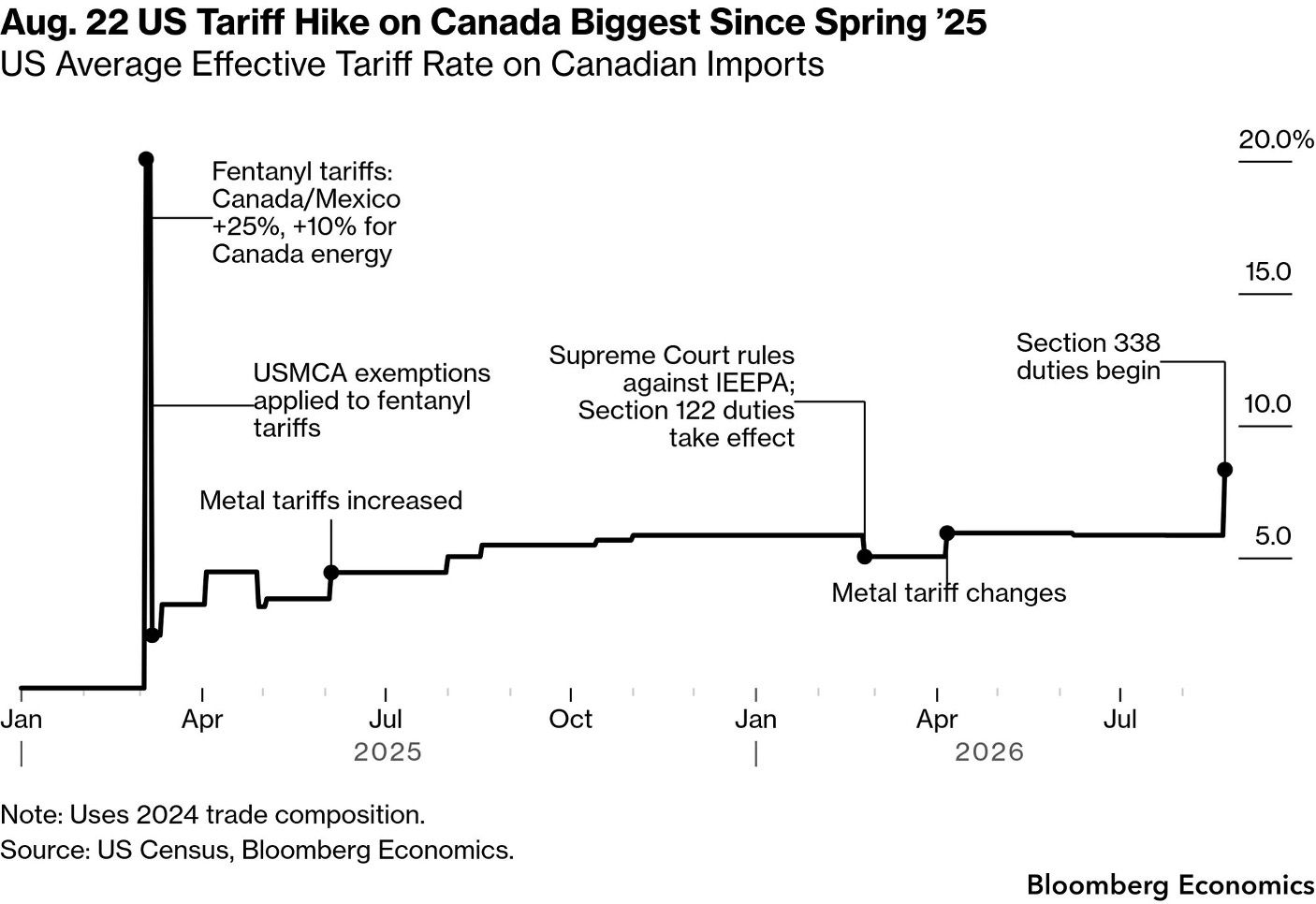
Trade tensions between Washington and Ottawa have crossed a critical threshold. After the failure of negotiations, the United States imposed massive tariffs on Canadian products, and Canada is preparing a symmetrical response. Beyond the bilateral trade figures, this confrontation reveals a struggle to redefine the balance of power in North America and tests the ability of a middle power to resist trade coercion.
Canada is not an ordinary trading partner for the United States. With $872 billion in annual trade, the bilateral relationship structures the Canadian economy far more than the reverse. Canada exports 76% of its goods to the United States, a concentration that represents 15.9% of its total GDP. This fundamental asymmetry explains why every move by Washington provokes existential reactions in Ottawa.
The breakdown of negotiations triggered unprecedented tariff measures. Washington first imposed 50% tariffs on $20 billion of Canadian products, on top of existing measures on steel, aluminium and automobiles. In response, Ottawa announced retaliation for 8 September: tariffs of 15%, 25% or 50% hitting more than 700 American products for a total of C$27.6 billion. This response is described as “dollar for dollar”.
This conflict is not only about tariff percentages. Negotiations had seemed close to a compromise: partial reductions on metals and automobiles, Canadian concessions on American spirits and digital services, a revival of the Keystone XL project. But Washington hardened its demands on heavy trucks, steel and aluminium.
More revealing still: the United States demanded direct influence over Canada's future trade agreements and over certain cultural and linguistic rules. This is not only about protecting American industries, but about placing Canada within a “North American fortress” steered by Washington. For Ottawa, accepting such conditions would have meant accepting a loss of sovereignty with no guarantee of lasting stability.
This calculation explains the change in Canadian strategy. The concessions granted under the previous leadership brought no stability. Canada therefore opted for a different approach: making Washington understand that escalation will also carry a cost for the United States.
The balance of power remains deeply asymmetric. But Canada has levers that few middle powers possess. It supplies 63% of the crude oil imported by the United States, almost 100% of its natural gas and 81% of its imported electricity. These figures are not abstractions: they represent jobs, industrial margins and purchasing power in the United States.
The Canadian bet is not to win a “trade war”, a notion that is itself questionable. It consists of convincing Washington that pressure on Canada generates domestic costs high enough to justify a compromise. Canada is also targeting American exports from politically sensitive states, amplifying this electoral calculation.
This confrontation is unfolding in a broader geopolitical context. The contrast is striking: Washington applies 50% tariffs to its Canadian ally, but is preparing an additional tariff of only 7.5% on China, with a view to preserving a truce ahead of a planned meeting between Trump and Xi Jinping on 24 September.
The world is therefore watching a central question: can a middle power resist American trade coercion, or does the tariff threat remain the decisive instrument of negotiations? A Canadian retreat would strengthen the strategy of threat. A balanced compromise would demonstrate that a targeted and credible response can change Washington's calculation. The coming weeks will determine not only the fate of North American trade, but also how middle powers negotiate in an environment of trade coercion.
This is not investment advice.