August 25, 2026
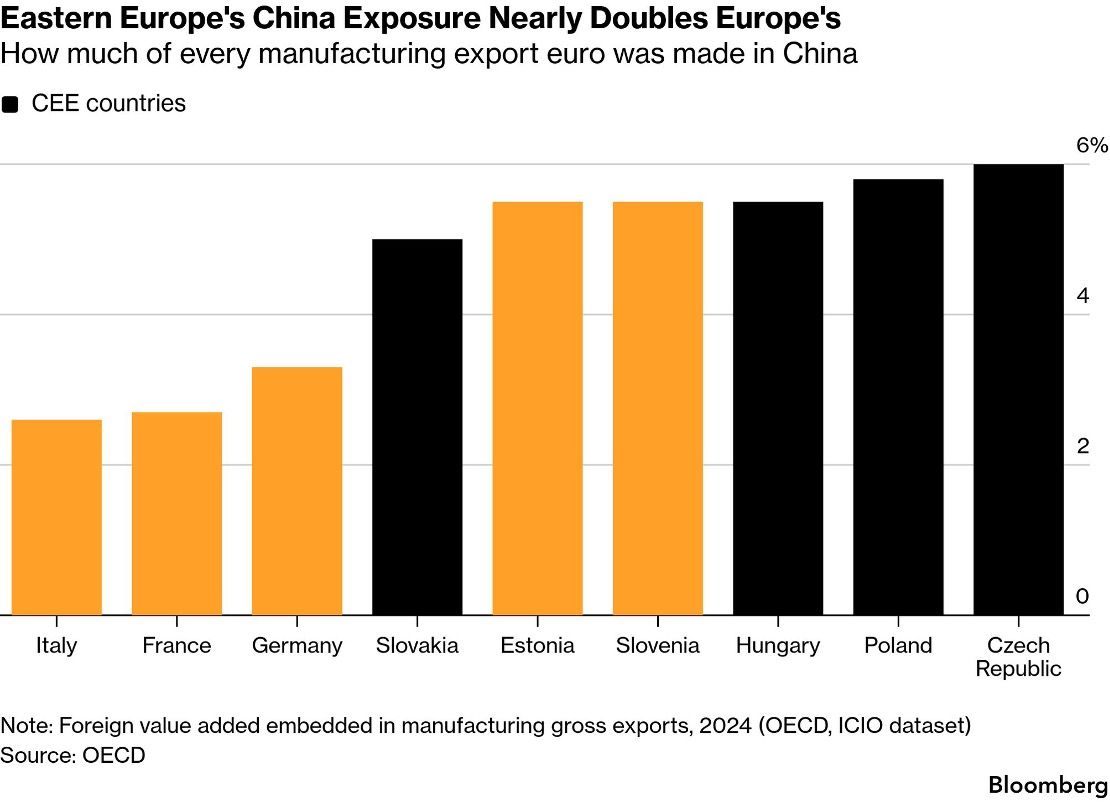
Central Europe long served as Germany's industrial back office, offering competitive costs and unrivalled logistical proximity. This model, built on three decades of specialisation, is changing rapidly. Two forces now shape its future: the reorganisation of German production in the face of its energy and trade fragility, and the strategic arrival of Chinese investors seeking a gateway to the European market.
Since the 1990s, Central Europe has been built around a clearly defined role: hosting the low-cost production of German industrial groups. Slovakia is the most striking illustration. Volkswagen Group set up there as early as 1991; its Bratislava plant today employs around 11,000 people and remains one of the group's major automotive hubs.
This model rested on three pillars: labour and energy costs significantly lower than Germany's, seamless integration into the European single market, and geographic proximity allowing tight logistics with German decision-makers and suppliers. It proved durable as long as Germany retained its industrial power and Chinese demand absorbed massive exports of vehicles and machinery.
Three simultaneous shocks are now weakening this productive architecture. First, the cost of energy. Germany, long endowed with competitive electricity, faces a structural rise in energy prices that erodes its cost competitiveness. Second, weak demand. German manufacturing is experiencing a slowdown that reduces orders to Central European suppliers and subcontractors.
But the deepest shock is technological and competitive. China no longer plays the role of passive outlet for European industry. It has itself risen to become a direct competitor in the decisive sectors: electric vehicles, batteries, machine tools and industrial equipment. This Chinese move upmarket captures a growing share of global demand and destabilises the German export model.
Faced with this reality, Central European governments have adopted a clear strategy: rather than passively enduring Chinese competition, attract it. Hungary and Slovakia are deploying substantial incentives for Chinese groups to establish plants on their soil. The stakes are high: retaining foreign investment, manufacturing employment and the productive capacity that the decline in German demand would otherwise threaten.
The figures illustrate this dynamic. In Slovakia, Volvo Group (controlled by GEELY) is investing €1.3 billion in an electric vehicle plant near Košice. In parallel, GOTION HIGH-TECH is committing more than €1.2 billion to a battery factory. These two projects crystallise a major shift: the automotive technology of the future is settling in Central Europe, no longer on German initiative but on that of Asian groups.
This trend is accompanied by partial German relocation. Around 25% of German companies are considering moving some production to Central and Eastern Europe, while 41% plan to invest there. Energy costs, regulatory pressure and geopolitical risks are pushing Berlin to review its productive geography.
For Beijing, setting up production in South-East Europe answers a threefold logic. First, proximity to the end customer. Producing locally shortens logistics lead times and improves commercial responsiveness to fragmented European demand. Second, reducing trade risk: tariffs and trade restrictions hitting products made in China can be partly circumvented by intra-EU production. Finally, a question of legitimacy: producing on European soil gives the appearance of a “local product” likely to foster acceptance by customers and regulators.
For Central Europe, the window is indeed open. It can capture both direct Chinese investment (batteries, automotive electronics, machinery) and the relocations of German companies cutting their energy costs. This is an unprecedented opportunity for industrial renewal: abandoning the narrow specialisation of German subcontractor to become a crossroads attracting diverse investors.
But the risk is at least as clear as the opportunity. If Central Europe captures only final assembly, while design, engineering, critical components and capital control remain in China or Germany, it will have exchanged one dependence for another. Value added, know-how and profitability would remain captured elsewhere. Assembling Chinese batteries with Slovak labour enriches the region only marginally.
To turn the opportunity into lasting success, Central Europe must simultaneously attract tier 1 and tier 2 suppliers, invest in engineering skills, create applied research ecosystems and negotiate technology transfer commitments with Chinese investors. This is ambitious, but achievable: it is exactly what some Asian regions have accomplished in two decades.
This is not investment advice.






