September 23, 2026
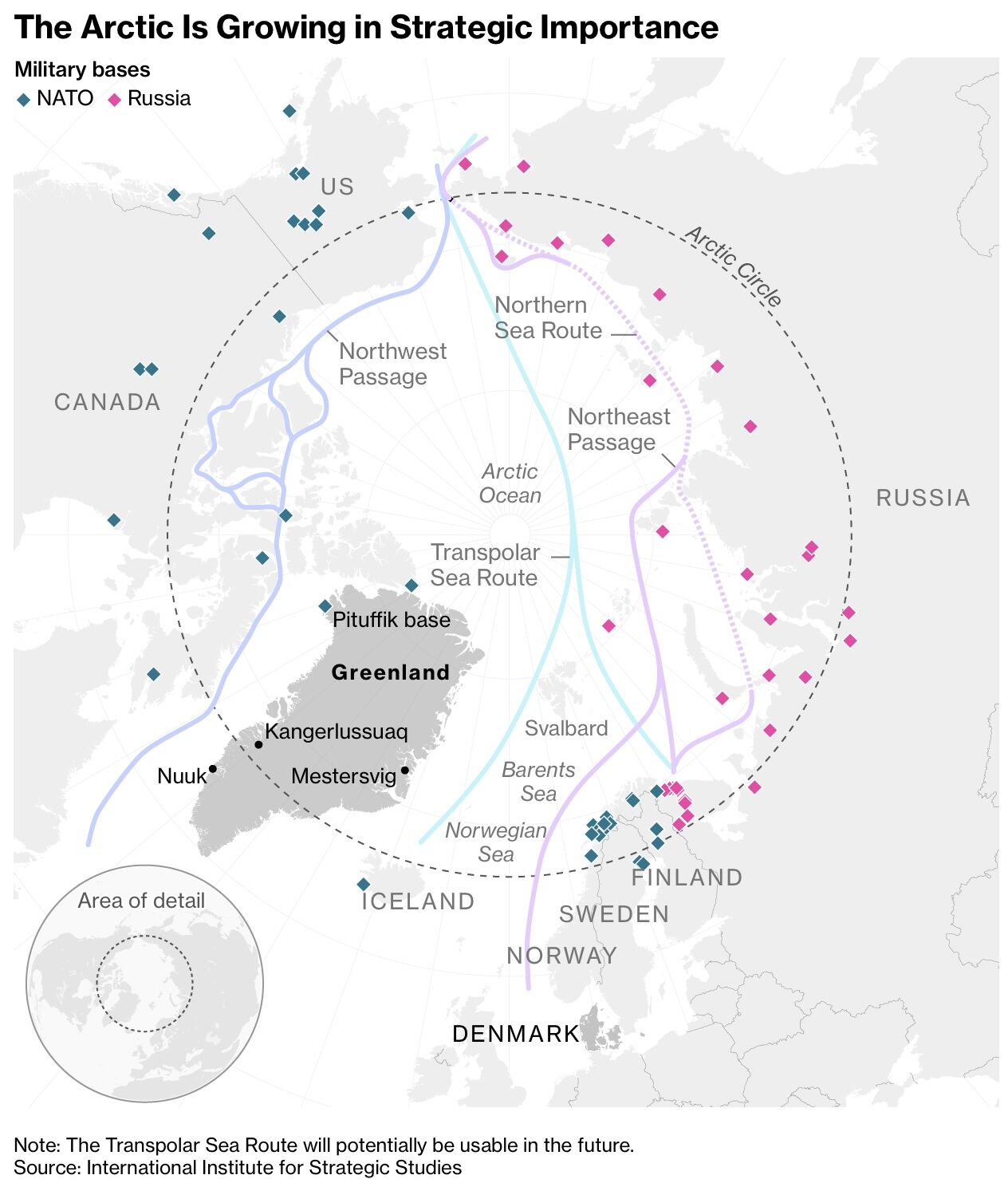
In September 2024, a revised agreement between the United States, Denmark and Greenland modernised the defence framework dating from 1951. Although Greenland retains its sovereignty and rejects any annexation, the text significantly extends the US military footprint in the Arctic. This development responds to growing geopolitical stakes: surveillance of the Atlantic approaches, limiting Chinese influence over critical minerals, and consolidating NATO's defence in the face of regional tensions.
The agreement signed on 22 September 2024 updates the 1951 one, concluded at the height of the Cold War. Since that date, the United States already had the right to maintain military forces, build facilities, move around and overfly Greenland, but subject to specific agreements for each new area.
The revision retains this architecture: Greenland remains under Danish sovereignty and fully retains its right to self-determination. No clause grants the United States partial sovereignty, a general right over minerals, or unilateral power over the territory. Washington only obtains the extension and clarification of military rights that already existed.
The text provides for the modernisation of Pituffik (the air base in northern Greenland), notably to contribute to the Golden Dome missile defence project intended to monitor the Arctic approaches. Two new sites are planned: Narsarsuaq and Mestersvig. The precise terms of their development remain to be negotiated between the parties.
One notable element: a fast-track procedure is provided for military facilities without permanent personnel, simplifying one-off deployments or troop rotations.
For the first time, the agreement makes US undersea access rights explicit. This clarification responds to the emergence of Arctic competition: submarine surveillance, control of new shipping routes, detection of foreign naval activity. An exclusivity clause is included: no state outside NATO will be able to maintain a lasting military presence in the area.
This provision is aimed primarily at Russia, but also at any third party that could exploit the absence of Western control. It also applies to the two straits of northern Greenland, strategic transit points.
The agreement includes a clause addressing Greenland's independence. Should a political separation from Denmark occur, an independent Greenland would have either to take over these military agreements or to apply to join NATO. This wording formally preserves Greenlandic sovereignty while structurally anchoring the territory in the Western architecture.
Contrary to the initial demands, Greenland's minerals are not directly transferred to the United States. However, the agreement includes a clause for screening “sensitive” foreign investments in critical materials (rare earths, lithium, nickel). This provision indirectly targets China, a major player in Arctic mining investment.
The exact mechanism of this screening remains vague in the published text, but it reflects a desire to limit Chinese economic penetration of resources crucial to the global energy transition, without resorting to nationalisation or direct transfer.
The arrangement expands NATO's surveillance capacity in the Arctic along three dimensions: ballistic missile (radars and detection of Russian launches), air (coverage of the North Atlantic approaches) and maritime/undersea (areas hitherto less controlled). This coverage makes any Russian power projection towards the North Atlantic more difficult.
Even so, the agreement does not entirely resolve questions about US credibility in the Arctic: the United States had already maintained a minimal capacity on the ground since 1951. The announced expansion remains gradual.
Trump promised an agreement at no cost to the United States, an assertion not borne out by the official text. It specifies neither the funding of the modernisations nor the amounts of US aid to Greenland. This budgetary opacity creates ambiguity about the long-term economic viability of the announced military commitments.
The 2024 agreement updates the Cold War for the era of Arctic competition. Greenland emerges unscathed from the threat of annexation and preserves its formal sovereignty. But its territory becomes more closely integrated into the Western defence arrangement, with implications for its internal political stability and its relations with other regional actors.
For NATO, it is a welcome reinforcement in the face of growing tensions in the Arctic. For the United States, it is a visible return to the Arctic front line after decades of minimal deployment. For China and Russia, it is the assertion of a Western lockdown over a strategic region.
This is not investment advice.