September 25, 2026
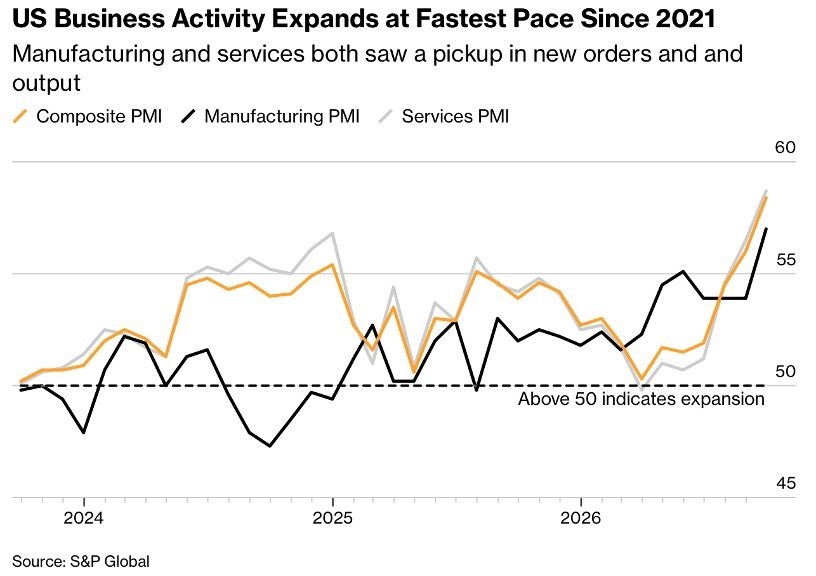
The US composite PMI has reached its highest level since July 2021, signalling a marked economic acceleration in September 2026. Far from a recession or stagflation, the US economy remains in a phase of sustained expansion, fuelled by investment in artificial intelligence, infrastructure spending and consumption by affluent households. This favourable growth trajectory nevertheless has a counterpart: inflationary pressures persist and bond yields are rising, tightening financial conditions.
Activity indicators converge towards an economy in robust expansion. The composite PMI rose from 56 in August to 58.4 in September, its highest since July 2021. Services posted a reading of 58.7 and manufacturing 57, reflecting a broadly shared improvement.
These data correspond to annualised growth close to 5% in September. The Federal Reserve Bank of Atlanta's GDPNow model estimates third-quarter growth at 5.1%, of which 4.1% driven by consumption. The Fed's outlook for 2026 projects growth of 2.3%, an unemployment rate of 4.1% and PCE inflation of 3.7% (3.4% excluding food and energy).
None of the three major catastrophe scenarios is present: orders, employment, consumption and investment are rising simultaneously, ruling out a recession; activity is accelerating rather than stagnating, ruling out stagflation.
This expansion is not a “Goldilocks” scenario – neither too hot nor too cold. Companies face rising costs, lengthening delivery times and the return of hiring difficulties. These frictions suggest that the economy is operating with a reduced safety margin.
The dominant regime can be characterised as a sustained inflationary expansion, fuelled by three converging engines: massive investment in artificial intelligence and in energy and industrial infrastructure, fiscal support from public authorities, and consumption by high-income households.
The risk of overheating is rising gradually, even if it has not become widespread. Productivity gains linked to new technologies can raise long-term growth potential, but they do not erase the current pressure on prices. The abundant supply of skilled labour is lacking precisely in critical sectors, while logistical bottlenecks reappear sporadically.
The latest rise in bond yields no longer reflects improved growth prospects alone. It combines three elements: stronger-than-expected activity, persistent inflationary pressures, and a very abundant supply of public and private debt that must be absorbed by markets.
The US ten-year yield gained close to 15 basis points in a single session, while the thirty-year yield returned to its highest levels since 2004. This rapid rise in rates reflects a realignment of market expectations regarding growth and inflation trajectories.
For equities, the balance is becoming increasingly demanding. On the one hand, sustained growth in operating income can offset the multiple compression caused by higher discount rates. On the other, companies must now generate sufficiently high earnings to compete with sovereign bonds offering a yield of around 5%.
This environment selectively favours companies with robust profitability and low debt. By contrast, real estate, heavily indebted companies and the most expensive stocks in terms of valuation multiples are gradually becoming more vulnerable. The equity risk premium is compressing: each additional basis point on sovereign yields widens the return gap that equities must close.
The US economy retains enough vigour to absorb a few more rate hikes without tipping into recession. However, this resilience gradually reduces the available safety margin. Each acceleration in activity intensifies inflationary pressures, pushing rates higher and compressing valuations further.
The balance remains fragile: the economy is neither overheated overall nor on the verge of a slowdown. It is navigating an intermediate zone where growth remains solid but the risks of instability are gradually rising, particularly for the sectors and agents most sensitive to rates.
This is not investment advice.






