October 5, 2026
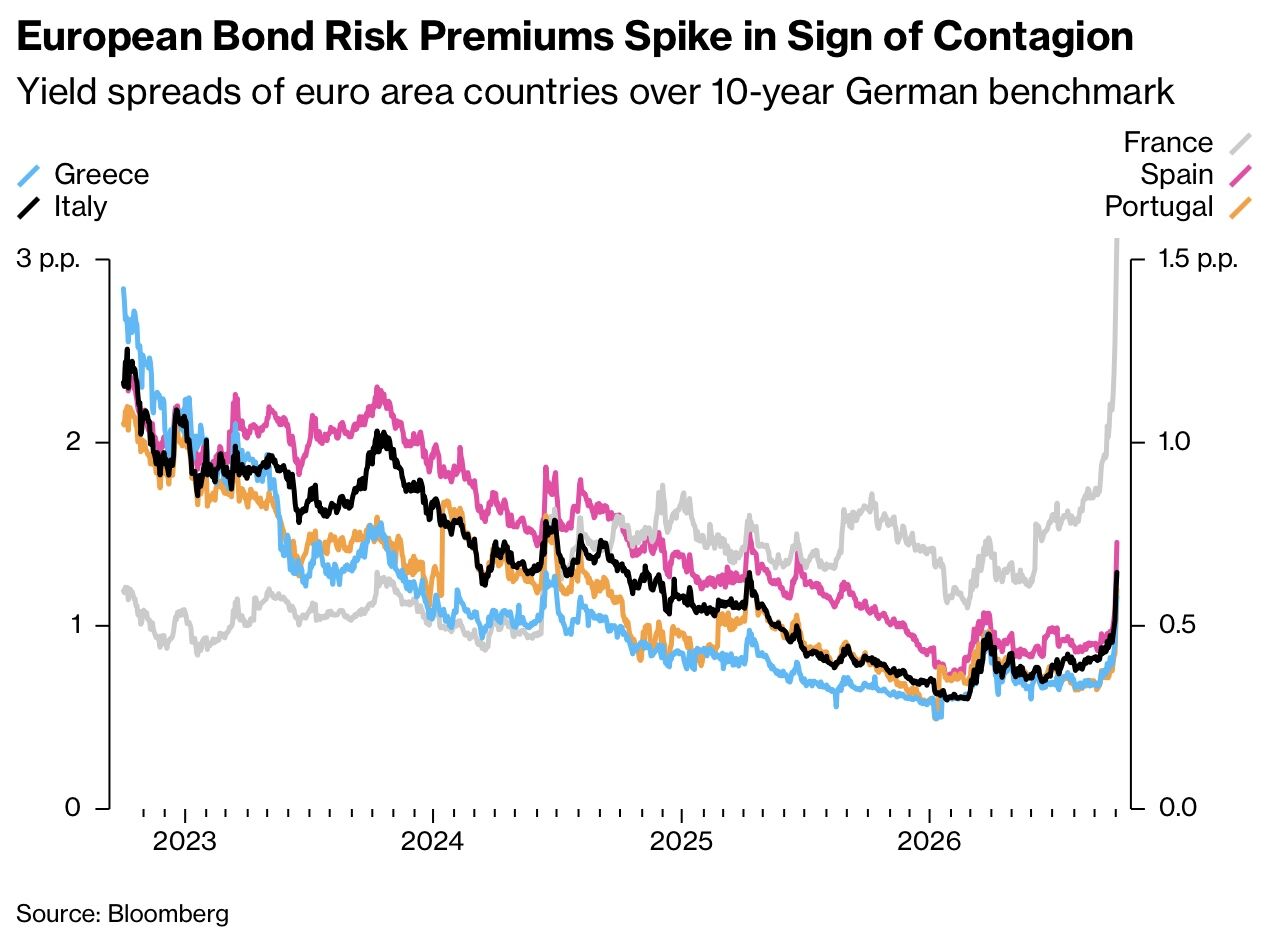
The yield spread between France and Germany reached 154 basis points in early October 2026, its highest level since 2015. This tension reflects market doubts about the French government's ability to restore fiscal credibility. Beyond the French situation, the risk is that this distrust spreads to other indebted European states, triggering a contagion dynamic liable to weaken the financial system as a whole.
On 2 October 2026, the ten-year yield spread between French and German bonds reached 154 basis points, a risk premium rarely seen since 2011. This level of tension reflects far more than a mere technical correction: it signals a fundamental questioning of the sustainability of French public finances.
The French budget deficit for 2026 is projected at 5.4% of GDP. The government aims to reduce it to 5% in 2027, while debt is expected to exceed 120% of GDP. These figures, even if they reflect some improvement on previous years, are not enough to reassure investors.
The market is expressing scepticism about three distinct stages: first, Parliament's ability to vote deficit-reduction measures; next, their effective implementation in the real economy; finally, their continuation after the presidential election. This sequence of doubts reveals deep concern about the political continuity of fiscal efforts.
A technical element aggravates this distrust: even if the deficit were brought back to 5% of GDP as planned, the debt ratio would keep rising because of the low rate of economic growth. The trajectory therefore offers no stabilisation of the debt, only a deceleration of its increase. For bond investors, this means the French problem persists structurally.
When a state's risk worsens, investors do not only adjust their assessment of that state. They also reassess other countries with similar profiles: high indebtedness, moderate growth, uncertain political context. Italy and Belgium are thus starting to suffer distrust without their fundamentals having deteriorated. This contamination by association reveals how markets adopt a broad-spectrum judgement on the euro area.
Many investors finance part of their bond portfolios on credit. When losses mount on French bonds, their risk-management rules force them to reduce their positions. This forced selling does not stop at French bonds: it extends to other European sovereign debts, including those whose fundamentals remain sound. The result: a broad decline in European bond prices, independent of the actual deterioration of the respective fiscal situations.
European banks partly fund themselves through the bond markets. If the cost of this borrowing rises, they pass the increase on to the rates offered to businesses and households. Credit conditions tighten: fewer loans granted, at higher rates. This credit contraction slows economic growth, which reduces government tax receipts and makes deficit reduction harder. A vicious circle sets in.
The warning signal appears when three elements combine: first, several European sovereign debts simultaneously experience a deterioration in their market conditions (widening spreads); next, investors flee massively into safe-haven assets, notably the German Bund, amplifying the spreads; finally, this distrust translates into a lasting increase in bank funding costs that curbs credit in the euro area.
At that stage, the French problem is no longer isolated. It becomes a threat to the stability of the European financial system, as it produces a credit contraction liable to weaken growth across the euro area.
Three conditions are necessary to restore fiscal credibility. First, build a budget on prudent growth and revenue assumptions, avoiding risky optimism. Next, provide for replacement measures: if a planned budget saving is not achieved, other measures must offset it to reach the targets. Finally, commit to lasting savings that survive the presidential election, thereby demonstrating stable political will.
One particular point of attention: preserving productive investment. Cutting capital or research spending too quickly would weaken the economy's potential growth, making it even harder to reduce the debt ratio in the medium term.
The ECB has tools to contain a panic, but not to solve a French fiscal problem. It could slow its rate hikes if excessive financial tightening threatens the transmission of its monetary policy. It could also resume reinvesting maturing bonds and activate its transmission protection instrument to limit disorderly rate movements.
These actions could support the countries contaminated by distrust, without requiring massive purchases of French bonds. The ECB can contain a market panic, but it cannot replace a credible French fiscal correction.
Three signals deserve regular attention: the simultaneous evolution of spreads for other indebted European debts; demand at new French issues (a decline would signal a major loss of confidence); finally, banks' funding costs, which directly measure credit tightening in the euro area.
This is not investment advice.