September 21, 2026
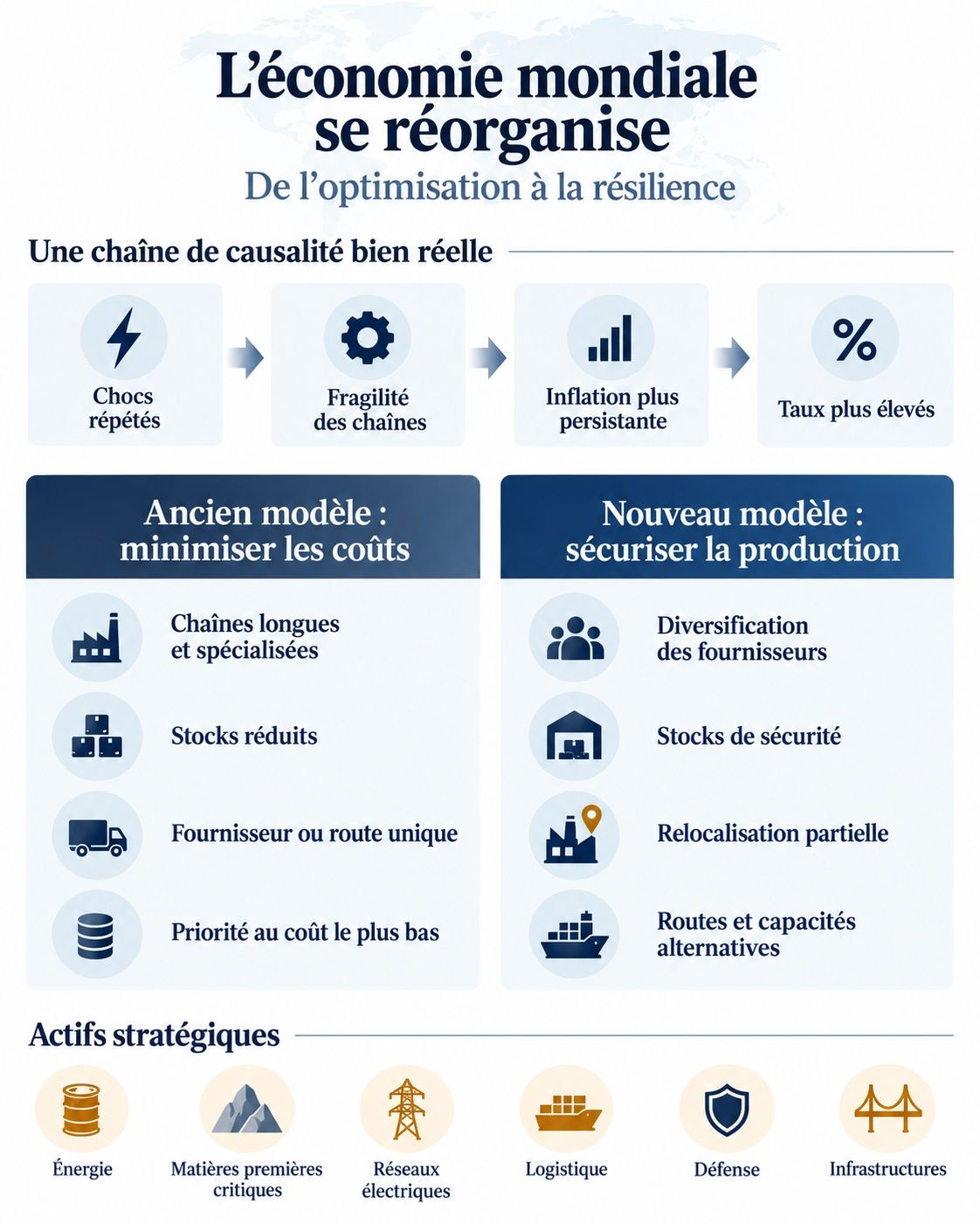
The economic shocks of recent years—pandemic, geopolitical conflicts, trade tensions, shortages of critical components—are no longer isolated accidents. They reveal a structural fragility: a global economy designed for maximum efficiency, but vulnerable to localised failures. This observation is driving a major paradigm shift in the way companies, governments and markets organise global production.
For three decades, globalisation was built on a simple principle: maximum specialisation, inventories cut to a minimum, a systematic search for the lowest cost. This model delivered spectacular results in terms of productivity and disinflation. As long as every link in the chain works without interruption, the system generates unrivalled efficiency.
Yet recent events have shown that this efficiency rests on a fragile assumption: continuity. A single failure—a port closure, the shutdown of a strategic plant, restricted access to a raw material—can paralyse an entire production chain, whatever its length or complexity. The longer and more interdependent the processes, the greater the systemic risk.
Faced with these vulnerabilities, a pragmatic response is gradually taking hold among companies and governments. The objective is no longer solely to produce at minimum cost, but to be able to keep producing even when a key element temporarily disappears.
This transition translates into concrete decisions:
These adjustments are not temporary anomalies. They reflect an emerging conviction: security of supply is now worth more than pure optimisation.
This paradigm shift has a direct impact on inflation dynamics. A succession of supply shocks, when it persists, is no longer perceived by households and companies as a transitory anomaly. It gradually becomes a structural reality, built into long-term price expectations.
As a result, central banks lose the ability to treat each shock as temporary. More persistent inflation requires heightened vigilance and, structurally, higher interest rates than those that prevailed after 2008.
Resilience never comes free of charge. Doubling up on suppliers, maintaining excess production capacity, producing more locally—these measures inevitably reduce an economy's apparent efficiency. They consume capital, mobilise additional labour and increase the safety margins built into final prices.
The structural disinflation that characterised the era of classic globalisation therefore becomes harder to achieve and to sustain. Unless major technological breakthroughs—notably in automation and artificial intelligence—offset a significant share of these additional costs, a new inflationary equilibrium should be expected.
For investors and companies, this shift raises the strategic importance of several areas: energy, critical raw materials, transport and communication networks, logistics, defence and, more broadly, essential infrastructure.
These sectors are not new, but their role in economic strategy is intensifying. Governments will gradually strengthen their control over or support for these chains. Investors will favour companies with strong balance sheets, genuine diversification of supply and control over the critical elements of their operations.
The global economy is no longer seeking only the lowest cost. It now accepts paying more to reduce its vulnerability. This shift is not a step back towards the protectionism of the 1970s, but rather a maturation: a globalised economy, yet better distributed, less concentrated, and deliberately less "just in time".
This is not investment advice.






