October 2, 2026
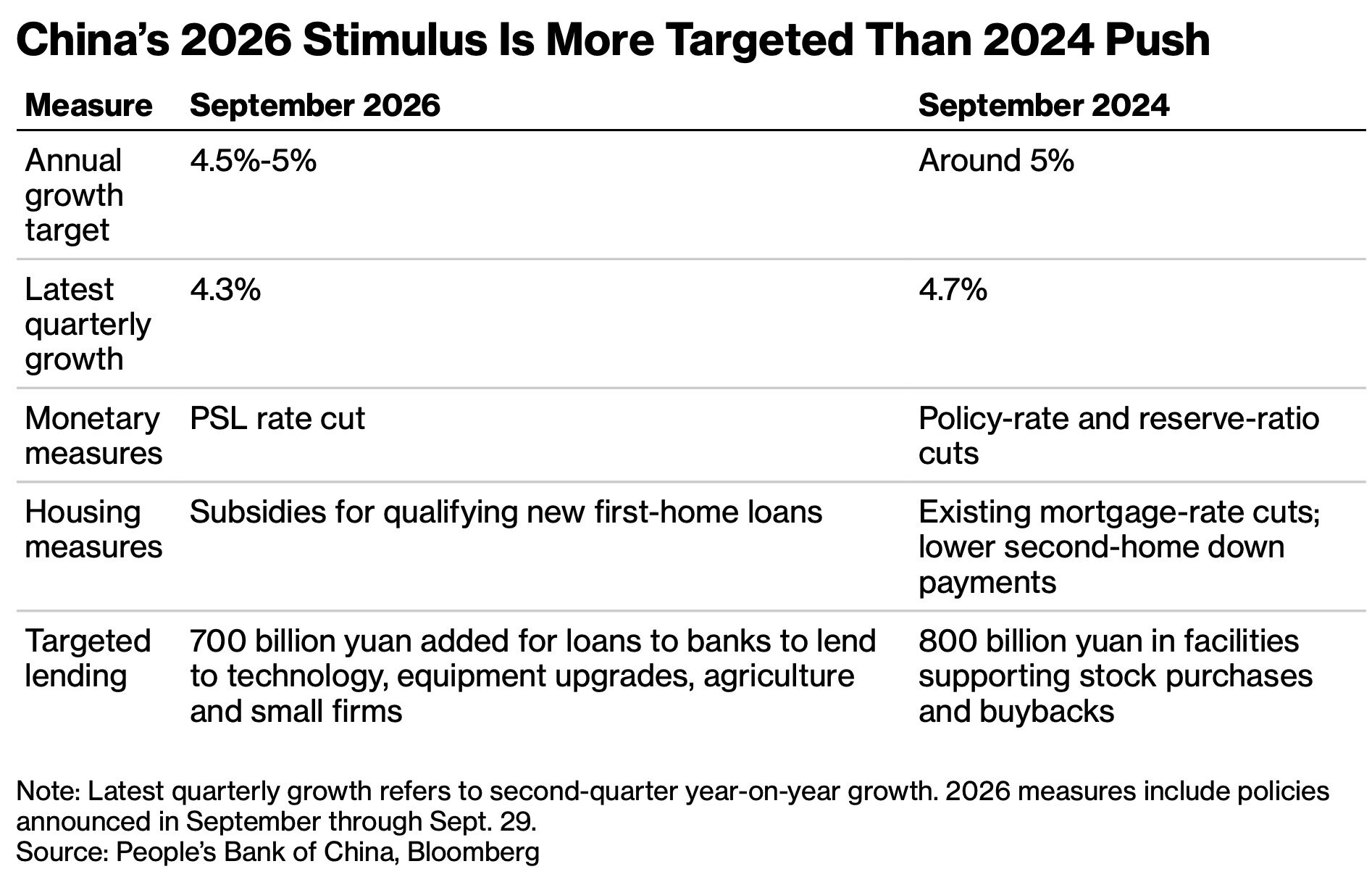
In October 2026, Beijing announced a support plan focused on bank credit and housing aid. These measures aim to sustain economic momentum, particularly in key industrial sectors, but leave the central question unanswered: how to restore household confidence in the face of uncertainty over jobs and housing wealth?
Beijing lowered the funding rate for public development banks from 1.75% to 1.50%. The 700 billion yuan announced constitute refinancing capacity made available to banks, not spending immediately injected into the economy. These funds are directed primarily at three sectors: technology, agriculture and small businesses.
In parallel, a housing aid scheme came into force on 1 October, focusing support on home ownership for first-time buyers. The scheme provides a 1-percentage-point rate subsidy for up to five years on principal capped at around 131,000 euros. To qualify, the home must cost no more than 197,000 euros and measure no more than 120 square metres. This approach targets areas where prices are low and housing inventories are large.
Lowering the cost of credit is a classic lever, but it addresses a symptom without treating the root cause of the lack of confidence. A lower monthly payment can indeed trigger purchases and support demand for furniture, appliances and renovation work. However, this incentive remains limited in the face of two major obstacles: uncertainty over future income and the fear of a further fall in property prices.
The aid mainly benefits households already able to buy and borrow. It does not durably strengthen the purchasing power of consumers as a whole. A broader economic recovery would require more security on employment, health coverage and pensions, in order to reduce so-called precautionary savings: those households accumulate out of fear of the future.
The refinancing plan primarily supports productive supply: power grids, computing capacity, telecommunications and logistics. This orientation reflects Beijing's strategy of industrial and technological scaling-up. It strengthens production capacity, notably through investment in artificial intelligence and digital infrastructure.
However, a structural risk is emerging: AI and productivity gains can increase supply faster than demand. When output grows faster than income and consumption, the imbalance between supply and demand widens, creating deflationary pressures.
Financial markets have noted that this plan remains far short of the scale of the response to the 2008 financial crisis. At the time, Beijing deployed a massive, direct stimulus. Today, several factors limit the effect of credit: indebted local governments have less room for manoeuvre, and genuinely profitable projects are becoming scarcer.
Targeted fiscal top-ups remain under consideration. The plan could be expanded. Nevertheless, no massive and lasting transfer to households has yet been announced. This absence is significant: without guaranteed additional income, consumers will continue to favour saving over spending.
In theory, this plan to support credit and investment can support GDP growth in the short term. But genuine economic rebalancing requires households to benefit more from the productivity gains generated by investment. Without that, the economy risks remaining trapped in a cycle where supply grows faster than demand, creating reverse inflationary pressures.
China's stimulus therefore rests on a bet: that massive investment in technology and infrastructure will, in time, create more and better-paid jobs, sufficient to restore consumer confidence. But the timing of this transmission remains uncertain.
This is not investment advice.