November 2, 2026
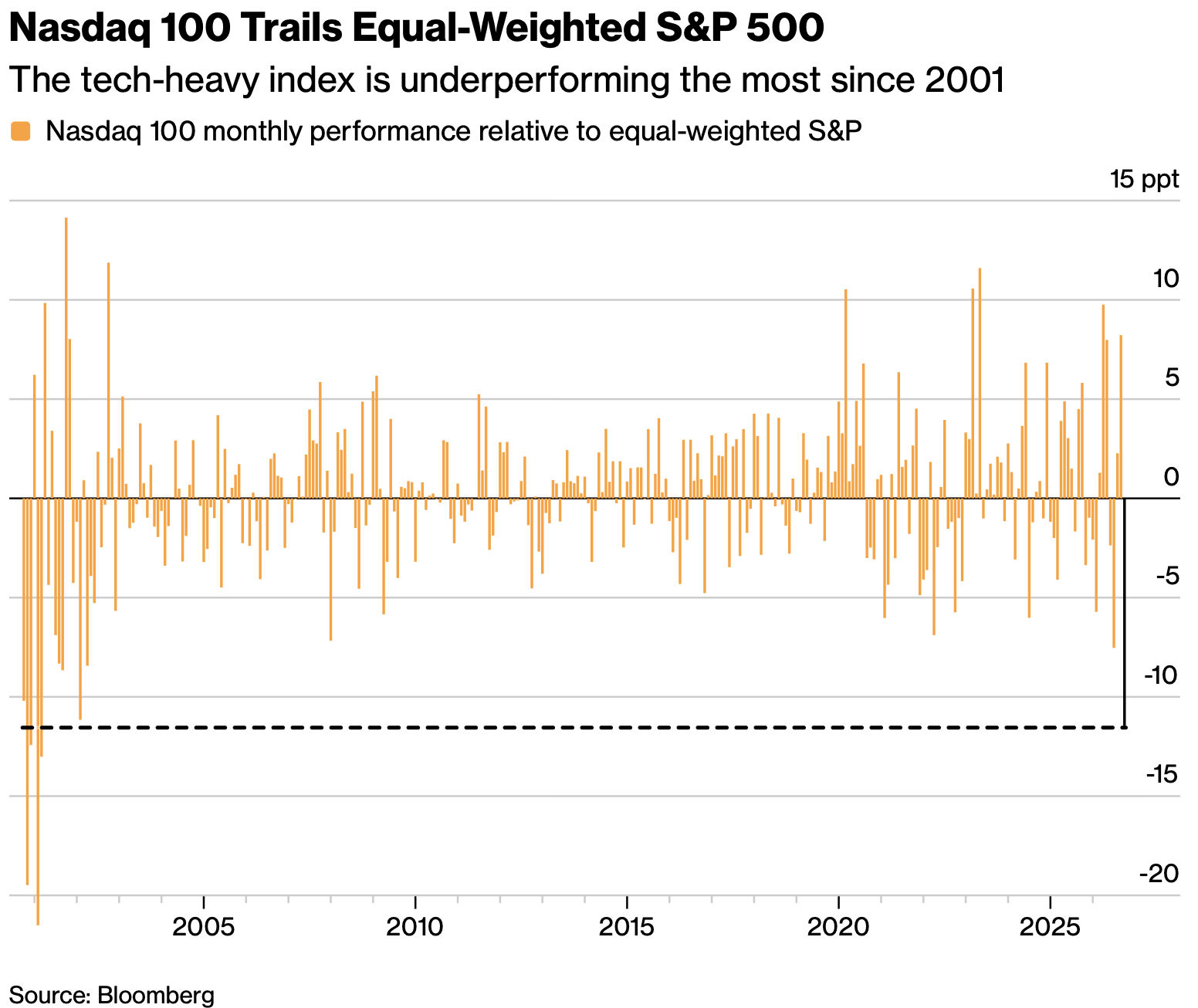
Technology markets are going through a critical moment. The recent falls in the Nasdaq 100 and the sector's big names reveal a growing tension: AI demands unprecedented investment, but returns are slow to materialise. This dynamic raises a fundamental question for investors: is this a temporary correction or the symptom of a regime change?
On Friday, the Nasdaq 100 fell 3.5%, while the S&P 500 lost 1.8%. More telling still: Alphabet Inc. lost 13% in a single session, and Intel 29%. These moves do not reflect mere cyclical volatility. They point to a reassessment of fundamentals.
Over nine months, the five giants Microsoft, Alphabet Inc., Amazon, Meta and Oracle generated $542.9 billion in operating cash flow, up 29%. Yet they invested $556.9 billion — twice as much as in 2025. The result: their free cash flow collapsed, from +$143.5 billion to −$14 billion. Share buybacks, which traditionally supported share prices, fell 83%.
This shift illustrates a phenomenon rarely seen among the world's largest companies: investment exceeds cash generation, and liquidity is shrinking fast.
Technology companies are not only AI players. At Alphabet Inc., advertising — historically the profit engine — is showing signs of slowing. Amazon faces pressure in e-commerce. Yet these mature businesses generate the margins that fund the expansion into AI.
As long as these engines run at full capacity, capital can be invested elsewhere. When they weaken, the internal funding model becomes fragile.
Massive investment in computing capacity is absorbing cash flows faster than expected. Share buybacks, which represented a significant capital buffer, are collapsing. To sustain investment, companies are turning to debt at a time when credit is becoming more selective and rates remain high.
This combination — falling liquidity, greater reliance on debt, a more cautious credit market — creates a less accommodating environment.
Given the strategic stakes of AI, every player seeks to secure its computing capacity and preserve its competitive position. Yet this dynamic generates a well-known risk in economics: when too much capital chases the same opportunities, competition creates overcapacity. And overcapacity destroys collective profitability.
Investing before demand is assured then becomes a race in which financial strength matters more than efficiency. The least well capitalised may be eliminated.
AI usage grows enough to make the infrastructure investments pay off. Well-capitalised companies rebound. Investors who held firm see returns materialise. This is the implicit scenario of optimistic investors since 2023.
Supply exceeds solvent demand. Prices for AI services fall. Margins decline. Valuations adjust downwards. The sector consolidates gradually, with losers and winners according to balance-sheet strength and the ability to cut costs. This is an adjustment scenario, common in technology cycles.
Funding tightens significantly. Investment projects are abandoned. Indebted players face growing difficulties. The shock spreads to suppliers, partners and, beyond them, to economic growth. This is the rupture scenario.
At this stage, demand for AI remains strong. Concerns focus more on the return on investment and on the cost of funding. A prolonged selection of companies by the market — favouring the financially strongest — seems credible in this environment.
This is an essential point: a major technological revolution can succeed fully while destroying a significant share of the capital invested to fund it. Investors must prepare for this possibility.
This is not investment advice.






