October 1, 2026
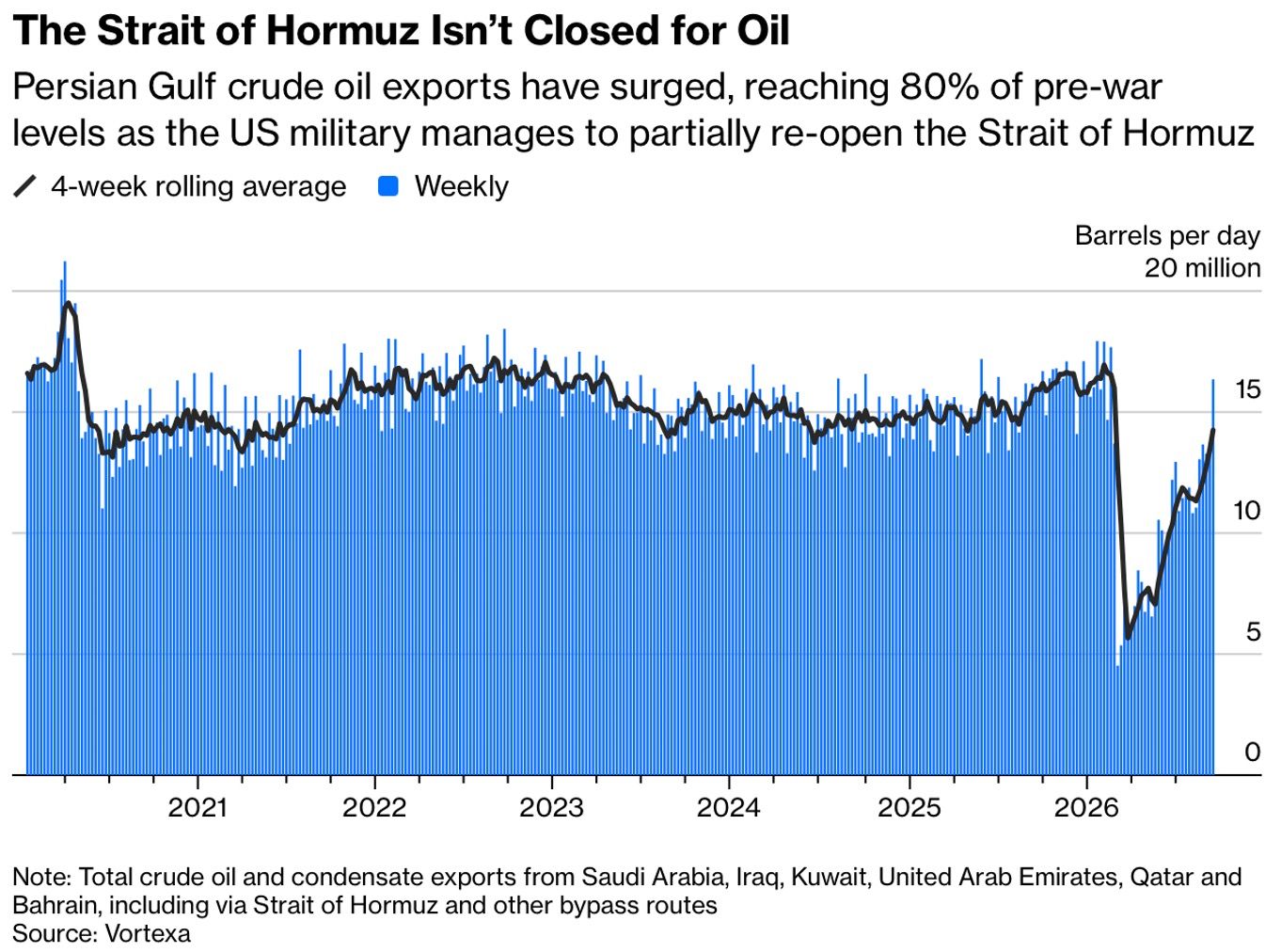
At $103 in October 2026, Brent does not reflect a physical shortage of crude, but the extraordinary cost of delivering oil despite regional disruptions. Middle East exports have partially resumed, thanks to costly arrangements: military convoys, ship-to-ship transfers and infrastructure workarounds. This recovery masks a fragile rebalancing, in which producers and consumers absorb an unprecedented security premium.
Export volumes have rebounded thanks to three factors: shipping passages protected by the United States, ship-to-ship cargo transfers and the partial reopening of the Saudi pipeline to the Red Sea. However, this recovery rests on costly and temporary solutions.
Chartering a supertanker remains exorbitant. A single voyage through Hormuz can cost up to $30 million, or around $15 extra per barrel transported. This sum covers freight alone; military protection, largely funded by the US budget, represents an additional public cost not built into the market price.
Faced with these charges, Gulf producers have opted for a customer-retention strategy: some are granting discounts of $20 to $30 per barrel. They thereby finance a large share of the logistical surcharge while preserving their commercial positions. The barrel therefore trades at a reduced price for sellers, while consumers partially benefit from this absorption.
The oil market now rests on two variables: the continuity of shipping routes and producers' ability to accept compressed margins.
Two straits concentrate the risk: Hormuz and Bab-el-Mandeb. Any major disruption in these passages—an attack on a port, a pipeline or a refinery—would cause a new drop in flows and an immediate resurgence of the security premium. Conversely, a regional agreement reducing tensions would allow this premium to collapse quickly and prices to normalise.
China nevertheless moderates this volatility. Its imports have been revised downwards, from 9.9 to 9.3 million barrels per day in the fourth quarter. Its stocks exceed 1.2 billion barrels, historically high levels. Above $100, its refiners cut their purchases; around $80, they would find more reason to return. This elasticity of Chinese demand acts as a shock absorber against price spikes.
The disruptions are not limited to crude. Regional exports of refined products have only returned to 3 million barrels per day, or 58% of normal. Diesel, a critical fuel for road transport, agriculture and construction, has exceeded $6.50 per gallon in the United States.
This energy shock is transmitted directly to exposed sectors. Logistics costs rise, passing part of the Middle East security premium on to consumer prices and cost structures. For central banks, including the Federal Reserve, this scenario complicates inflation management. With rates already high, prolonged tightening would quickly weigh on economic activity and access to credit.
Oil at $100 tells a different story from that of physical deficits. It pays less for a shortage than for an exceptional cost: that of keeping flows going despite war, risky passages and damaged infrastructure.
This dynamic raises a strategic question: how to reduce this cost durably? The options come down to three: reduce regional tensions, strengthen logistical alternatives or lower global demand. Each of these paths remains uncertain in the short and medium term.
This is not investment advice.