October 26, 2026
The S&P 500 has shown apparent stability for three months, but beneath the surface, credit markets are sending a warning signal. Investors are becoming selective: risk spreads are widening, refinancing costs are soaring, and artificial intelligence projects are coming under unprecedented critical scrutiny. This rebalancing reveals a fundamental tension: economic growth increasingly relies on investments whose profitability and repayment capacity remain to be proven.
The S&P 500 has traced an almost flat path for three months. This surface-level status quo masks a more nuanced reality: some stocks are suffering pronounced corrections, while others are holding up. This two-speed dynamic is reflected in expected volatility: the VIXEQ, which measures the implied volatility of technology and innovation stocks, peaks at 41.9. By comparison, the VIX, which captures the volatility of the index as a whole, remains moderate at 19.45.
This telling gap suggests that pressure is concentrated on growth stocks, particularly those exposed to artificial intelligence. Hedge funds, traditionally active in these segments, reduced their exposure in 7 of the last 8 sessions. Their net sales of technology reached the highest levels since September 2024. This move is not trivial: it signals a cautious reassessment within the community of sophisticated investors.
The composition of US economic growth is evolving rapidly. In the second quarter, investment in IT equipment rose 32.7% year on year, while industrial construction fell 22.8%. Artificial intelligence is capturing a growing share of corporate and government investment budgets.
At the same time, consumption depends heavily on affluent households and their financial wealth. This concentration creates a paradox: corporate profits remain solid, but the cross-purchases and cross-financing within AI projects do not automatically guarantee the expected return on investment. Computing infrastructure projects require massive capital expenditure before generating predictable and sustainable revenues.
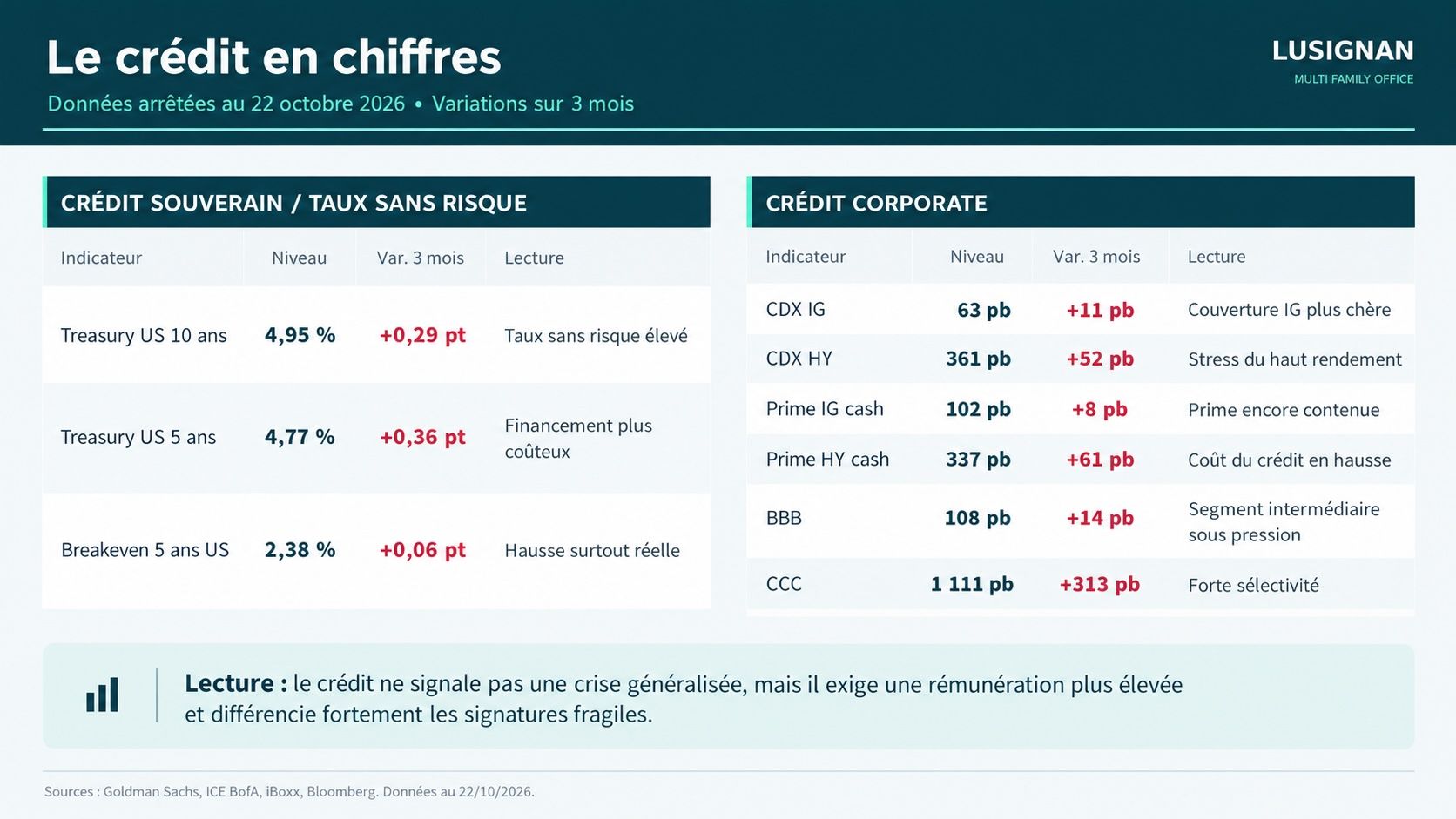
It is in the bond market that the tension appears most clearly. In three months, risk premiums have risen noticeably. For quality companies (investment grade, IG), spreads reach 87 basis points, up 12 points. For high yield (HY), they have climbed to 338 basis points, up 72 points. For the most fragile names (CCC), the premium peaks at 1,111 basis points, a rise of 188 points.
These spread widenings reflect a general rise in interest rates, but also a change in attitude: investors are becoming more demanding in their selection of borrowers. Average bond yields illustrate this higher cost of financing: 6.23% for IG securities and 8.40% for HY. Refinancing debt is becoming a costly operation.
The tensions are not limited to fragile names. They are also reaching the major players in AI and data centres. The premium on the bond basket of well-rated computing providers widened by 17 basis points in a single week, a significant move for entities generally considered safe.
Bonds financing data centres are under even sharper pressure. Between the end of June and mid-October, these securities lost an average of 6.7% in price, against 3.8% for the US HY bond market as a whole. Beyond the rise in rates, investors are revising upwards their perception of the risk associated with these projects. Their future profitability and their ability to repay debt are becoming central criteria.
The supply of financing for AI and infrastructure projects is exploding. More than $106 billion of bonds dedicated to project financing have been issued in 2026, against $37 billion in 2025. These figures reflect companies' massive appetite for capital.
Projections for 2027 are even more ambitious: Goldman Sachs anticipates $300 billion in issuance dedicated to data centres and $420 billion in direct issuance by the major computing providers. This volume of debt to be placed creates a twofold concern for investors.
On the one hand, they are reassessing the default risk of fragile borrowers. On the other, they are measuring the volume of debt that even the most solid players must absorb. Financing remains open, but conditions are tightening. The additional cost could hold back investment or weigh on future profits, either through lower margins or through an adjustment of expansion programmes.
The default rate in the HY segment stands at 3.4%, a level that reveals genuine tension without tipping into a generalised crisis. Investors are managing a situation of heightened selectivity rather than a systemic denial of credit.
Elements to watch in the coming weeks include new issuance (volume and spreads), the evolution of risk premiums outside the AI sector, cash available after massive investments, and earnings forecast revisions. These indicators will help determine whether the credit market is anticipating a lasting slowdown or a temporary normalisation.
This is not investment advice.