July 8, 2026
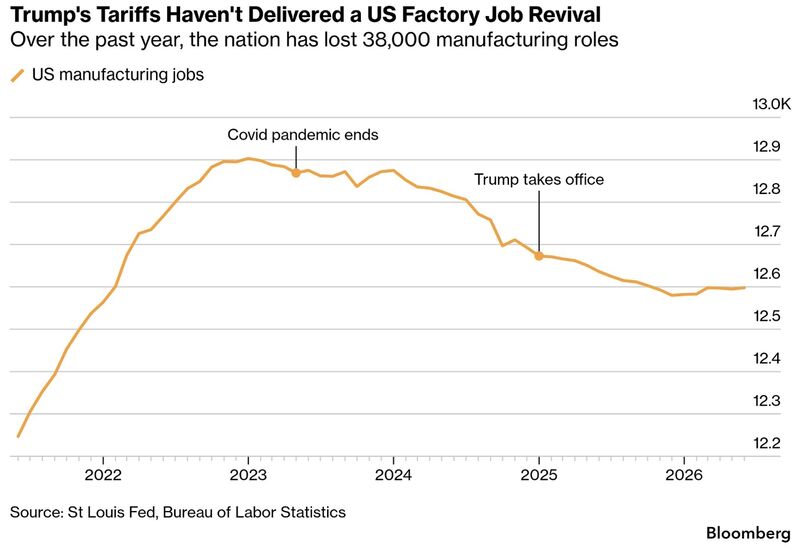
Manufacturing employment in the United States has fallen from a peak of close to 19.5 million people at the end of the 1970s to 12.6 million today, a decline of around 35%.
Despite reshoring policies, industrial investment and strong demand linked to artificial intelligence, manufacturing employment remains slightly below its pre-pandemic level.
These data illustrate the gap between the return of industrial investment and the evolution of employment in the sector.
Reshoring policies favour certain industrial locations, but they do not allow a complete industrial ecosystem to be rebuilt quickly.
Many factories remain dependent on imported components, which slows the implementation of certain projects.
At the same time, investment in semiconductors, data centres and electrical infrastructure is boosting demand for skilled trades, notably electricians, automation engineers and maintenance technicians.
However, these new facilities are also far more automated than previous generations of factories.
The main challenge is therefore no longer solely to build production sites, but also to have the skills needed to operate them. Jobs are being created, but they mainly concern specialised profiles and remain largely offset by productivity gains.
The available evidence suggests that reshoring could produce economic effects different from those observed in previous industrial cycles.
According to this analysis, reshoring should above all support investment, strengthen industrial sovereignty and improve the resilience of supply chains, rather than recreate the volumes of manufacturing employment seen in the past.
This development is also presented as favourable in the long term for the Federal Reserve. An increase in production capacity, combined with productivity gains, can help support growth while limiting inflationary pressures.
America's industrial renaissance thus appears more as a transformation of productive capital and technologies than as a massive return of manufacturing employment.