October 19, 2026
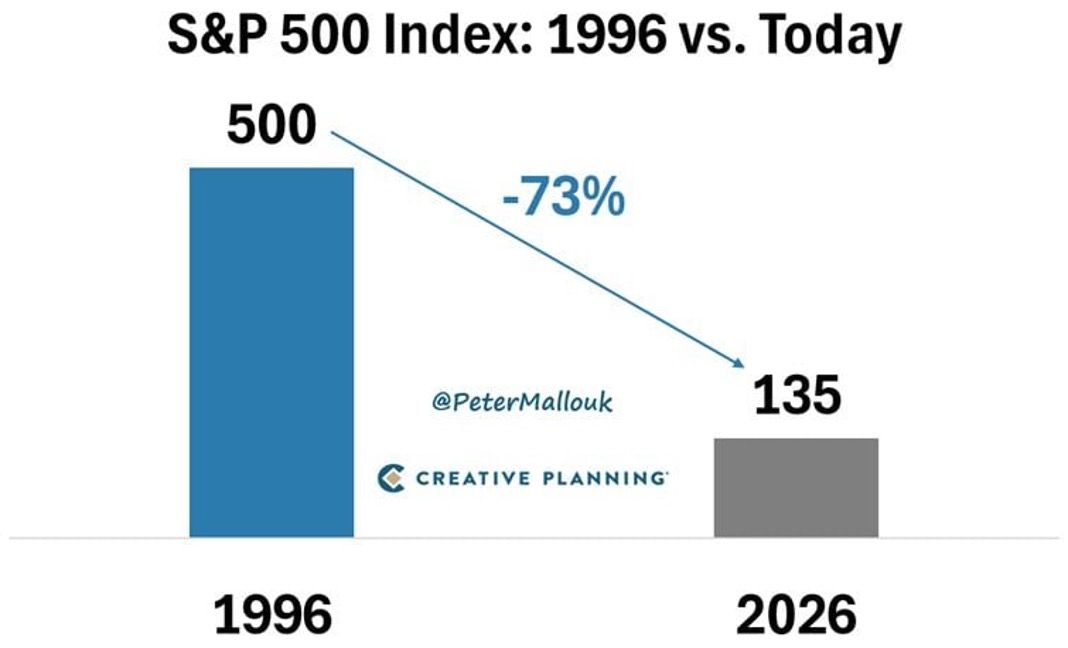
Since 1996, 73% of the companies making up the S&P 500 have left the index. This massive turnover reflects less a failure rate than a reality: indices follow market transformations, while active managers seek to anticipate them. Against a backdrop of increased concentration around large technology names, this distinction becomes strategic.
That only 135 of the 500 members of 1996 still feature in the index in 2026 may seem spectacular. It needs qualifying: this statistic measures presence in an index, not a judgement of economic failure. A company leaves the list for several reasons: growth that places it outside the 500 largest capitalisations, merger, spin-off, or decline. Each of these scenarios tells a different story.
NVIDIA replaced Enron in 2001. Amazon joined the index in 2005; Kodak left it in 2010. JDS Uniphase, which entered in 2000, collapsed when the telecoms bubble burst. These examples illustrate a simple dynamic: the index records a size that has been reached, not a guaranteed future performance.
Other changes reflect sector consolidation. Mobil merged with Exxon in 1999: the name disappeared, but the business continued. Hewlett-Packard split into two entities in 2015, both included in the index. These moves show that the composition of the index follows corporate strategies, rather than dictating them.
Over the years, the weight of the index has become concentrated. The biggest winners grow further, owing to their increasing weighting. This dynamic creates a dependence on a small number of companies, notably those linked to artificial intelligence. Concentration increases the risk that the expectations built into the share prices of these giants fail to materialise or slow down.
This is where active management comes in. A manager can spot two sources of value: first, identifying elsewhere mid- or large-sized companies whose prospects are insufficiently valued by the market. Second, detecting the small and mid-sized companies capable of becoming tomorrow's leaders, before their potential entry into the index.
This approach nonetheless requires strict discipline. To compete with exchange-traded funds (ETFs), a manager must master three elements: rigorous valuation, contained fees and an investment horizon long enough for their convictions to bear fruit. Concentration alone does not guarantee outperformance.
Artificial intelligence broadens the manager's capabilities. It makes it possible to analyse a larger number of companies, to cross-reference financial data and contextual information, and to test several scenarios in parallel. Used correctly, it multiplies the reach of human judgement.
It does not replace it. AI identifies patterns, tests hypotheses, organises information. It is the manager who makes sense of it, who accepts or revises their convictions according to the facts, who decides when to act.
The edge of active management rests on the ability to spot the right companies early, buy them at a fair price, and give that conviction time to bear fruit. AI supports this process by widening the field of observation and speeding up analysis. But it eliminates neither the risk of being wrong, nor the need to revise positions when reality differs from expectations.
This is not investment advice.