September 22, 2026
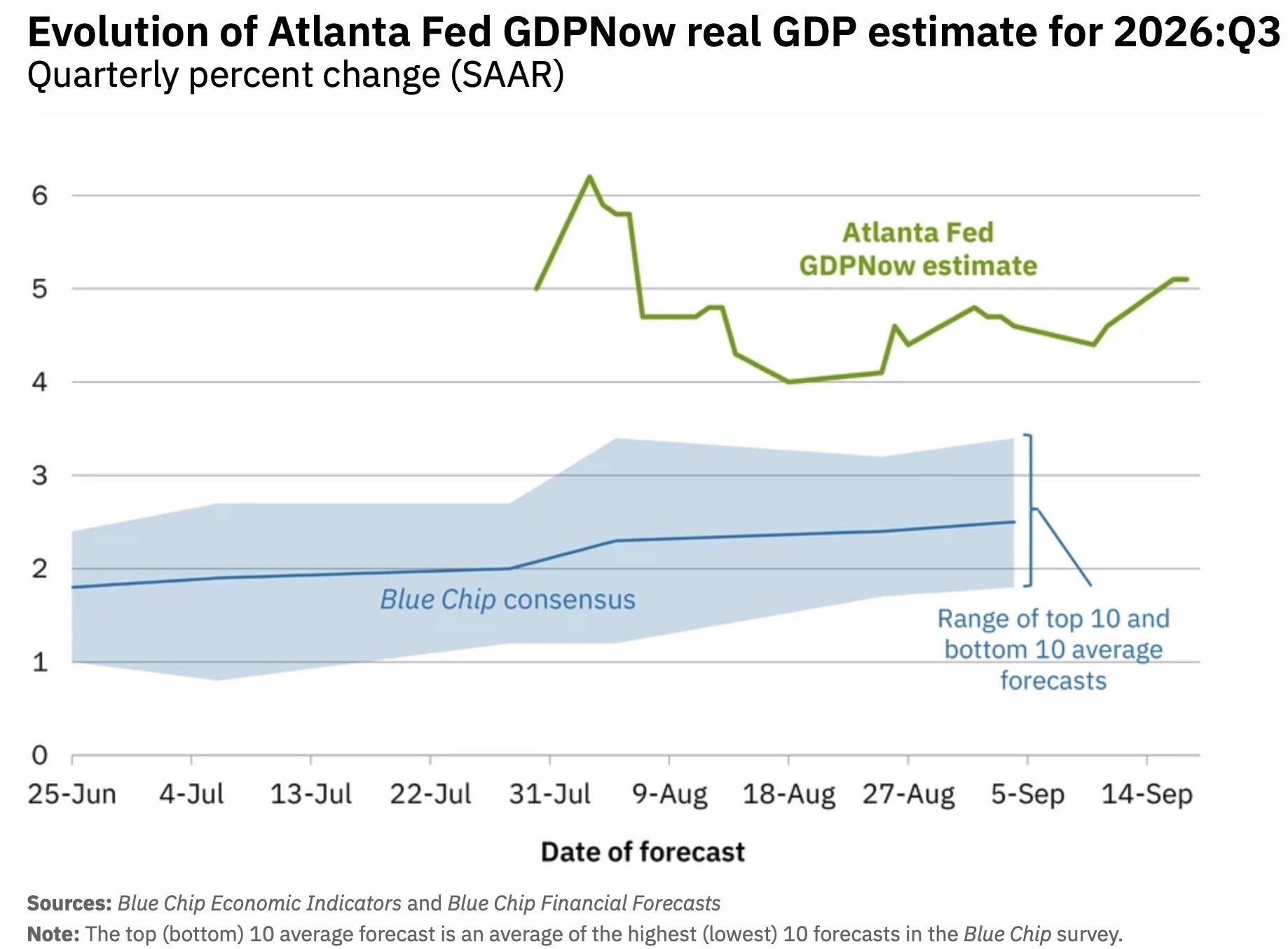
US growth is accelerating while the Federal Reserve continues its tightening cycle. At the heart of this context: a central question for investors. Can corporate earnings keep rising despite the higher cost of capital? Equity markets are answering yes for now, but this balance rests on fundamentals that any shock could undermine.
The acceleration in US growth shown by the GDPNow model — up from 4.4% to 5.1% annualised — deserves a nuanced reading. The breakdown reveals that consumption contributes 2.8 points, while private investment adds 3.2 points, of which around 2 points come from the change in inventories. Foreign trade, in retreat, subtracts 1.4 points of growth.
Excluding inventory movements — often volatile and less indicative of the economy's sustainable pace — estimated growth is close to 3.1%. This more moderate figure better reflects the sustainable trajectory. Domestic demand shows some resilience: retail sales rebounded 1.2% in August after a 0.5% decline in July. This recovery remains to be confirmed on the basis of price-adjusted figures, in order to establish whether the rebound is structural or temporary.
On the equity market front, the dynamics are instructive. The S&P 500 P/E multiple — calculated on expected earnings — has declined from 22 to 19 since the start of the year. At the same time, the index remains close to its all-time high of around 7,800 points, reached in August.
This apparent contradiction has an explanation: the fall in multiples has been more than offset by the growth in estimated earnings. In other words, investors are willing to pay less per dollar of earnings, but total earnings are rising fast enough for the index to consolidate its gains. This mechanism is classic during rate normalisation cycles: valuations contract, but fundamentals remain supportive.
The Federal Reserve raised its policy rates by 25 basis points on 16 September, a decision already priced in by markets. More interesting: the market anticipates a firmer path of hikes than the median projection of Fed members. It prices in one additional hike by the end of 2026, then around two more by autumn 2027.
This divergence between market expectations and the Fed's projections raises a question: are markets anticipating inflation persisting above target, or are they pricing in a risk scenario? Resilient activity and inflation held above the objective could indeed justify a few additional hikes. Nevertheless, the scale of the cycle envisaged remains well below that of the aggressive 2022 cycle.
For equities to hold their current levels, earnings must keep growing despite a rising cost of capital. This is the market's central assumption. So far, this balance is holding. Earnings forecasts have grown enough to absorb the contraction in multiples.
However, this balance has points of fragility. A rapid rise in long-term rates could destabilise current valuations by inflating the discount rate applied to future earnings flows. Likewise, a downward revision of earnings forecasts — particularly in the technology sector, which weighs heavily in the indices — would be a significant shock for markets. Companies would then struggle to justify their current valuation levels, even with compressed multiples.
The economic and market dashboard paints a solid base case: moderate but resilient growth, a Fed raising rates gradually without brutality, and earnings capable of supporting equities. Nevertheless, this scenario rests on a delicate balance. The two main risks — an acceleration in long-term rates or an earnings disappointment — could tip it quickly.
For investors, this configuration calls for heightened vigilance: tracking actual earnings growth against forecasts, monitoring the evolution of bond yields, and staying alert to any change in the Fed's communication. Fundamentals are currently acting as a shock absorber against monetary tightening. As long as they remain solid, markets have a footing. As soon as they weaken, the balance breaks.
This is not investment advice.






