November 3, 2026
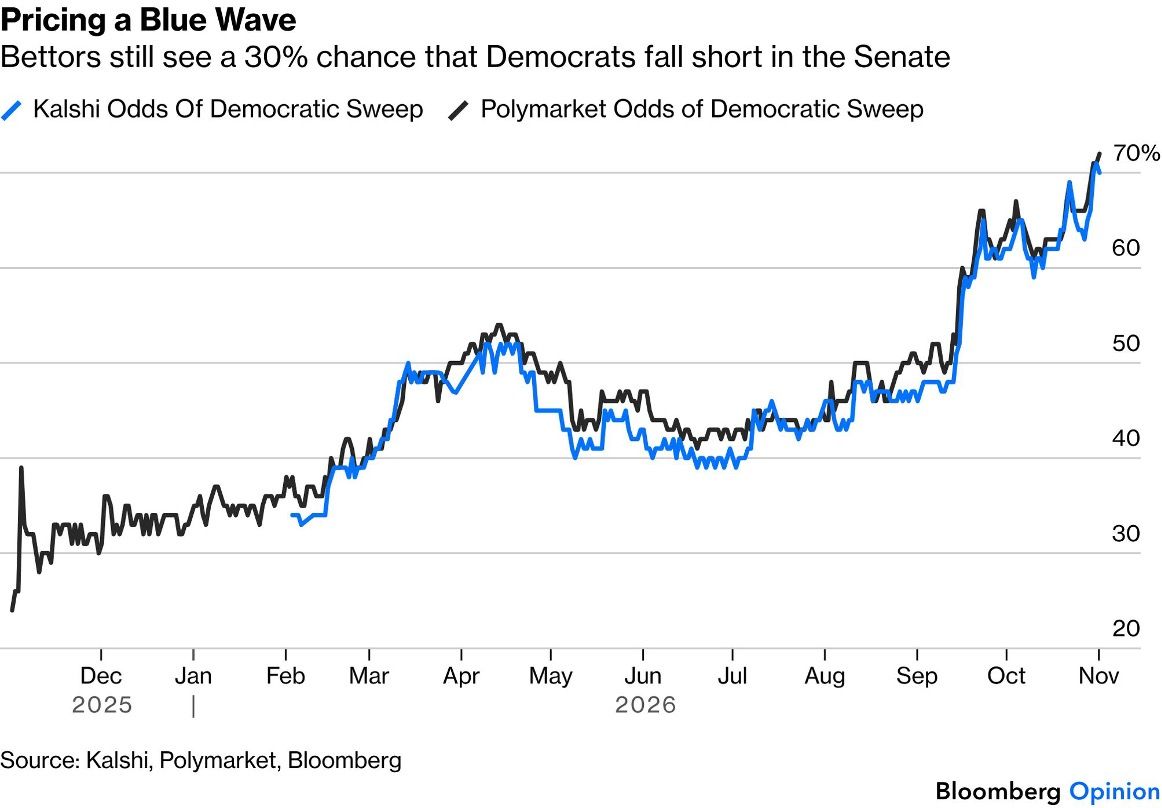
The upcoming US midterm elections are gradually shaping a scenario in which the Democrats could retain control of the Senate, or even win the House of Representatives. But between polls and election results, a gap always remains possible. Beyond the vote, it is above all the institutional dynamic between a Republican president and a potentially Democratic Congress that will shape the next two years, with very real implications for financial markets.
The latest New York Times and Siena Research polls place the Democrats ahead in five Senate seats currently controlled by Republicans. They are tied in a sixth. This configuration, if confirmed, would allow them to retain their Senate majority, including their strategic Michigan seat.
Prediction markets such as Polymarket and Kalshi already largely price in this scenario and assign a substantial probability to Democratic control of both chambers. However, recent electoral history reminds us that surprises happen. Unpredictable votes in Brazil and elsewhere illustrate that the dominance of one scenario in the polls never equals a certain result.
If the Democrats control Congress facing a Republican president, they would have significant levers. They could refuse to pass new Republican laws, control the allocation of budget appropriations, and multiply congressional investigations. In the Senate, they could block judicial and government nominations.
But this blocking power has its limits. Without a two-thirds majority in each chamber, a Democratic Congress could not override a presidential veto. This asymmetry gives the Republican executive a structural advantage.
A Republican president could reject almost any Democratic legislative initiative. At the same time, he would retain room for action in the areas where the executive already holds constitutional powers: foreign trade, immigration, foreign policy and the federal administration. The courts, notably the Supreme Court, would remain an additional check.
This configuration produces less a total paralysis than a succession of confrontations: vetoes, legal challenges, investigations, and ad hoc compromises carved out in each budget negotiation.
The issue is not two years of complete gridlock. It is rather an institutional framework in which every legislative advance becomes a matter of negotiation, in which decisions crystallise around crises or deadlines imposed by the budget calendar.
The real economic risk is concentrated on one point: funding the US government requires the joint agreement of Congress and the president. Neither can impose its plan alone. This is the ground where standoffs become concrete and costly.
The recent precedent illustrates it. In 2025, budget deadlocks caused 42 days of partial shutdown of the federal government. In a context of heightened confrontation, this type of shutdown could recur.
The direct economic impact of a shutdown — lost activity, payment delays — is generally contained. But the indirect impact is more serious: repeated shutdowns send a signal to financial markets about Washington's ability to manage its public finances sustainably. It is a confidence factor that cannot be overlooked.
A scenario of Democratic control of Congress does not produce a frozen economy, but a political game whose new rules financial markets must take on board.
Budgetary power becomes the central issue. Every negotiation on the debt ceiling, every vote on funding federal agencies, becomes an occasion for confrontation. Future budget deadlines — generally scheduled in the autumn — could crystallise crises.
Washington's ability to maintain a stable budgetary order, or at least to avoid repeated shocks, will become a risk-assessment factor for bond investors, notably on medium-term Treasuries.
The 2026 Midterms do not draw an absolute winner, but a new balance of power. If the polling scenario is confirmed, two years of controlled political instability could follow, with the federal budget as the main economic breaking point. Financial markets, already accustomed to pricing in this type of institutional risk, would adjust their expectations accordingly.
This is not investment advice.






