October 29, 2026
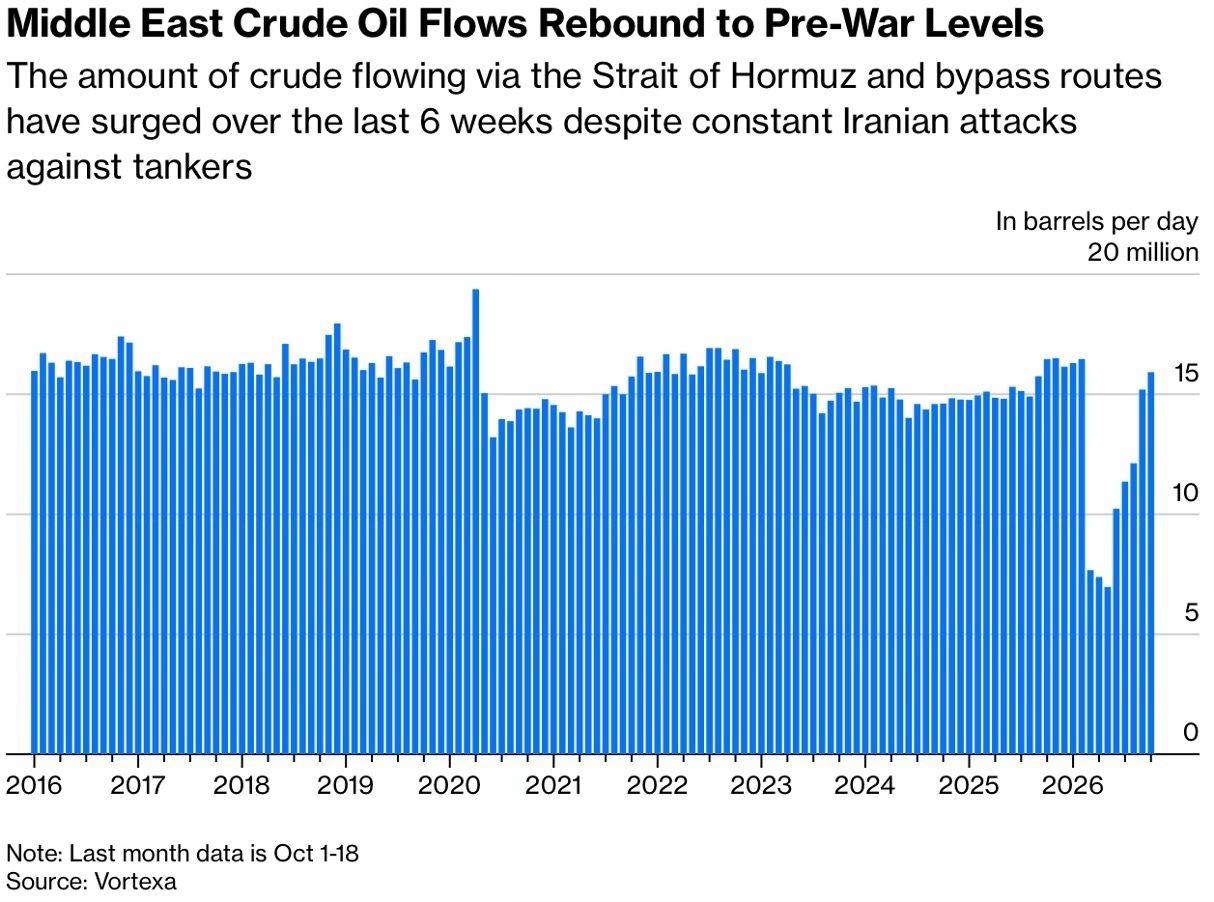
The return of Middle East oil exports to near pre-war levels has not been matched by a proportional fall in prices. Brent remains high, revealing a structural gap between supply capacity and market resilience. Understanding this divergence sheds light on the long-term dynamics of energy markets.
In early October, Middle East oil exports (excluding Iran) reached around 16.5 million barrels per day, a level comparable to that before the crisis. Paradoxically, Brent stands at $113.88 a barrel, while US WTI sits at $99.90. The gap of nearly $14 between these two benchmarks points to deeper frictions in the international market.
This divergence between the recovery in flows and the persistence of high prices deserves explanation. It does not result from a simple mechanical reaction to available volumes, but from more complex structural factors affecting the entire supply chain.
The return of flows is not the same as a normalisation of supply. Between the end of February and the end of September, global inventories fell by 509 million barrels. This decline signals that current production, despite its recovery, remains insufficient to meet demand while rebuilding reserves. A calm market requires not only flows, but the capacity to accumulate safety stocks.
Beyond crude production, logistics play a central role. Supply chains remain disrupted: mandatory detours, high insurance costs and increased freight charges raise the cost of the oil ultimately delivered to consumers. Exports of refined products from the Gulf remain significantly below their historical levels, squeezing the supply of available finished products.
The threat of a fresh disruption of major shipping routes or of an attack on critical infrastructure introduces a risk premium into price formation. This premium remains justified as long as regional instability persists, regardless of the current technical capacity to deliver oil.
Between 2011 and 2014, the oil market sustained high prices, supported by emerging-market demand and supply constraints. Then the rise of US shale oil, combined with a slowdown in global demand and OPEC's strategy, triggered a sharp reversal. Brent fell below $60 between 2015 and 2017, illustrating that no price regime is perpetual.
This historical alternation reveals a major lesson: regime breaks occur when the fundamental balance between supply, demand and inventories tips. Prices stay high only as long as that balance justifies it.
A lasting easing of oil prices requires the convergence of three elements:
Rather than focusing on nominal prices, market participants should pay attention to: the evolution of global inventories (a key indicator of relative tightness), the price spread between the different Brent maturities (reflecting short-term expectations), and the evolution of shipping costs (an indirect indicator of the security of routes and insurance).
A lasting fall in prices does not necessarily require an immediate peace agreement. The gradual adaptation of supply, the improvement of logistics chains and the rebuilding of inventories could be enough to create the conditions for an easing. Conversely, a global economic slowdown reducing oil consumption could also lead to lower prices, but without resolving the underlying geopolitical factors.
The history of oil shows that a regional conflict can persist for years without prices remaining durably high: it is the evolution of the fundamental balance between supply, demand and inventories that ultimately prevails. The market has powerful, but slow, adaptation mechanisms.
This is not investment advice.






