October 28, 2026
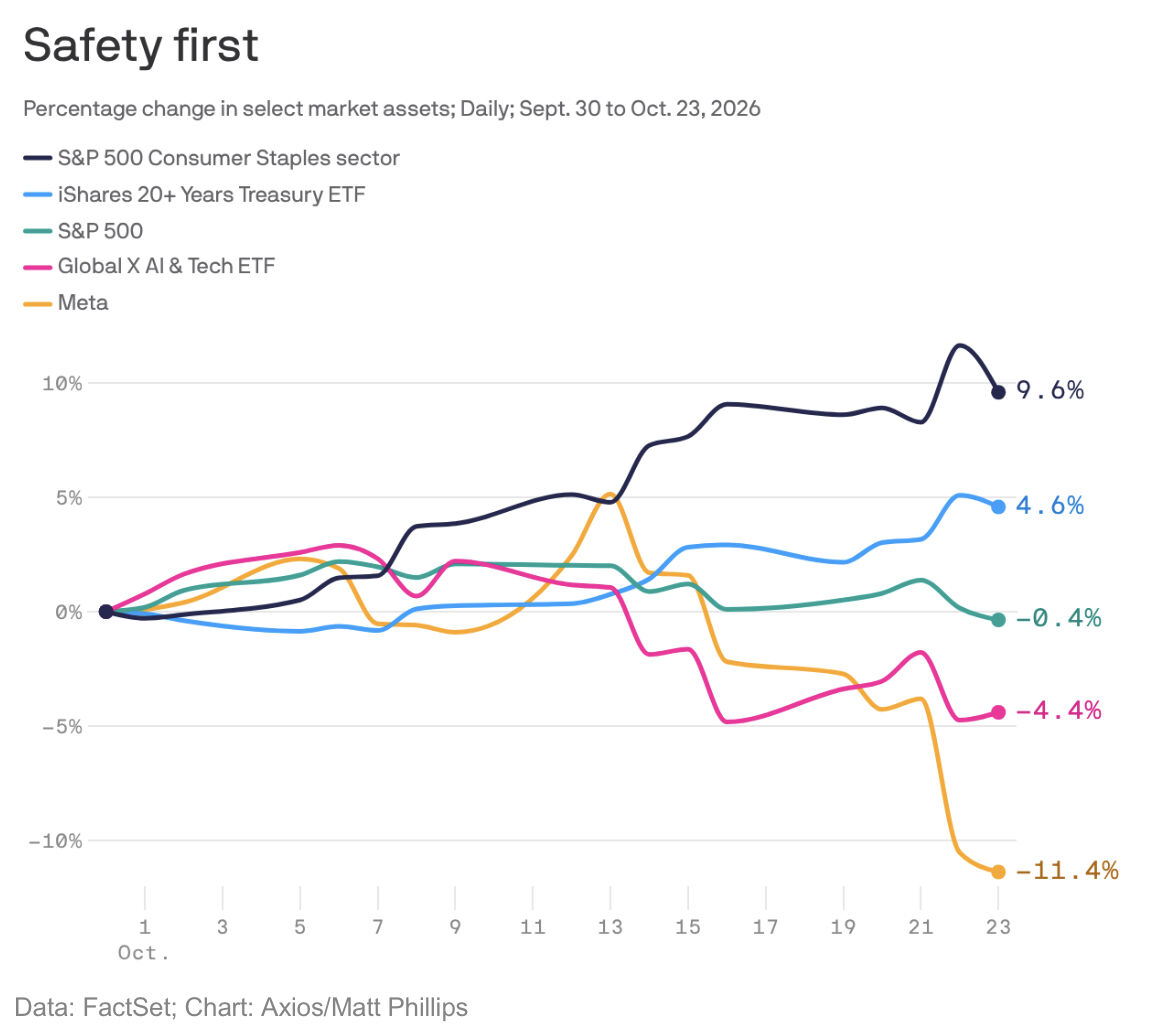
Since late September, US markets have been going through a major shift. Investors are sharply cutting their exposure to large technology stocks in favour of bonds and defensive sectors. This rotation is not an abandonment of growth, but a reassessment of risk and a return to more diversified investment criteria.
Market dynamics have reversed in remarkable fashion. Consumer staples have gained 9.6% since late September, while long-dated US bonds have risen 4.6%. By contrast, the S&P 500 has slipped 0.4%, global AI-related stocks have fallen 4.4% and Meta has dropped 11.4%.
The scale of this swing is especially visible among small and mid caps. On Thursday, the equal-weighted S&P 500 outperformed the traditional version by more than 1.9 points, a gap not seen since July 2024. This reveals a strategic move by investors: they are not leaving equities en masse, but redeploying their portfolios towards companies with more predictable revenues and less dependence on AI.
After several years dominated by technology stocks, US bonds have regained undeniable appeal. The 10-year yield is back at 5%, after exceeding 5.3% in early October. This move has been accompanied by massive inflows into bond index funds.
Since the start of October, these funds have collected around $58 billion. As a share of total ETF inflows, that represents 38%, a considerable proportion that reflects a major realignment of allocation strategies.
For investors seeking real yield, US inflation-linked bonds offer an interesting prospect, with a 2.6% real yield at ten years. This combination of attractive yield and potential protection against an economic slowdown explains the renewed interest in fixed income.
The correction is not hitting technology uniformly. While semiconductors are posting significant declines, the software and cybersecurity segments are advancing. This segmentation reflects a finer analysis of risk within the sector.
Defensive sectors, notably healthcare and consumer staples, are weathering the turbulence better. This differentiated performance reflects a shift in selection criteria: investors no longer judge companies solely on their AI exposure or short-term growth potential.
The ability to generate cash, the visibility of future earnings and balance-sheet strength are regaining a central role. Companies showing predictable revenue growth and established profitability are attracting fresh interest, while those too dependent on massive AI investment cycles are facing valuation questions.
Bonds traditionally act as a safe haven when fears of an economic slowdown dominate. They have risen in that context since late September. However, this protection remains conditional.
An acceleration in inflation, particularly through a surge in oil prices, could revive inflationary pressures and push bond yields back up, reducing the appeal of existing bonds. This underlying fragility is a reminder that bonds are never an absolute hedge, especially in an environment where inflationary pressures persist.
The current rotation does not signal a radical paradigm shift. Investors are not rejecting growth or the long-term potential of technology. Rather, they are carrying out a disciplined reassessment of the risk-return trade-off.
After years marked by portfolios converging on giant technology stocks and an acceleration of AI-related themes, classic criteria are regaining weight: reasonable valuations, earnings visibility, financial strength and cash generation. This normalisation of allocation suggests a market that is gradually restoring the distinctions between risk profiles and return profiles.
This is not investment advice.