November 1, 2026
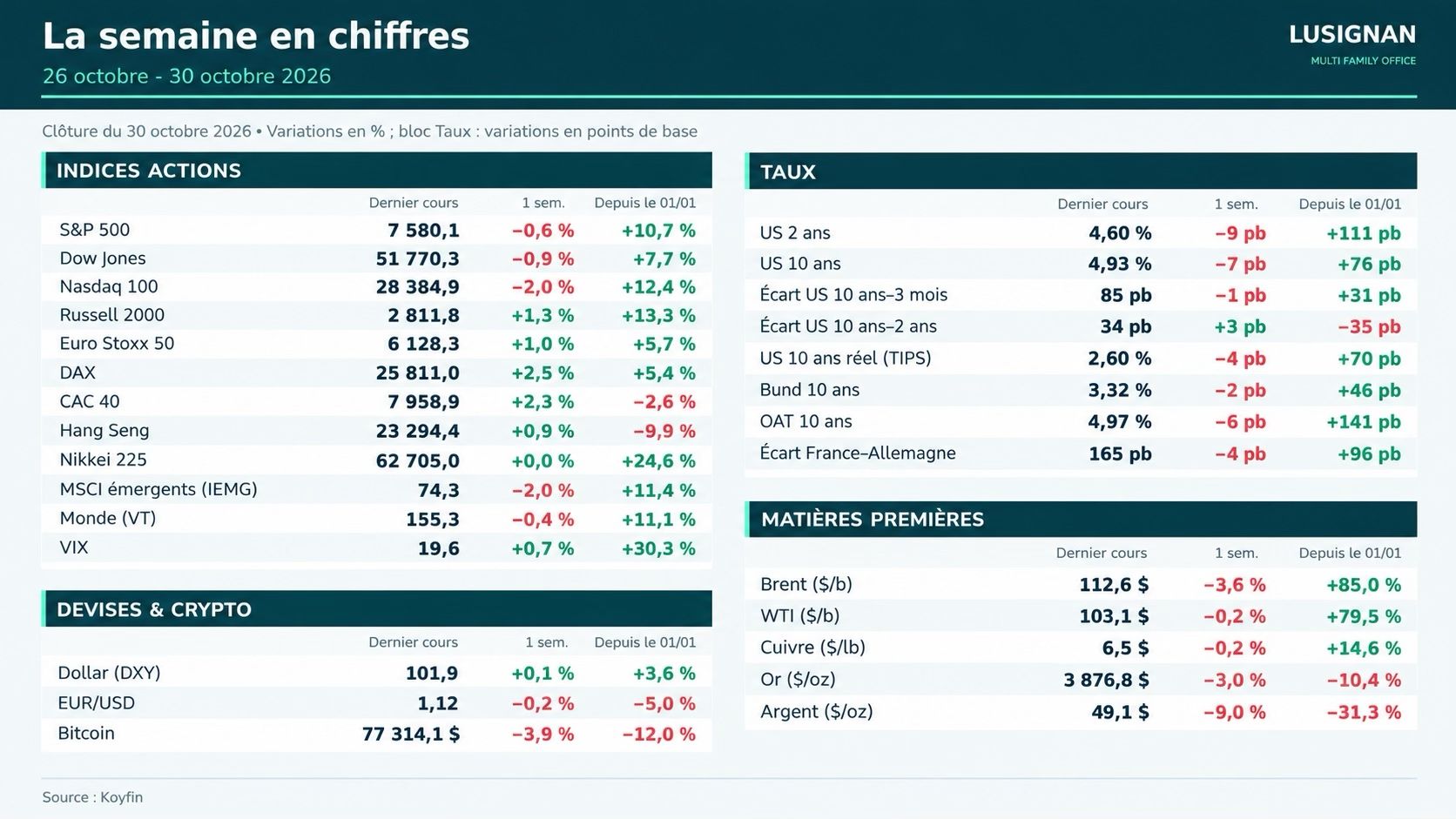
Global markets went through a pivotal week marked by a major repositioning: Wall Street posted a notable pullback, weighed down by the technology giants, while capital was redeployed towards mid-cap stocks and overlooked sectors. On the macroeconomic front, multi-speed growth persists across regions, and a central question is emerging: will the colossal investments in artificial intelligence finally deliver the expected returns?
Wall Street recorded a notable correction over the week, with the technology giants bearing the main responsibility for the pullback. At the same time, a historic reduction in positions held by hedge funds fuelled this de-risking dynamic.
This correction did not translate into a general flight to cash or to traditional safe havens. On the contrary, investors carried out a tactical redeployment towards mid-cap stocks and sectors that had been offloaded from portfolios. This rotation benefited European markets, which posted gains. The market thus appears to be less in “panic” mode than in “selective reallocation” mode.
US yields fell over the week, with bonds regaining their status as a defensive asset class in times of uncertainty. This move reflects renewed appetite for fixed-income assets in the face of equity volatility.
At the same time, credit spreads of companies active in AI widened noticeably. This phenomenon illustrates investors' growing selectivity: financing for AI remains necessary, but the risk premiums demanded are rising, signalling that the profitability issues associated with these very large-scale investments are being taken into account.
The dollar and the euro moved within narrow ranges over the period. Bitcoin, by contrast, posted a decline, weakened by a major cyberattack on a cryptocurrency exchange.
Oil fell back over the week as Saudi exports recovered and prospects of easing tensions emerged. Gold and silver both suffered significant liquidations, reflecting a less favourable environment for tangible safe havens.
US GDP accelerated to an annualised pace of 3.4% in the third quarter. Consumption rose by 3.8%, driven by household demand, while investment in AI infrastructure supported overall investment. At the same time, PCE inflation stands at 3.6% year on year, and household savings have declined. The Federal Reserve is keeping its policy rates in a range of 3.75% to 4% and is not ruling out a further hike, signalling continued vigilance against inflationary pressures.
Euro-area GDP grew by 0.4% in the third quarter, a modest advance. Inflationary pressures remain significant: inflation stands at 5.4% in Italy, 4.9% in Spain and 3.4% in France. Germany is the exception thanks to tax relief on fuel. The European Central Bank is holding its rates at 2.5% while considering a forthcoming tightening. France, for its part, recorded a contraction of 0.1%, with consumer confidence at its lowest since 2013, while Germany grew modestly by 0.2%.
Chinese industrial profits rebounded by 14.4% in September, supported by the technology sectors. The persistent weakness of domestic demand and property markets nonetheless remains a structural factor constraining overall economic momentum.
The earnings season revealed diverging trajectories. Anthropic filed for its initial public offering, temporarily reviving investor interest in the AI sector. Microsoft posted solid growth in its cloud computing activities, but announced a $25 billion financing programme.
Conversely, Alphabet Inc. and Amazon disappointed the markets with a slowdown in their core businesses and AI spending that remains high. Alphabet lost nearly $500 billion in market capitalisation on Thursday. Intel plunged 28.6% on Friday after providing disappointing guidance. Meta saw its credit rating placed under review because of the scale of its investments. Mercedes-Benz AG lowered its outlook after a 31% drop in its Chinese sales in the third quarter.
Artificial intelligence retains its status as a structural economic driver. However, one requirement has emerged clearly: the markets now demand that the massive investments made in this technology translate into tangible profitability and cash generation. The routs suffered by some technology giants reflect this transition from a phase of optimistic speculation to a phase of more rigorous commercial and financial scrutiny.
This is not investment advice.






