October 4, 2026
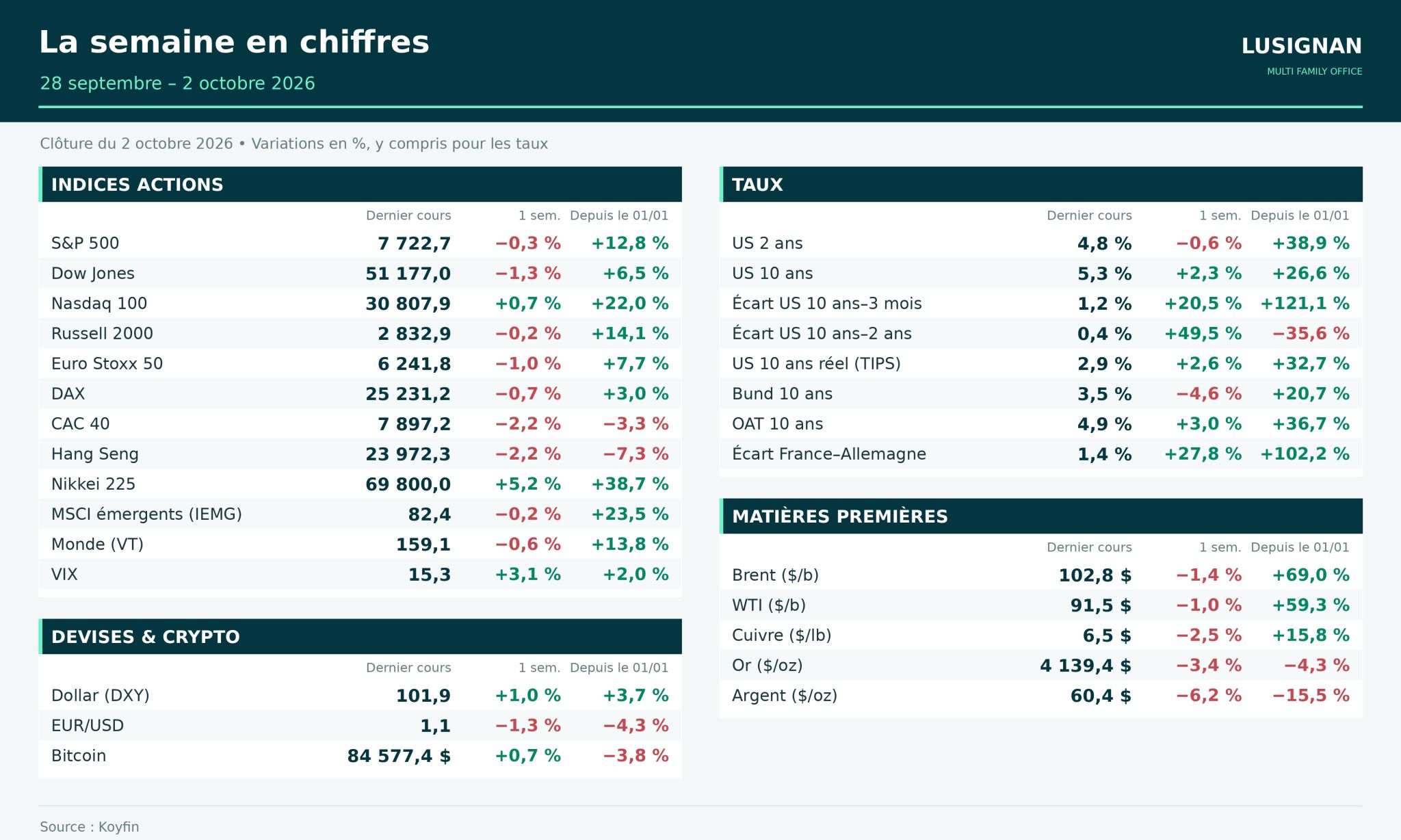
The week marked an ambiguous turning point for global markets. While US employment data eased fears of an immediate tightening of monetary policy, geopolitical tensions and European fiscal challenges weighed on risk assets and boosted the dollar. Artificial intelligence remains a driver for technology, while credit is gradually tightening financing conditions.
In the United States, the S&P 500 fell 0.3% while the Nasdaq 100 gained 0.7%, benefiting from the outperformance of AI-driven technology stocks. In Europe, the picture was less favourable: the Euro Stoxx 50 shed 1.0% and the CAC 40 slipped 2.2%, penalised by concerns over France's fiscal trajectory.
This divergence illustrates a market fragmented between technological optimism and persistent macroeconomic concerns.
The dollar appreciated 1.0% while the euro fell 1.3%, reflecting two forces: high US ten-year yields at 5.3% (up 12 basis points) and risk aversion pushing investors towards safe-haven assets.
In the euro area, tensions intensified. The yield spread between French and German bonds widened to 141 points, from 31 points the previous week. This reflects investors' doubts about the viability of France's fiscal trajectory. At the same time, credit risk premiums rose, signalling a gradual tightening of financing conditions for private and public borrowers.
Brent crude fell 1.4%, helped by the return of oil flows and the G7's announcement that it would release strategic reserves. These supply measures partly eased the tensions linked to geopolitical risks in the Middle East.
Gold shed 3.4%, penalised by the combination of a strong dollar and high real yields, which reduce the appeal of the yellow metal, perceived as yielding nothing.
The September US jobs report surprised by its weakness: only 29,000 jobs created, along with downward revisions of 60,000 for the two previous months. The unemployment rate stood at 4.2%. These disappointing figures immediately reduced expectations of a rate hike in October, supporting Friday's stock market rebound.
In parallel, core PCE inflation for August rose by only 0.2%, less than anticipated, strengthening the case for a Federal Reserve pause. However, real consumption rose 0.6%, showing that households continue to spend despite a slowing labour market.
The manufacturing PMI stabilised at 54.5, but hiring slowed more than demand, a sign of growing exposure to cyclical risks. Equity funds collected $20.6 billion over the week, reflecting a persistent appetite for US risk assets.
Euro area inflation accelerated to 3.8% in September, from 3.2% in August, mainly under pressure from energy prices. Core inflation, excluding energy and food, remains at 2.5%, more moderate.
The European Central Bank is closely monitoring these tensions, and high market rates are already slowing activity. Beijing, for its part, is stepping up targeted economic support, but the recovery remains uneven, reflecting the structural challenges of the world's second-largest economy.
Micron Technology reported quarterly revenue of $61.5 billion, beating expectations and confirming the strength of demand for AI chips. Amazon signed an unprecedented contract for 690 MW of nuclear electricity with Constellation Energy, illustrating the strategic importance of carbon-free energy for the cloud giants.
Accenture reported bookings and guidance above forecasts, benefiting from the digital transition and corporate investment in AI.
Conversely, Nike announced a restructuring and job cuts after disappointing sales, a sign that the luxury and sportswear sector is facing competitive and demand pressures.
Anthropic disclosed in its prospectus future commitments of $518 billion for infrastructure and compute, with a valuation reaching $2 trillion, illustrating the scale of investment needed to sustain the generative AI race.
The week highlighted a market in unstable equilibrium. Weak US employment data reassured investors about an immediate tightening, but they also signal a labour market that is weakening. At the same time, high long-term rates and rising credit premiums penalise borrowers and reduce growth momentum.
In Europe, fiscal tensions weigh on confidence, while the dollar gains ground. AI remains a supportive theme for large technology and infrastructure companies, but the gains are not uniform: corporate restructurings bear witness to an economy undergoing selective adjustment.
This is not investment advice.