September 9, 2026
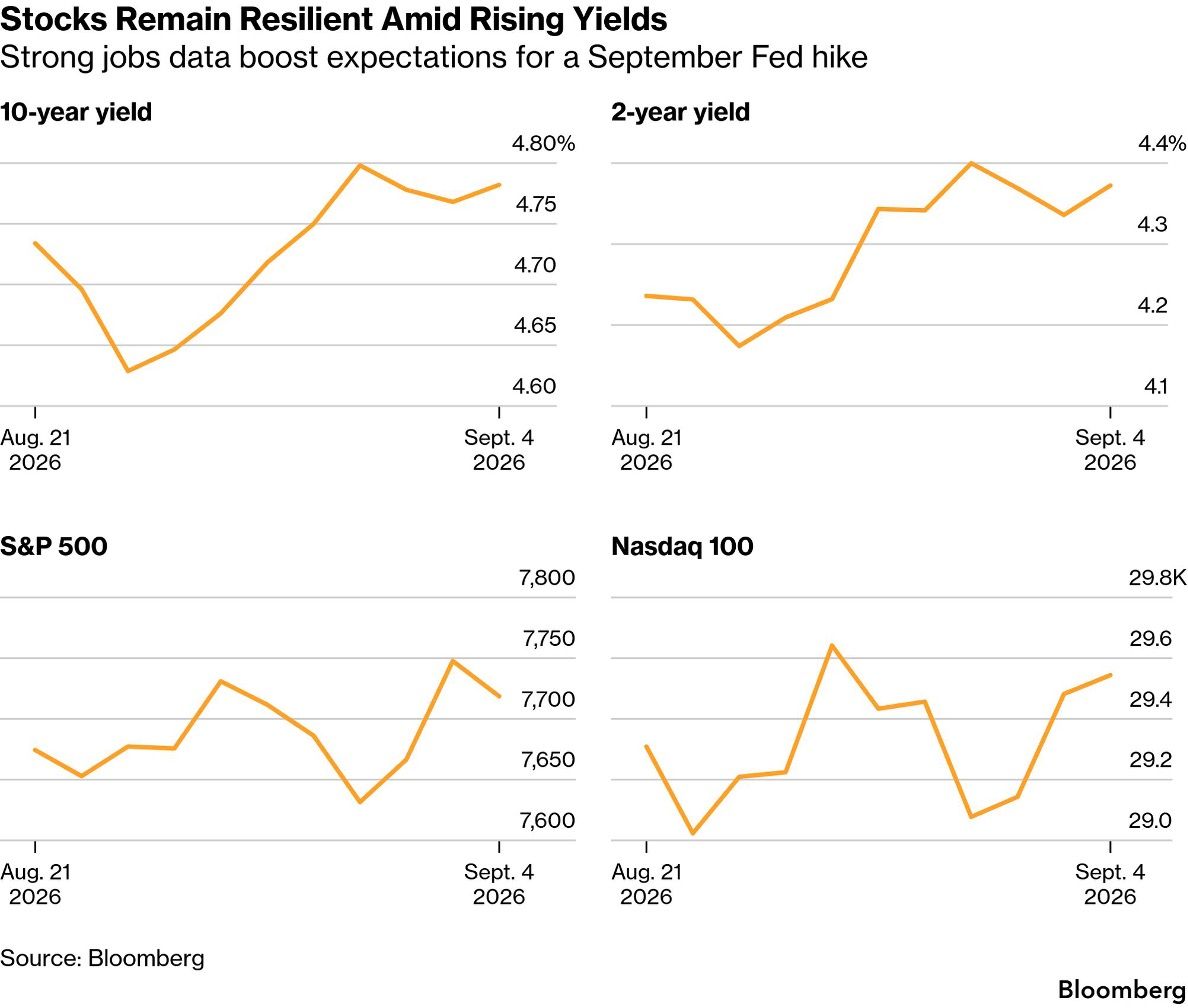
Equity markets are showing remarkable resilience despite tighter financial conditions. The S&P 500 has risen 12.8% since the start of the year even as US bond yields have moved markedly higher. This apparent contradiction raises a major question: does this strength reflect sound economic rationality, or have valuations left too little margin to absorb the shocks to come?
The apparent solidity of equity markets does not come out of nowhere. The US economy continues to create significant numbers of jobs: 162,000 positions were added in August. On the earnings front, S&P 500 profits rose 33% year on year in the second quarter.
When a rise in yields is accompanied by more robust economic growth, it often reflects an increase in nominal growth. In this context, improving earnings can offset the mechanical effect of a higher discount rate. This partly explains why equities are holding up despite higher rates.
Several structural factors are also slowing the transmission of tighter financial conditions. Fixed-rate debt of households and companies, often taken on at lower rates, continues to shield them from an immediate rise in their financing costs. For the large companies that dominate the indices, access to credit remains easy and liquidity abundant. Finally, credit premiums remain contained: 81 basis points for investment-grade bonds and 265 points for high yield.
Current valuations deserve careful examination. The S&P 500 is trading at around 20 times expected earnings, giving an earnings yield close to 5%. That is barely above the yield on the 10-year US Treasury, which stands at 4.78%.
This valuation level remains defensible under certain precise conditions: earnings growth must remain rapid. If profit forecasts are revised downwards, the yield gap between equities and bonds narrows significantly, which would make equity valuations difficult to justify.
The concentration of risk aggravates this vulnerability. Profit growth comes largely from three sectors: artificial intelligence, technology and energy. Yet the five large groups associated with AI had already borrowed 220 billion dollars in 2024. The market implicitly assumes that the profitability of these massive investments will materialise before financing becomes prohibitive. That is a plausible assumption, but it leaves little room for disappointment.
The most difficult scenario for markets to handle would combine three elements: a slowdown in economic growth, persistent inflation, and continued rate hikes by monetary authorities. In that context, rates would rise while earnings fell at the same time, removing the two pillars that currently support valuations.
Another risk concerns bond price dynamics. The US Treasury market is heavily used by leveraged funds. A disorderly rise in yields could trigger margin calls and forced selling, creating a self-reinforcing cycle of rate increases.
The real warnings would be multiple and simultaneous: the 10-year Treasury yield quickly crossing the 5% mark, the MOVE index of bond volatility exceeding 100, a marked widening of credit premiums, and a downward revision of earnings forecasts.
Markets remain rational as long as earnings and access to credit effectively absorb the rise in rates. Today, that condition holds. However, the margin for error has narrowed considerably. Bond yields now offer a genuine alternative to equities, and implied market volatility remains low, suggesting that risk expectations may not reflect the scale of the underlying vulnerabilities.
This configuration remains sustainable as long as growth and profitability conditions do not deteriorate. But it makes markets particularly sensitive to the slightest change in the economic or financial regime.
This is not investment advice.






