October 30, 2026
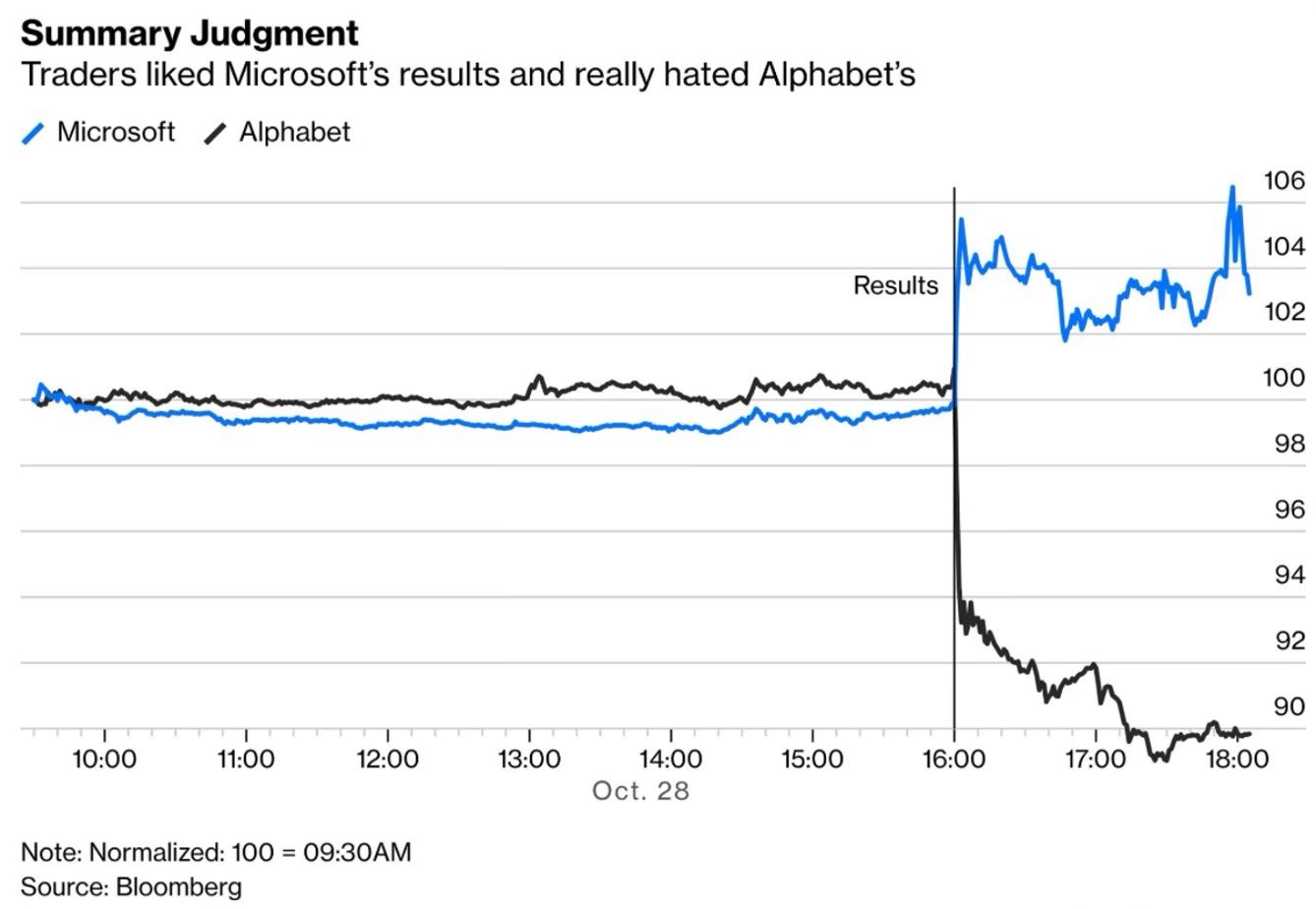
The October 2026 quarterly results of Microsoft and Alphabet mark a major turning point in how the tech giants are valued. While Microsoft converts AI demand into robust cash flows, Alphabet faces a paradox: spectacular cloud growth sits alongside a slowdown in its core advertising business. Markets now penalise not growth itself but how it is funded and how profitable it is.
Microsoft posted revenue of $92.3 billion, up 19%, while Azure, its strategic cloud business, jumped 48% – beating expectations of 44%. More telling still: free cash flow reached $18.6 billion, exceeding forecasts by $10 billion.
This performance reflects a model that works: AI investments are quickly translated into marketable applications, capturing demand from companies ready to spend on solutions that can be used immediately.
Alphabet reported revenue of $127.6 billion, up 25%, and Google Cloud surged +103%. However, the legacy advertising business – the main source of profits – disappointed: $82 billion against $83.4 billion expected. Critical point: free cash flow contracted by $9.1 billion.
Both companies are devoting colossal sums to AI: $45.2 billion per quarter for Microsoft, around $51 billion for Alphabet. But the path to conversion remains uneven.
For Microsoft, AI drives a virtuous circle: accelerated growth, abundant cash, self-funded future investment. The delivery delays seen in its results do not call the ambition into question, only its timetable.
For Alphabet, the picture is more complex. Google Cloud shows remarkable momentum, but AI-enhanced searches still generate less advertising revenue than traditional searches. The company must therefore solve a delicate equation: monetise AI without cannibalising its revenue base.
The market reaction was clear-cut. Alphabet plunged 12.6%, wiping out more than $500 billion of market capitalisation. Microsoft, initially up 3%, ended almost flat.
The severity of the penalty inflicted on Alphabet goes well beyond the disappointment on advertising revenue. Investors are expressing a deeper concern: spending is accelerating while cash is deteriorating, and the future profitability of these investments remains opaque.
This contrast reveals a shift in valuation criteria. Growth alone no longer captivates the markets. Cash flows, the marginal return on investment and visibility on how it is funded have become decisive.
This selectivity is probably not a temporary accident. With more than $700 billion of investment planned in 2026 for the sector's four American giants, the gaps between companies will widen. Those that convert this spending into sustainable cash flows will see their valuations rewarded; the others will face greater market discipline.
This environment favours actively managed portfolios that pay attention to valuations and financial fundamentals. Managers with the expertise to discern the real returns on AI investments – beyond mere announcements – can create relative value.
Artificial intelligence retains its transformative potential for revenue growth and operational efficiency. But markets now distinguish investments that create immediate value from those that promise to create it later. This distinction, long obscured by technological euphoria, is gradually taking hold.
This is not investment advice.






