The essentials in one coffee
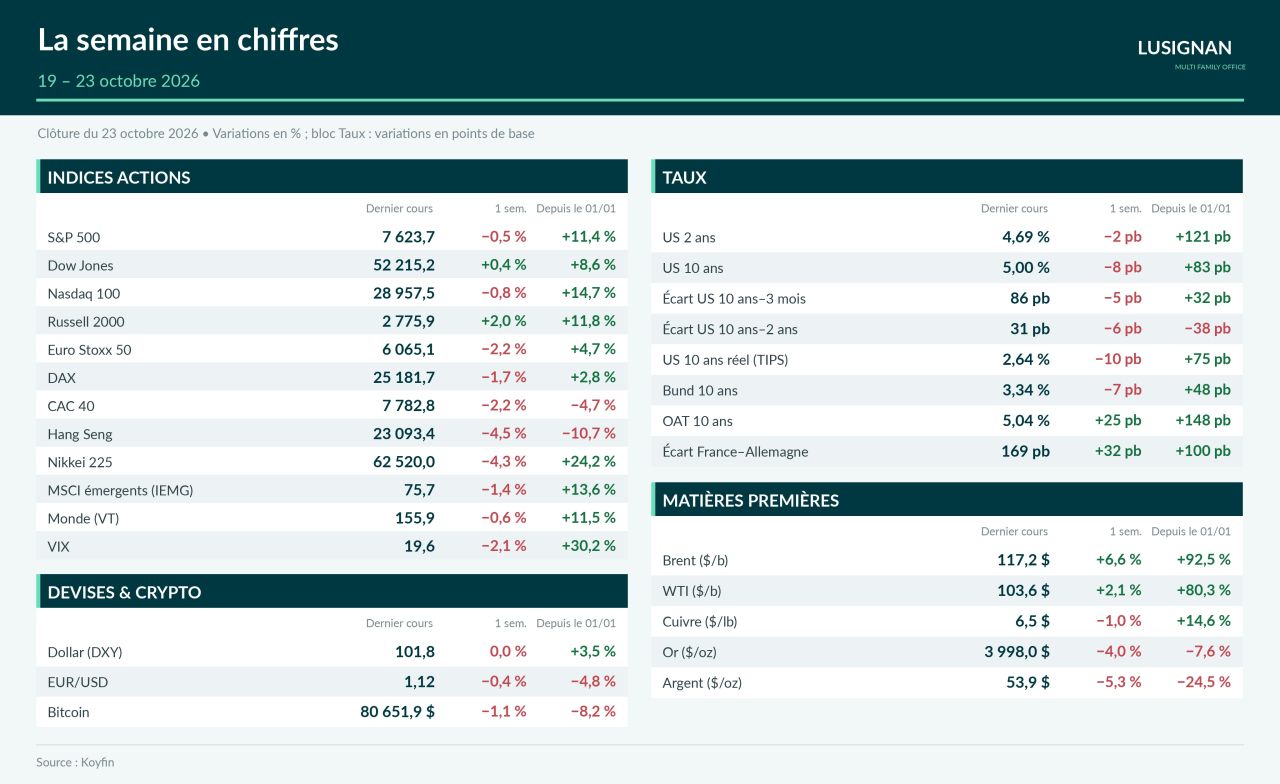
- France: OAT-Bund spread at 167 bp, highest since 2011; the 10-year OAT crosses 5% for the first time since July 2002, on the eve of Moody’s verdict.
- AI: semiconductors lose 6.7% on Thursday, worst session since June; money moves into the equal-weighted S&P 500 (+1.9% over the week) rather than leaving the market.
- Energy: Brent at $116.64 (+6% over the week, +90% since 1 January) after Houthi attacks on Saudi Arabia.
- Rates: bonds become a hedge again — the US 10-year loses 17 bp on Thursday, its best session in more than two years; pause expected from the Fed and the ECB this week.
FRANCE · DEBT & BUDGET
Genuine distrust, amplified by a positioning shock
- The triggers: the 17 October mobilisation (550,000 demonstrators according to the Interior Ministry, more than 1,800 arrests), 2027 budget still not passed, presidential election in April; energy +21.3% year on year in September.
- The mechanics: hedge funds holding OATs with high leverage had to cut their positions, in a market whose depth was more than 50% below normal (Allianz Trade); they would account for roughly half of the move (Fidelity International).
- Limited contagion: the euro now tracks the spread (EUR/USD at 1.12), but the large banks remain little exposed (€64bn of OATs, 17% of their equity) and Schneider Electric raised €6bn in an issue oversubscribed several times over.
LUSIGNAN'S VIEW — Forced sellers have largely exited and long-term investors are reappearing in the 7-10 year segment: a less gloomy reading than the consensus. France risk remains concentrated in domestic stocks, not the market as a whole — patience and selectivity.
RATES & CENTRAL BANKS
Bonds regain their role as a hedge
- Thursday: while semiconductors were sliding, the US 10-year lost 17 bp to end the week at 4.99%: when AI coughs, bonds protect again.
- Inflation: 3.7% in the United States and 3.8% in the euro area in September; status quo expected from the Fed on Wednesday (3.75-4.00%) and from the ECB on Thursday (2.50%), with a final move more likely envisaged in December.
- US debt: a $32,000bn market, nearly 70% held by private investors who are more sensitive to yields: the return demanded at the long end can remain high, even if the Fed cuts short-term rates.
LUSIGNAN'S VIEW — Yields not seen in more than twenty years (US 10-year near 5%, TEC 10 at 5.05%) and a recovered hedging function: quality carry becomes attractive again. With the central bank calendar priced in, oil and credit will guide long rates.
AI & CREDIT
The bill arrives: the market asks who pays for AI
- Rotation: on Thursday, Nasdaq 100 −2.9% and semiconductors −6.7%, but 336 S&P 500 stocks up against 165 down, the equal-weighted index +0.8% and consumer staples at a record.
- Financing: $419bn of AI-related bond issuance since January (+90% compared with all of 2025); Oracle default insurance at a record, CoreWeave’s above 1,000 bp; Meta’s first negative free cash flow since 2012.
- Credit: global spreads at their widest since May 2025 (129 bp), iTraxx Crossover at 341 bp: the risk is priced in, without investors fleeing.
LUSIGNAN'S VIEW — The market is sorting AI between profitable, self-financed producers and borrowers building their data centres on credit: issuer quality matters as much as the theme. Money is leaving semiconductors, not the market.
ENERGY, METALS & CHINA
Oil takes back control, China holds its growth
- Oil and gas: Houthi strikes on the Shaybah field (Aramco) and Dammam airport, Strait of Hormuz still closed; European TTF gas touches €93.19, highest since 2022, with low stocks ahead of winter.
- Metals: gold fails its safe-haven test (−4.1% to $3,997) despite easing rates; silver gives up 6.2%.
- China: GDP +4.5% year on year in Q3 (4.4% expected), driven by the external sector (exports +36.3% in September) while property investment falls 20.6% over nine months.
LUSIGNAN'S VIEW — As long as Brent holds above $110, central banks lack room and Europe pays more than the United States. The Chinese surprise benefits technology supply chain suppliers first; luxury is still waiting for the Chinese consumer.
OTHER NEWS
In brief
- Results in Europe: L’Oréal (organic growth of 7.7%), EssilorLuxottica (up to +11%) and SAP (cloud backlog +26%) welcomed; Kering (around −16% over the week) and Carrefour (up to −12%, targets lowered after the riots) punished.
- Results in the United States: a good season, poorly rewarded — Lockheed Martin jumps up to 10% on missiles, while Netflix (−5.7%) and General Motors (−6.6%) fall on cautious outlooks.
- This week: vote on the 2027 budget in the National Assembly on Tuesday, Fed on Wednesday, ECB on Thursday; Alphabet, Microsoft and Amazon report; US midterm elections on 3 November.
This is not investment advice.