The essentials in one coffee
- Fed: +25 bp to 3.75-4.00%, unanimously, the first hike since July 2023; 16 of 18 members see at least one more hike this year.
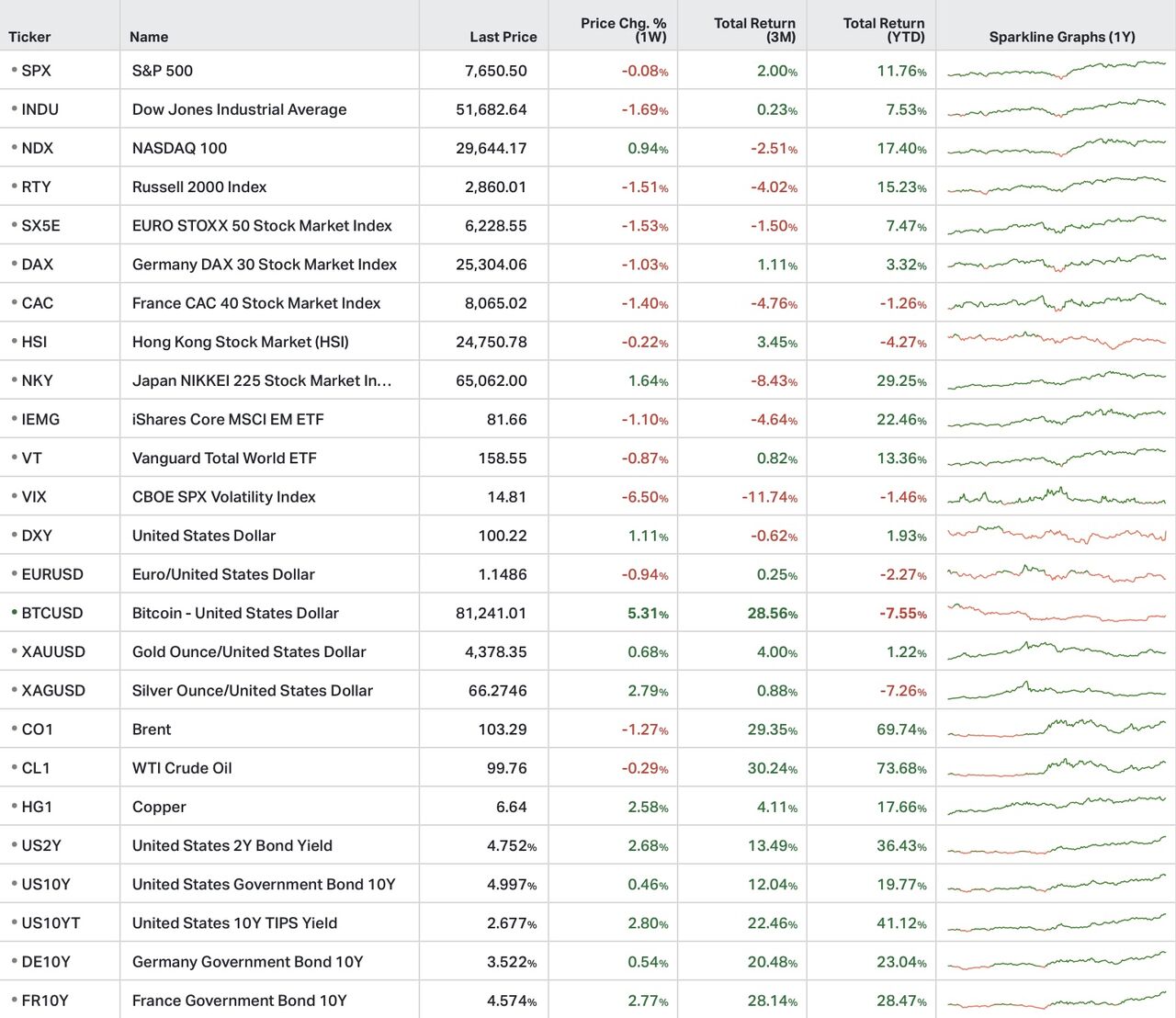
- Rates: the US 10-year ends at 5.01% after a high not seen since 2007; the OAT-Bund spread reaches 100 bp, a first since 2012.
- Japan: the BoJ takes its rate to 1.25%, highest since 1995, without convincing; the yen touches 158 against the dollar before a “rate check”.
- Energy & AI: Brent at $103.33 after a peak at $108.75; the call to slow down AI costs semiconductors 5% on Monday.
CENTRAL BANKS
The Fed hikes, and says so; Tokyo and London stay vigilant
- Fed, Wednesday 16: 25 bp hike to 3.75-4.00%, vote 12-0; median “dots” for end-2026 at 4.1% against 3.8% in June. Kevin Warsh: “inflation is too high, and has been for too long”.
- An economy holding up: retail sales +1.2% in August (+0.8% expected), control group +1.4%; the market prices a 50 to 55% probability of a second hike as early as 28 October.
- BoJ and BoE: the BoJ hikes to 1.25% (vote 7-2); the Bank of England stays at 3.75% by 6 votes to 3, with inflation back up to 3.1%.
LUSIGNAN'S VIEW — Credible tightening, but not yet finished: stay invested with selectivity, keeping the 30 September PCE revision and the 28 October Fed in sight.
RATES & DEBT
5% in the United States, 100 bp for France
- United States: the 10-year ends at 5.01%, the 2-year touched 4.74%; the 2-10 year curve is at its flattest in eighteen months and the 30-year mortgage rate reaches 6.97%.
- France: OAT-Bund spread at 100 bp (Bloomberg), 10-year OAT at 4.56%, highest since 2008; around €30bn of savings proposed for 2027, finance bill on 30 September.
- The threshold to watch: above 5.25-5.50% on the US 10-year, equities and bonds would tend to move in the same direction (Bloomberg).
LUSIGNAN'S VIEW — Rates at these levels make it possible to lock in high coupons, preferably with capital protection; the State's credit quality is not in question, attention is on the fiscal trajectory.
ENERGY & GEOPOLITICS
The Saudi pipeline, Hormuz and diesel
- East-West pipeline: closed after attacks, it allowed Hormuz to be bypassed; Brent touches $108.75 on Tuesday then falls back to $103.33 (–1.3%), still +29% over three months.
- Hormuz: 9 tankers a day leave it, against 25 to 30 before the conflict (Morgan Stanley).
- Diesel: $6.25 a gallon on average in the United States, the historical equivalent of Brent at $190 (Bloomberg); oil and the US 10-year now move in tandem.
LUSIGNAN'S VIEW — As long as the pipeline and the strait remain disrupted, energy sustains inflation and volatility: favour solutions that combine yield and capital protection.
EQUITIES
AI eases off, software breathes
- Monday's shock: Dario Amodei's call to slow down the most powerful models, backed by Sam Altman and Elon Musk, costs semiconductors 5%; cybersecurity gains 11%, software rebounds.
- Over the week: S&P 500 –0.1%, Nasdaq 100 +0.9%, Euro Stoxx 50 –1.5%, CAC 40 –1.4%, Nikkei +1.6%; rate-sensitive stocks suffer more.
- Valuation: the S&P 500 trades at around 19 times expected earnings, and the Shiller CAPE is at 41, the level of 2000; in Europe, Volkswagen cuts its 2026 margin to 1% at most.
LUSIGNAN'S VIEW — With rates at 5%, valuation becomes the real issue: stay invested, but selective — it is earnings, not multiples, that carry the market.
OTHER NEWS
In brief
- China: industrial production +5.2%, but retail sales +0.4% and fixed investment –7.2%: domestic demand remains very weak.
- Gold: +0.7% over the week to $4,379 despite the Fed; gold ETFs took in $18bn in August, the second-largest monthly inflow in history.
- Companies: Generac signs an agreement with Amazon worth up to $8bn for data centres; Warren Buffett steps down as chairman of the board of Berkshire Hathaway.
This is not investment advice.