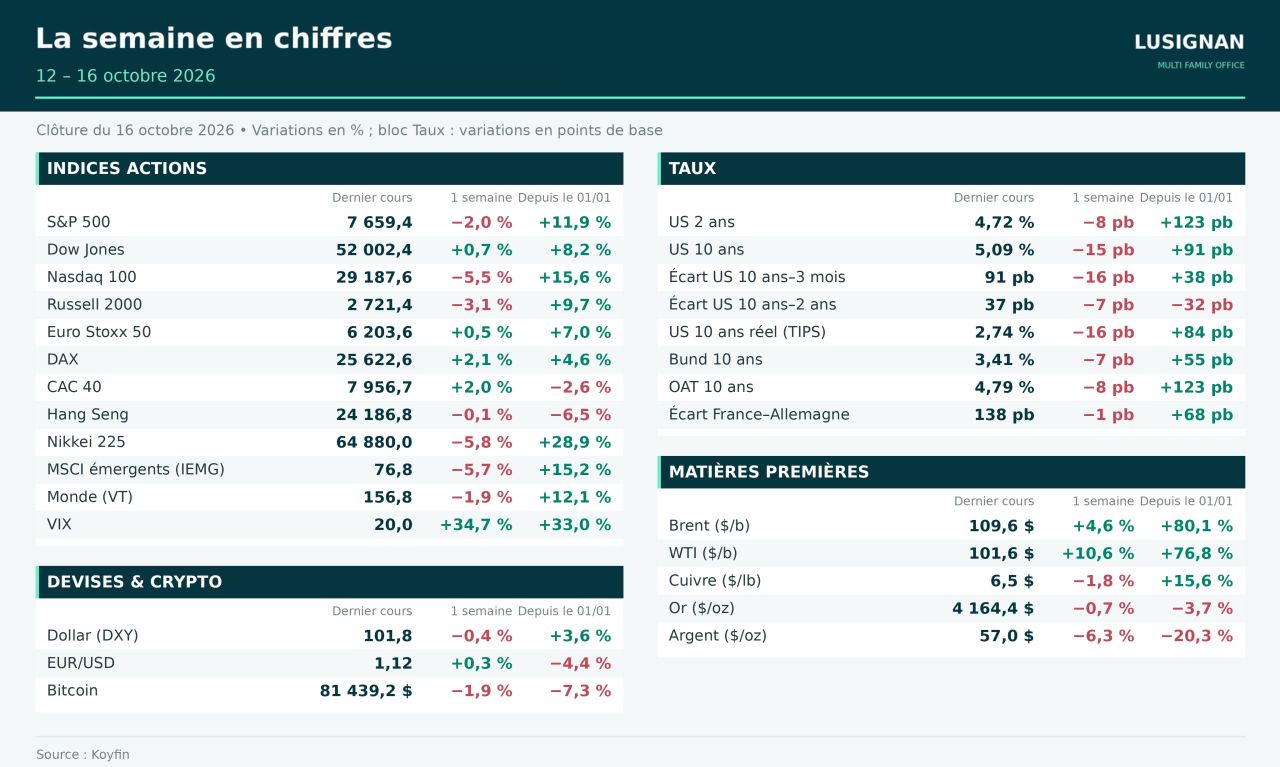
The essentials in one coffee
- Inflation: US CPI at 3.7% (3.6% expected); oil remains the transmission belt.
- Oil: attacks around Hormuz, Brent back near $110 (+4.9% on the week).
- AI & credit: CoreWeave bonds below 80% of par; the market is testing financing, not demand.
- Markets: S&P 500 within 2% of its record, CAC 40 +2%, Kospi −14.5%: rotation rather than capitulation.
RATES & CENTRAL BANKS
Hotter inflation, long rates easing
- US inflation: September CPI at 3.7% year on year (3.6% expected), energy +20.4%; producer prices +6.3% year on year, the sharpest rise in more than four years.
- Fed: the probability of a hike as early as 28 October rose to nearly 50% after the CPI, before falling back to around 15% on Friday; swaps price in a hike in December.
- Long rates: the US 10-year ends at 5.07%, versus a peak of 5.36% the previous week; bonds once again played their role as a hedge for equities.
LUSIGNAN'S VIEW — The level of yield offered by quality bonds deserves to be locked in: it is once again a credible alternative to equities. Caution on long maturities ahead of the 27-28 October Fed, as inflation remains driven by energy.
ENERGY & GEOPOLITICS
Hormuz keeps inflation alive
- Oil: Brent ends at $109.86 (+4.9% on the week), WTI gains 10.4% and European gas 7.5%; flows through the strait fall to 11.6 million barrels per day, versus 17.2 in normal times.
- Supply responses: accelerated release of IEA emergency stocks, Russian diesel (a $1 to $2 per barrel effect according to Goldman Sachs) and 17 million barrels offered by Washington: without bringing prices down.
- IMF: part of global resilience rests on stock drawdowns; the 2027 rebound assumes a gradual reopening of Hormuz from March.
LUSIGNAN'S VIEW — Asymmetric risk: as long as emergency stocks compensate, the barrel remains contained; should they run out before the strait reopens, oil would rally again, and rates with it. Above $100, it is the primary risk factor for risk assets.
AI & CREDIT
AI tested by the cost of capital
- CoreWeave: stock −15.5% on 14 October, five-year CDS near 1,195 basis points, 2032 bonds around 76.5 cents for a yield close to 16%; $35.1bn of financial debt at end-June.
- Contagion: eighth consecutive session of declines for US semiconductors, a first since October 2008; the Kospi sheds 14.5% on the week and enters a bear market.
- Demand intact: ASML raises its annual guidance for the third consecutive quarter, TSMC guides Q4 between $52.3bn and $54.3bn: the market is testing financing, not demand.
LUSIGNAN'S VIEW — Selectivity: favour players that fund AI from their own equity and convert their capacity into revenue and cash. The risk would become systemic if credit tightened beyond AI: that is not demonstrated at this stage.
FRANCE
OAT: a widening deemed excessive, Moody’s on 23 October
- Rates: the 10-year OAT ends at 4.80% and the spread to the Bund at 138 basis points; Goldman Sachs deems the widening excessive and sees a tightening in the coming weeks instead.
- CAC 40: −4.24% year to date as of 12 October (dividends reinvested) versus +7.03% for the Euro Stoxx 50, but +2% on the week; around 85% of CAC 40 revenue comes from abroad.
- Agenda: Moody’s review on 23 October (Aa3, negative outlook), then S&P on 27 November (A+); deficit expected at 5.4% of GDP in 2026.
LUSIGNAN'S VIEW — 23 October is the next tipping point: a confirmed rating would tighten the spread and relieve banks and insurers. Until then, favour the CAC 40's large exporters over small domestic stocks, which are more sensitive to credit.
OTHER NEWS
In brief
- US banks: equity trading sharply higher (+72% at Goldman Sachs, +49% at JPMorgan); record inflows of $232bn at Morgan Stanley, Bank of America disappoints (down as much as −8.7% intraday).
- Q3 results: earnings expected up 29.6% for the S&P 500 and 21% for the STOXX 600; Schneider Electric raises its target, LVMH grows only 1%.
- IMF: global growth raised to 3.1% in 2026, then 3.4% in 2027; France lowered to 0.4% then 0.7%.
This is not investment advice.