September 24, 2026
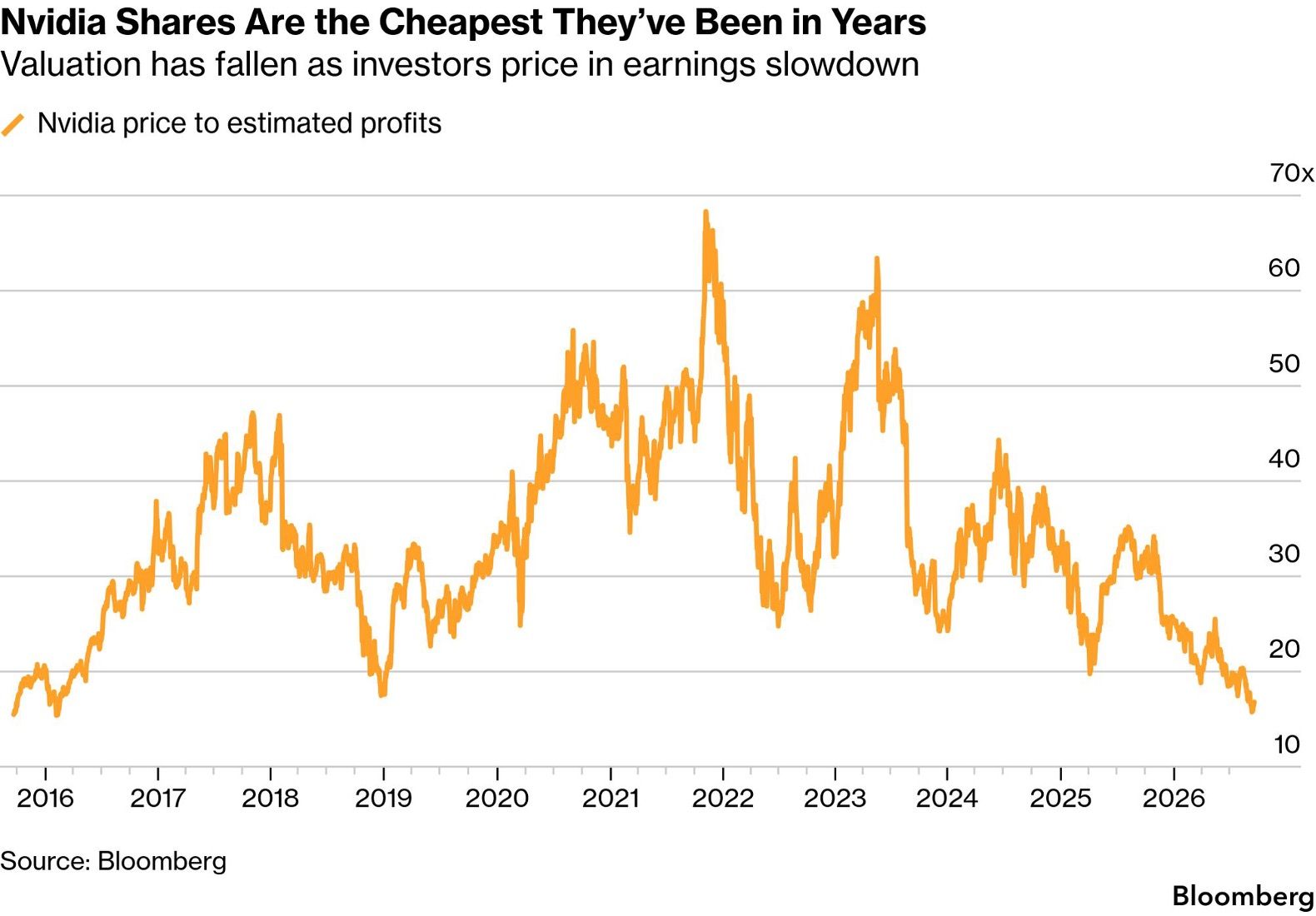
Nvidia is posting spectacular results: $96.2 billion of revenue in the latest quarter, up 106% year on year. Yet despite expected growth of 70% for 2028, the market is asking a crucial question: will the semiconductor giant be able to keep its exceptional margins once its customers have more choice and demand more transparent returns on their infrastructure investments?
In the latest quarter, Nvidia generated a gross margin of 75%, a sign of almost unprecedented dominance of its market. The company's guidance for its fiscal 2028 (ending January 2028) calls for 70% sales growth. At the same time, the analyst consensus anticipates strongly rising normalised earnings per share: $9.3 in 2027, $15.7 in 2028 and $21.1 in 2029, a compound annual growth rate of 50% over the period.
At first glance, these figures would justify a premium valuation. At a share price of $224.5, the stock trades at 14.3 times expected 2028 earnings and 10.7 times 2029 earnings. Yet this multiple has fallen significantly, revealing an interesting disconnect: earnings forecasts keep improving, while the market is becoming more demanding on valuation.
Nvidia's growth rests on two closely linked pillars. The first is the continued expansion of data centres worldwide, driven by demand for computing capacity. The second is technological renewal: each new generation of processors must support both higher sales volumes and a higher average price per unit.
This balance is not trivial. Nvidia itself expects a temporary compression of its gross margin, from 75% currently to 71–72% in the last quarter of its current fiscal year, before a return to 72–73% in 2028. To get there, the company intends to raise its prices, notably to offset higher memory costs.
This seemingly technical detail reveals a major economic reality: on an annual revenue base of $700 billion, each point of gross margin represents $7 billion of gross profit. At this scale, preserving margins is no longer a bonus; it is a necessity for earnings growth.
Nvidia's major customers, notably cloud operators and digital service providers, are investing massively in computing infrastructure. To justify this spending, they must extract a substantial return from their data centres.
The base case assumes that this profitability will remain sufficient to justify orders at the same pace. But the market doubts this assumption. If customers observe insufficient returns, or if payback cycles lengthen, they may slow their orders or demand lower unit costs. Neither of these scenarios is favourable to Nvidia's margins.
Nvidia's largest customers are developing their own semiconductors. Although global demand for computing capacity keeps growing, the diversification of supply sources strengthens buyers' bargaining power.
Nvidia could continue to increase its sales volumes, but in a context of heightened competition. The logical consequence: more processors sold, but at lower unit prices or with compressed margins, since customers would have alternatives.
Nvidia's current valuation, even at a reduced multiple, rests on a precise premise: customers will keep paying more for new generations of processors, while leaving Nvidia a substantial share of the value created.
This scenario is not impossible. Demand for compute remains robust and Nvidia's processors offer superior performance. However, it also assumes that customers will tolerate a compression of their own margins to finance more expensive equipment, or that the business models of digital services will generate enough additional return.
The real test will come when two conditions converge: greater availability of technological alternatives and more rigorous scrutiny of investment returns by customers. At that point, Nvidia will have to demonstrate its ability to preserve its margins while remaining the market's preferred choice.
Nvidia has no doubt about its ability to sell more. The market rather doubts that it can do so at current prices and margins, once competition has intensified and the scrutiny of returns has hardened. Rising earnings forecasts reflect expected growth; the falling multiple reflects uncertainty about the durability of margins. This disconnect is the market's real signal.
This is not investment advice.






