October 9, 2026
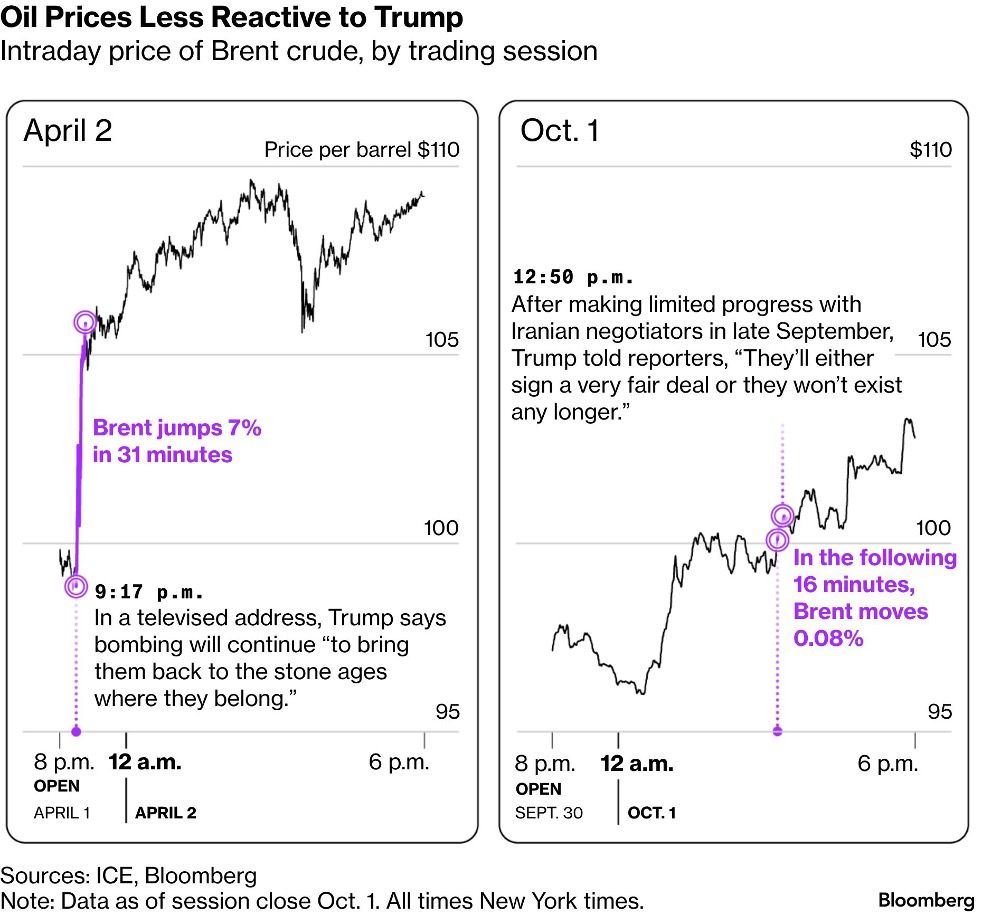
The oil market is adapting. Where a threat from Trump triggered a 7% rise in Brent in 2026, comparable statements now produce moves of only 0.08%. This shift reveals a fragile balance: operators place less trust in words, favour flow data, and accept higher supply costs in exchange for greater resilience.
Between April and October 2026, Brent's responsiveness to threats collapsed. This phenomenon reflects several realities: repeated statements without follow-through, promises of agreement followed by reversals, and the absence of immediate evidence on cargoes have worn down the credibility of political signals.
Traders are adopting a more rigid stance. They wait for tangible evidence, watch the physical flow of vessels and the diversion routes rather than betting on statements. This change in behaviour also reduces open positions: speculative positions on Brent are at their lowest since March 2025, a sign of reduced risk appetite.
However, this operator fatigue does not eliminate volatility. A real disruption of deliveries or a concrete military escalation could still move markets, but operators avoid committing before they have facts.
At the end of September 2026, Middle East crude exports were back to 98% of their pre-war level. For refined products, the restart is slower: only 58%. This asymmetry reveals where the real tension is concentrated.
Tankers sail via alternative routes, bypass risk areas, and suppliers outside the Gulf are increasing their market share. The adjustment did not wait for a peace agreement; it was built around the acceptability of additional costs.
Maritime freight illustrates this acceptability. On United States–Asia routes, the cost reaches $38.50 per barrel for a very large crude carrier. This spread reflects detours, enhanced insurance and delays. The market absorbs these extra costs rather than seizing up.
Refining remains the bottleneck. More exported crude is not enough to ease finished products, particularly diesel and jet fuel. Refineries remain saturated or damaged, and their capacity has not kept pace with the recovery in crude exports. This lag prolongs tensions on heating energy and heavy mobility.
The adjustment is not only about supply. The IEA forecasts a 2.5 million barrels per day decline in global consumption in 2026. Three factors are at play: high prices reduce demand in sensitive economies, fuel shortages constrain activity in certain sectors, and supply restrictions force energy efficiency.
This decline absorbs part of the production that has returned. Without this contraction, prices would have had to rise more sharply or stocks would have accumulated. Demand therefore acts as an invisible but effective shock absorber.
The Brent price alone no longer tells the full energy story. Three additional dimensions weigh on economies:
Freight. At $38.50 per barrel on long routes, transport surcharges are becoming structural. They add to the spot price and fuel inflation in importing countries.
Tight refining. Finished products (diesel, jet fuel, petrol) remain more expensive than crude would justify, because capacity is insufficient. This tension on derivatives weighs more on heating and transport than the crude price does.
Precarious stocks. Depleted fuel reserves leave little margin against an attack or a delivery interruption. In a sudden recovery in demand, these stocks would be absorbed quickly, limiting any easing of prices.
The stability of flows from the Middle East, and their offset by other routes, remains the key. In early October, the decline through the Strait of Hormuz was offset elsewhere, but this recovery remains fragile. Any interruption, even local, could spread for lack of margin.
Monitoring of transport costs, regional spreads (indicators of local tension) and stored fuel levels. Declining stocks signal lower resilience; a surprise recovery in demand could then exceed available supply, even if crude returns.
Futures contracts and time spreads indicate whether the market anticipates normalisation or persistent tension. A market in "backwardation" (forward prices below spot) suggests tight short-term supply, while "contango" (higher forward prices) indicates an expectation of easing.
The oil market has learned to decode announcements without taking them at face value. It has developed alternative routes, accepted logistical surcharges, and adjusted demand downwards. On these three fronts, resilience is real.
But this solidity rests on costly balances and thin stocks. A concrete military escalation, a major refinery interruption, or a simultaneous rebound in demand could blow this balance apart. For now, the market is holding, but it has not gained flexibility; it has only shifted its breaking point.
This is not investment advice.