November 4, 2026
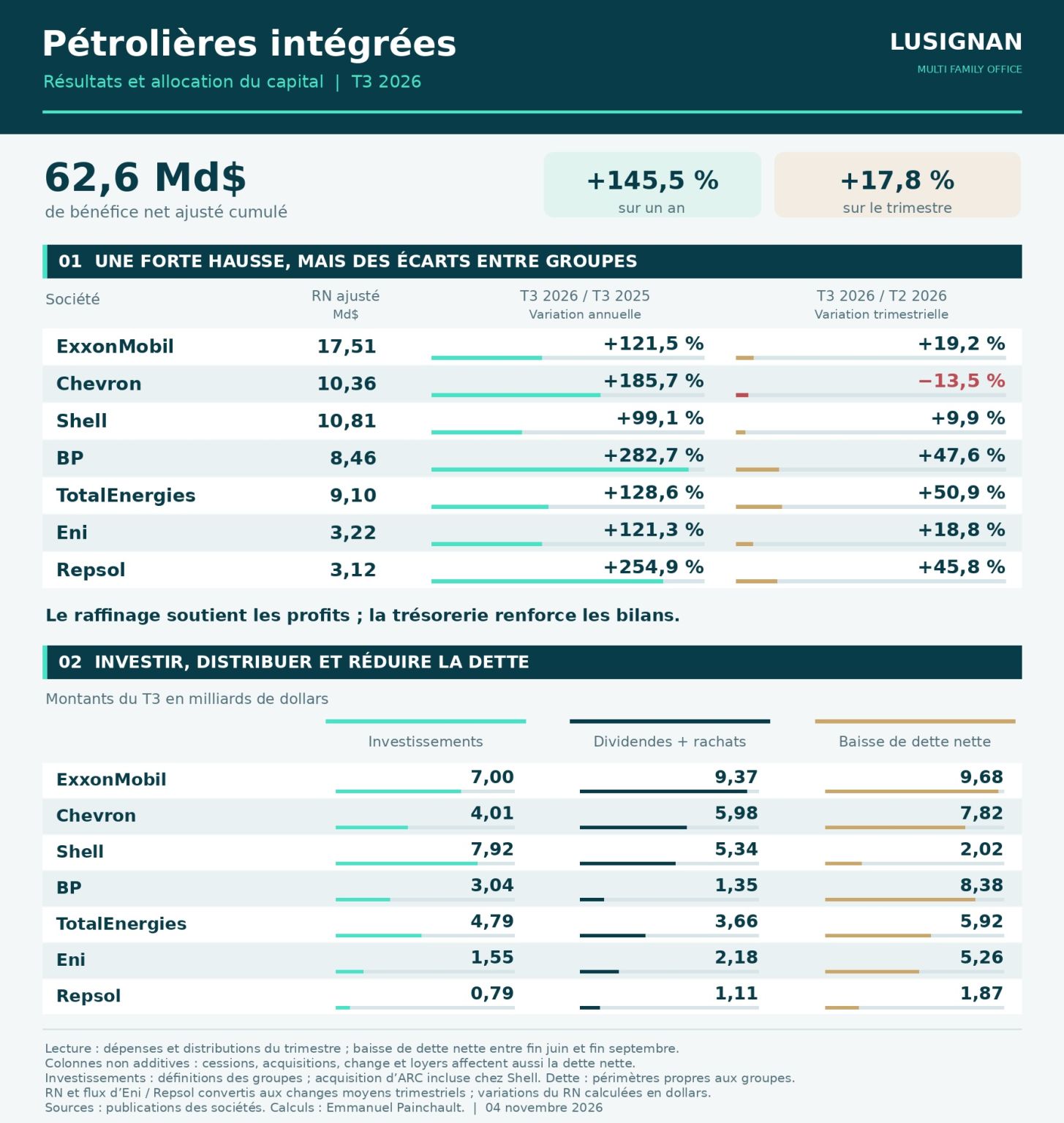
The seven global oil majors recorded remarkable growth in net earnings in the third quarter of 2026, driven not by crude extraction but by integrated control of their value chains. As crude prices fall, refining, gas and international trading are becoming the drivers of profitability, revealing the strategic importance of asset location and operational complementarity.
Over one year, the seven majors accumulated $62.6 billion in adjusted net earnings, an increase of 145.5%. This spectacular performance masks a structural turning point: the source of profits is shifting along the value chain.
ExxonMobil illustrates this phenomenon. Between the previous quarter and Q3, adjusted earnings from its energy products (refining and distribution) rose from $4.1 billion to $9.1 billion, more than doubling. At the same time, upstream earnings (extraction and production) fell from $9.2 billion to $7.3 billion.
This reversal reflects an often underestimated operational reality: having crude does not guarantee the supply of finished fuels. Disruptions to refining capacity—whether from maintenance, incidents or regional imbalances—create bottlenecks. Those who control the processing facilities and have reliable access to cargoes capture the price spreads and differential margins.
Facility availability, access to cargoes and control of transport—assets that set the majors apart from pure producers—are becoming decisive. International gas and trading activities reinforce this position. Those who exploit the regional price spreads created by the fragmentation of energy markets generate additional margins.
Geographic location and asset complementarity are emerging as durable competitive advantages, not easily replicated by new entrants.
The exceptional cash generated is not financing a general revival of investment. On the contrary, it feeds three uses in order of priority: deleveraging, dividends and share buybacks. Investment budgets remain contained, signalling capital discipline in the face of macroeconomic uncertainty.
This orientation reveals strategic maturity: strengthening balance sheets rather than betting on volume growth. The groups are choosing resilient solidity over aggressive expansion.
Global cost pressures are not disappearing, but some majors are offsetting them with internal efficiency gains. BP cut its underlying costs by 4.1% year on year. However, a normalisation of refining margins—if it occurs—could expose still-high operating costs. Repsol saw its transport and freight costs jump 63%, a trend that could spread if logistical volatility persists.
In terms of strategic allocation, the majors favour low-cost resources, natural gas and extensions of existing facilities. Disposals and partnerships free up capital for the projects judged most profitable, without abandoning the energy transition.
Nevertheless, approaches diverge. BP is beginning to refocus its renewables portfolio. Shell is tightening the selection of green investments. TotalEnergies is pursuing a more integrated electricity model. Eni is financing renewable projects through partnerships. These differences reflect distinct trade-offs between immediate profitability and long-term positioning, as well as differences in perceived financing needs.
The strength of the integrated model will be fully measured when refining margins and regional price spreads converge towards normalised levels. For now, exceptional profits are strengthening balance sheets and attesting to the resilience of the vertical value chain in the face of short-term oil shocks.
However, this dynamic rests partly on fragmented regional supply-demand conditions. Better integration of energy markets or a lasting normalisation could erode refining margins and narrow trading spreads, bringing profitability back to more moderate but potentially more stable levels.
This is not investment advice.






