November 5, 2026
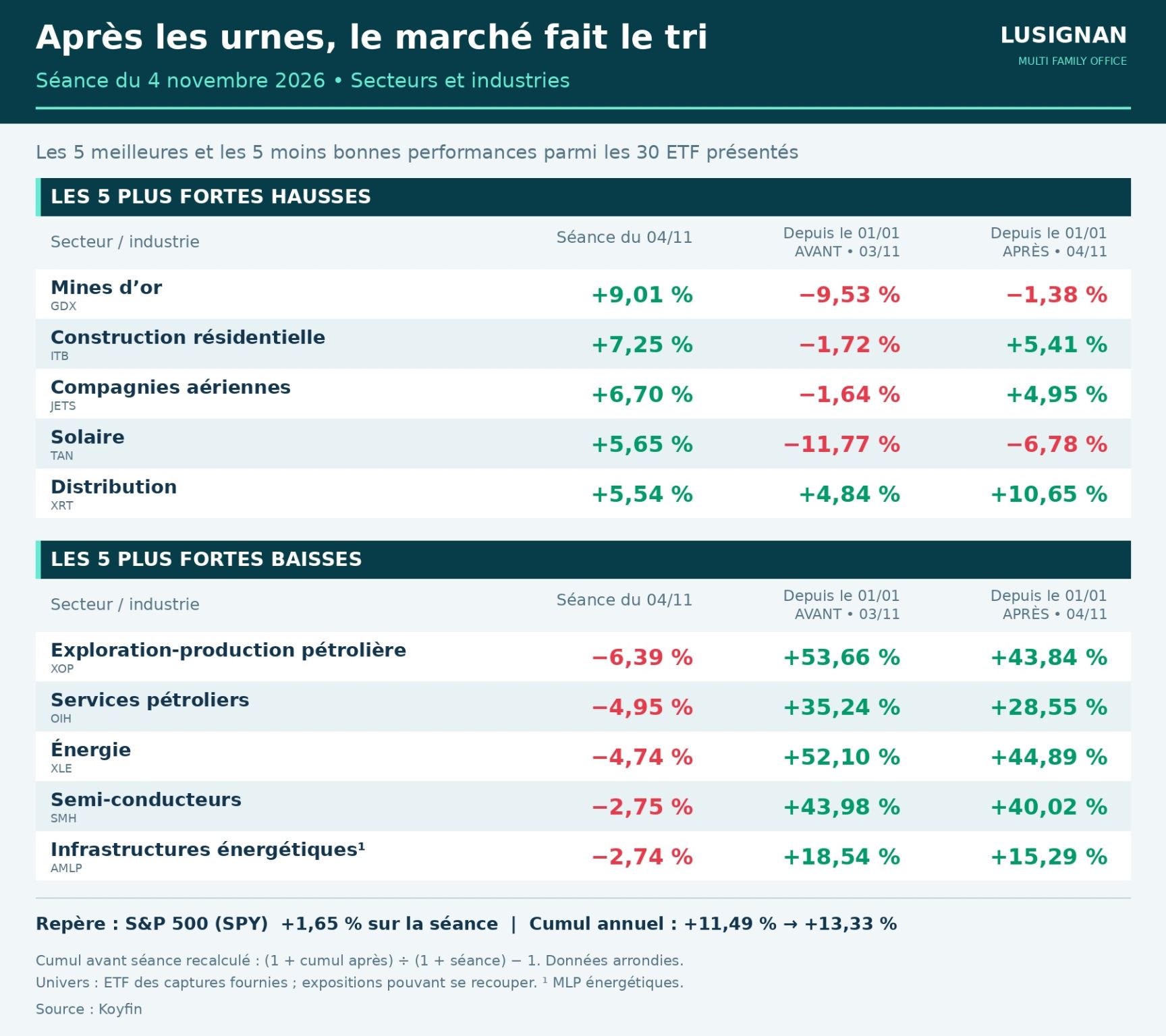
On 4 November 2026, the S&P 500 index gained 1.65%, but beneath this seemingly moderate rise, a major redistribution of investment preferences is taking shape. Sectors that had lagged since the start of the year are regaining ground, while those that had dominated are giving some back. This move reveals far more than simple profit-taking: it is a portfolio rebalancing that broadens the base of support for the rally.
Four of the five best-performing sectors on 4 November were still down for the year the day before. Homebuilding (+7.3%), airlines (+6.7%) and retail (+5.5%) moved back into positive territory. This spectacular catch-up appears consistent with a correction of the gaps accumulated since the start of the year.
However, two phenomena should be distinguished: the technical rebalancing of portfolios and the improvement of earnings prospects. The session demonstrates the former; it does not yet confirm the latter. Investors are narrowing the gaps between winners and losers, but this move can coexist with unchanged fundamentals for these sectors.
Despite a notable decline on 4 November, oil exploration and production retains a 44% year-to-date gain, and semiconductors 40%. The session narrows gaps built up over several months without overturning the underlying structure of performance.
This illustrates a key point: profit-taking on the year's winners does not imply the disappearance of their prospects. Rather, it reflects a normalisation of valuations after a prolonged rise. The market, moreover, recognises this mechanism: it is buying the laggards while selling the leaders at the same time, rather than fleeing the market as a whole.
The S&P 500 index is finding support beyond technology. Consumer discretionary (+4.3%), financials (+3.5%) and healthcare (+3.1%) advanced notably, while the technology sector was practically flat (−0.01%). This last point deserves attention: an index gain without a meaningful contribution from technology signals broader market participation.
If confirmed over several sessions, this broadening would indicate a reduction in the concentration of gains in a small number of stocks. It is a classic criterion of a healthy market: a rally supported by many sectors generally proves more durable than one carried by a few giants.
Broad sector labels mask much finer arbitrage. Solar gained 5.7%, but clean energy as a whole gained only 0.7%. Internet advanced 2.4%, while semiconductors fell. These intra-sector divergences reflect a clear distinction drawn by the market: a single structural transition — whether in energy or technology — does not benefit all of its players equally.
The market is valuing competing business models differently. This selectivity underlines that sector rotation is not blind; it responds to precise criteria of profitability, exposure to specific trends, or relative valuation.
The context remains instructive. The jump in gold miners came alongside gains in consumer discretionary, while industrials fell 1.1%. This combination — defensives (gold) up, discretionary (consumption) up — does not describe a unanimous expectation of economic acceleration. Rather, it reflects calibrated uncertainty: the market is hedging its bets between two scenarios, rather than concentrating on one.
Such a picture suggests persistent caution, disguised as a portfolio rotation. Investors are diversifying their risks rather than adopting a clear direction.
The session of 4 November shows a market capable of advancing on engines other than those of the previous period. This is a positive signal for broadening participation. However, the strength of this move will depend on two conditions: its duration — one day does not make a trend — and its translation into the earnings of companies in these cyclical and defensive sectors.
If the rise in laggards persists and is accompanied by confirmation of earnings prospects, it will mark a structural change. If it reverses quickly, it will remain a technical blip in a market dominated by other forces.
This is not investment advice.






