September 6, 2026
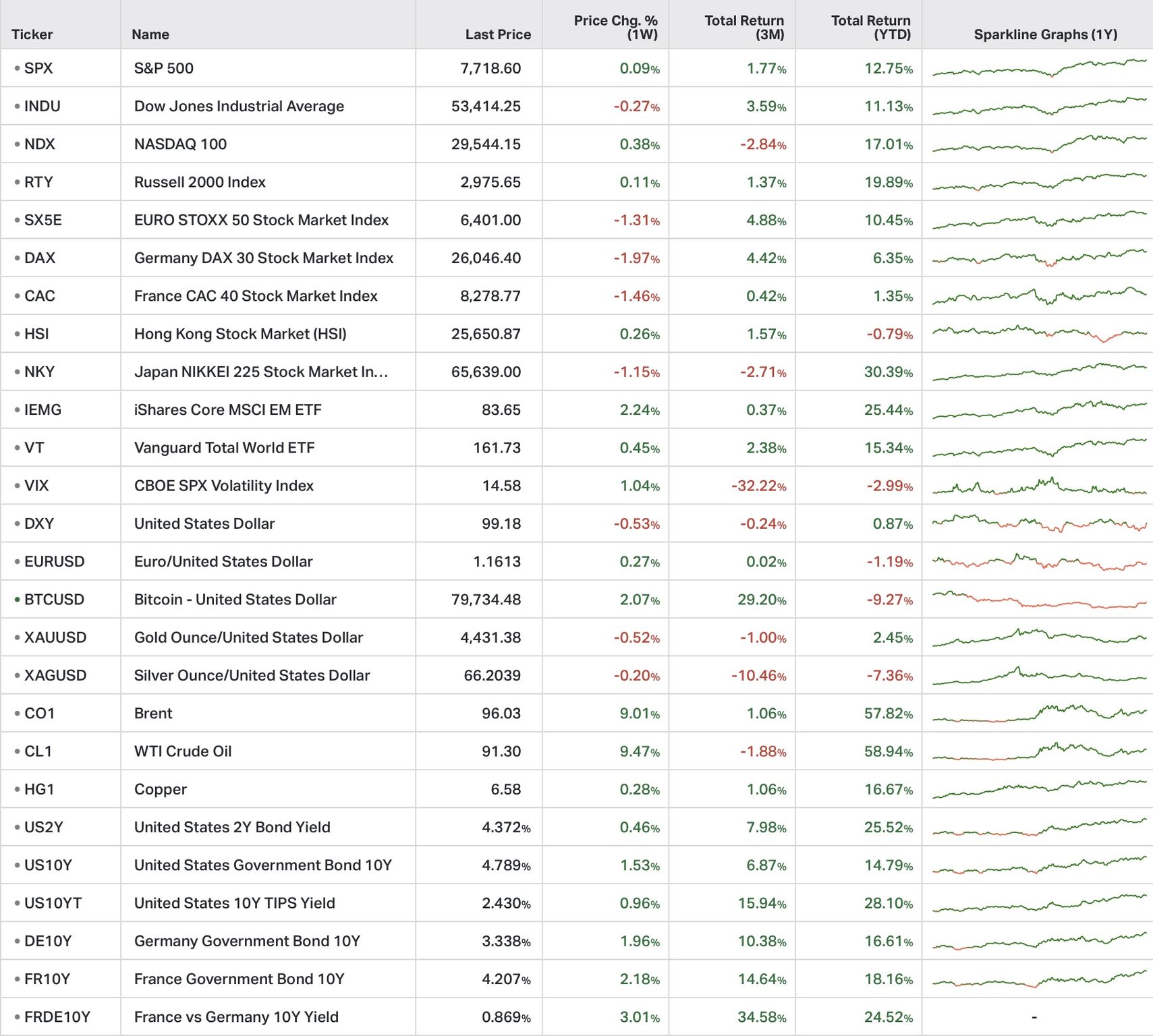
Global markets recorded a mixed week. While Wall Street held its balance thanks to technology and AI stocks, Europe and Japan lost ground in the face of rising rates and energy shocks. An environment in which the strength of the US economy and the rise in oil dominate monetary-policy expectations.
The S&P 500 index ended practically flat (+0.1%), the Nasdaq 100 gained 0.4% and the Russell 2000 0.1%. This resilience rests largely on sectors linked to artificial intelligence, which absorb the broader macroeconomic tensions.
In Europe, the picture darkens. The Euro Stoxx 50 fell 1.3%, while Germany's DAX lost 2.0%. This weakness reflects greater exposure to energy shocks and growing concern about further tightening by the European Central Bank. Continental economies, more dependent on energy imports, suffer more from the effects of rising oil prices.
In Japan, the Nikkei fell 1.2%, penalised by the rise in Japanese interest rates in anticipation of imminent action by the Bank of Japan. By contrast, emerging markets gained 2.2%, benefiting from relative momentum and the weakening of the dollar.
The dollar weakened by 0.5%, losing ground to a revitalised yen. The Japanese yen gained around 2.5%, buoyed by expectations of a Bank of Japan rate hike and by anticipated interventions in the foreign-exchange market.
On the bond front, yields rose across all major blocs. The US 10-year yield advanced 7 basis points to 4.8%, the German Bund gained 6 points to 3.3%, while the French OAT rose 9 points to 4.2%. This synchronised rise in yields reflects a confluence of factors: persistent public deficits, the need for central banks to control inflation, and above all the rise in oil prices, which revives inflation risks. The bond market faces an environment in which debt issuance is increasing and the prospect of restrictive monetary policy being maintained for longer is taking hold.
Brent jumped spectacularly by 9.0% to reach $96 a barrel, driven by renewed clashes around the Strait of Hormuz. This energy spike transmits geopolitical risk directly to future inflation expectations and monetary policy. A lasting rise in oil thwarts hopes of short-term monetary easing, particularly for the US Federal Reserve.
Gold fell 0.5%, penalised by higher real rates, which reduce the appeal of non-productive assets. Bitcoin rose 2.1% after an extremely volatile week, marked by the vicissitudes of expectations regarding the Federal Reserve's decisions.
The US labour market shows surprising strength. In August, 162,000 jobs were created, well above the 55,000 expected. The unemployment rate remains stable at 4.1%, while labour-force participation stands at 61.6% and wages are up 3.1% year on year.
Private-sector activity indices remain solid. The manufacturing ISM holds at 54.6 and the services ISM at 55.4, signalling a resilient economy. However, prices remain high, reflecting persistent inflationary tensions. The trade deficit widened to $88.6 billion, notably because of increased demand for AI equipment. The Federal Reserve's September decision will depend on how inflation data evolve.
In Europe, inflation accelerated to 3.3%, but core inflation fell to 2.4%, indicating that the shock comes above all from energy. A rate hike by the European Central Bank on 10 September is largely priced in by the markets.
In Germany, industrial orders gained 2.5% and recorded their third consecutive monthly rise, driven in particular by large contracts. This sign of industrial activity nevertheless remains fragile against a backdrop of rising energy costs.
Dell Technologies jumped 16% after raising its annual sales forecast by $25 billion, largely attributed to growing demand for AI servers. This performance illustrates the massive commercial opportunity represented by the race for AI infrastructure.
Broadcom posted spectacular growth, although deemed insufficient relative to market expectations. NVIDIA, consolidating its central role in the AI ecosystem, is acquiring Hugging Face for $13 billion, strengthening its position in machine-learning tools and models.
Conversely, negative news predominates elsewhere. Uber announced the elimination of 3,300 positions, while lululemon again lowered its revenue forecasts, illustrating a contraction in discretionary spending.
The week confirms a central scenario: a resilient US economy combined with a lasting rise in oil pushes back expectations of monetary easing. The cost of capital remains at the centre of the stakes for investors, while central banks balance the resilience of activity against residual inflationary pressures. This context favours sectors with stable cash flows and assets sensitive to the economic cycle.
This is not investment advice.






